Download Mendeley
Characterization of the ligand binding pocket of the virulence regulator Rns, a member of the AraC/XylS family of transcription factors.
Tolbert, J.D., Talbot, K.M., Bollinger, C.M., Kull, F.J., Munson, G.P., Midgett, C.R.(2025) mSphere 10: e0011525-e0011525
- PubMed: 40704798 Search on PubMedSearch on PubMed Central
- DOI: https://doi.org/10.1128/msphere.00115-25
- Primary Citation Related Structures:
8VRQ, 8VST, 9CA5, 9CA6 - PubMed Abstract:
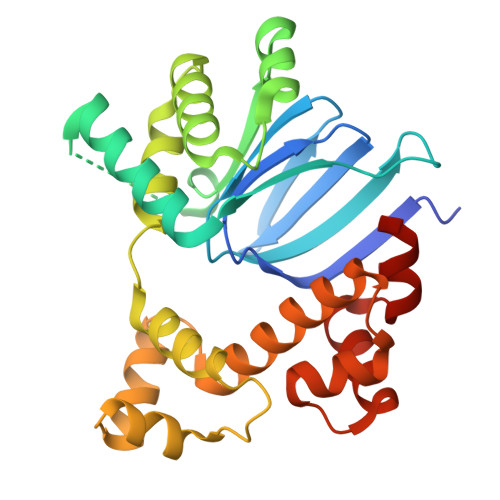
Diarrheal disease caused by Gram-negative enteric pathogens, such as enterotoxigenic Escherichia coli (ETEC), Vibrio cholerae , Shigella spp., and Salmonella spp., is a leading cause of morbidity and mortality of children, especially in low resource nations. While progress has been made in reducing this burden, there remains a need to develop effective therapies. Recently, we determined the structure of Rns, a member of the AraC/XylS family that regulates the expression of pili and other virulence factors in ETEC. The structure revealed decanoic acid bound between the N- and C-terminal domains. To test the hypothesis that bound decanoic acid directly inhibits Rns, we identified amino acid side chains predicted to be necessary for ligand binding. Removal of the positive side chains of R75 and H20 rendered Rns insensitive to fatty acid inhibition. Additionally, mutations designed to block decanoic acid binding also produced a variant Rns that was fatty acid insensitive. We also observed that this variant is structurally more flexible than wildtype Rns bound to decanoic acid, suggesting that fatty acid binding contributes to structural rigidity. These studies demonstrate that Rns binding pocket residues are critical for binding fatty acids, which result in inhibition of DNA binding and support our hypothesis that fatty acids must bind in the binding pocket to inhibit other AraC regulators. Further work by us and others suggests that inhibition of AraC virulence regulators by fatty acids is a common paradigm among many bacterial pathogens. Therefore, understanding the molecular basis of inhibition lays the groundwork for the development of small molecule therapeutics targeting enteric disease. As antimicrobial resistance increases, it is critical to develop new strategies to combat these infections. One area of concern is bacteria that cause intestinal disease such as Salmonella species, Vibrio cholerae , Shigella species, and enterotoxigenic Escherichia coli (ETEC). ETEC is a leading cause of travelers' diarrheal disease and a leading cause of mortality for children under 5 years old. To cause disease, ETEC requires the gene regulator Rns. Our previous work found that Rns was inhibited by a fatty acid. Here, we identify key features in the protein that are required for not only binding fatty acids but also for responding to them. This was done through a combination of microbiological as well as structural techniques of altered Rns proteins that can no longer bind fatty acid. Understanding how Rns is inhibited will lead to new ideas about how to target this class of proteins without causing antimicrobial resistance.
- Department of Chemistry, Dartmouth College, Hanover, New Hampshire, USA.
Organizational Affiliation: