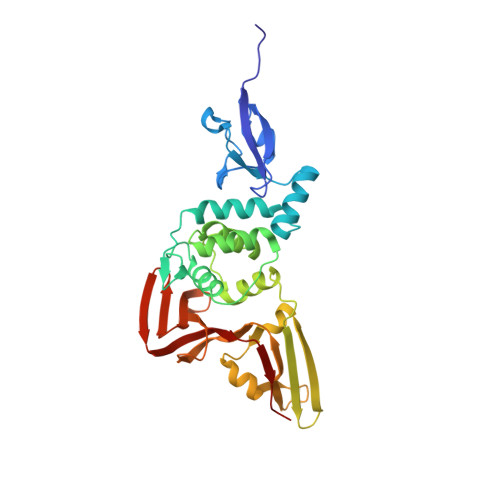
8VEC | pdb_00008vec

Deep Mutational Scanning of SARS-CoV-2 PLpro


Experimental Data Snapshot

  • Method: X-RAY DIFFRACTION
  • Resolution: 2.00 Å
  • R-Value Free: 
    0.217 (Depositor), 0.217 (DCC) 
  • R-Value Work: 
    0.174 (Depositor), 0.174 (DCC) 
  • R-Value Observed: 
    0.177 (Depositor) 

Starting Model: experimental
View more details

wwPDB Validation 3D Report Full Report

Validation slider image for 8VEC

This is version 1.1 of the entry. See complete history

Literature

Mutational profiling of SARS-CoV-2 papain-like protease reveals requirements for function, structure, and drug escape.

Wu, X.Go, M.Nguyen, J.V.Kuchel, N.W.Lu, B.G.C.Zeglinski, K.Lowes, K.N.Calleja, D.J.Mitchell, J.P.Lessene, G.Komander, D.Call, M.E.Call, M.J.

(2024) Nat Commun 15: 6219-6219

  • DOI: https://doi.org/10.1038/s41467-024-50566-9
  • Primary Citation Related Structures: 
    8VEC

  • PubMed Abstract: 

    Papain-like protease (PLpro) is an attractive drug target for SARS-CoV-2 because it is essential for viral replication, cleaving viral poly-proteins pp1a and pp1ab, and has de-ubiquitylation and de-ISGylation activities, affecting innate immune responses. We employ Deep Mutational Scanning to evaluate the mutational effects on PLpro enzymatic activity and protein stability in mammalian cells. We confirm features of the active site and identify mutations in neighboring residues that alter activity. We characterize residues responsible for substrate binding and demonstrate that although residues in the blocking loop are remarkably tolerant to mutation, blocking loop flexibility is important for function. We additionally find a connected network of mutations affecting activity that extends far from the active site. We leverage our library to identify drug-escape variants to a common PLpro inhibitor scaffold and predict that plasticity in both the S4 pocket and blocking loop sequence should be considered during the drug design process.


  • Organizational Affiliation
    • The Walter and Eliza Hall Institute of Medical Research, Parkville, VIC, Australia.

Macromolecule Content 

  • Total Structure Weight: 36.1 kDa 
  • Atom Count: 2,750 
  • Modeled Residue Count: 318 
  • Deposited Residue Count: 318 
  • Unique protein chains: 1

Macromolecules

Find similar proteins by:|  3D Structure
Entity ID: 1
MoleculeChains  Sequence LengthOrganismDetailsImage
Papain-like protease nsp3318Severe acute respiratory syndrome coronavirus 2Mutation(s): 1 
Gene Names: rep1a-1b
EC: 3.4.19.12 (PDB Primary Data), 3.4.22 (PDB Primary Data)
UniProt
Find proteins for P0DTD1 (Severe acute respiratory syndrome coronavirus 2)
Explore P0DTD1 
Go to UniProtKB:  P0DTD1
Entity Groups
Sequence Clusters30% Identity50% Identity70% Identity90% Identity95% Identity100% Identity
UniProt GroupP0DTD1
Sequence Annotations
Expand
Reference Sequence

Small Molecules

Experimental Data & Validation

Experimental Data

  • Method: X-RAY DIFFRACTION
  • Resolution: 2.00 Å
  • R-Value Free:  0.217 (Depositor), 0.217 (DCC) 
  • R-Value Work:  0.174 (Depositor), 0.174 (DCC) 
  • R-Value Observed: 0.177 (Depositor) 
Space Group: P 21 21 2
Unit Cell:
Length ( Å )Angle ( ˚ )
a = 57.958α = 90
b = 85.47β = 90
c = 82.88γ = 90
Software Package:
Software NamePurpose
PHENIXrefinement
Aimlessdata scaling
PHENIXphasing
XDSdata reduction

Structure Validation

View Full Validation Report


Entry History 

& Funding Information

Deposition Data


Funding OrganizationLocationGrant Number
Wellcome TrustUnited Kingdom222698/Z/21/Z

Revision History  (Full details and data files)

  • Version 1.0: 2024-03-20
    Type: Initial release
  • Version 1.1: 2024-08-07
    Changes: Database references