Download Mendeley
An artificial intelligence accelerated virtual screening platform for drug discovery.
Zhou, G., Rusnac, D.V., Park, H., Canzani, D., Nguyen, H.M., Stewart, L., Bush, M.F., Nguyen, P.T., Wulff, H., Yarov-Yarovoy, V., Zheng, N., DiMaio, F.(2024) Nat Commun 15: 7761-7761
- PubMed: 39237523 Search on PubMedSearch on PubMed Central
- DOI: https://doi.org/10.1038/s41467-024-52061-7
- Primary Citation Related Structures:
8UXS - PubMed Abstract:
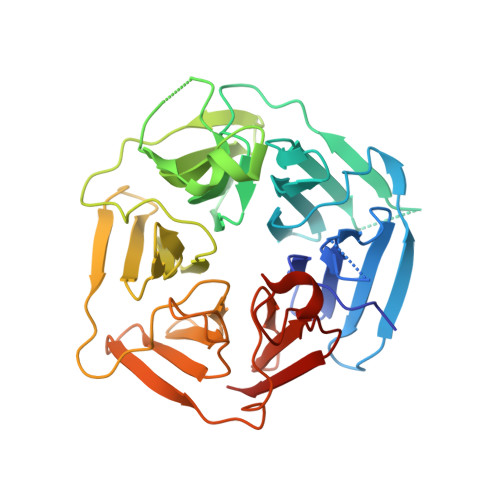
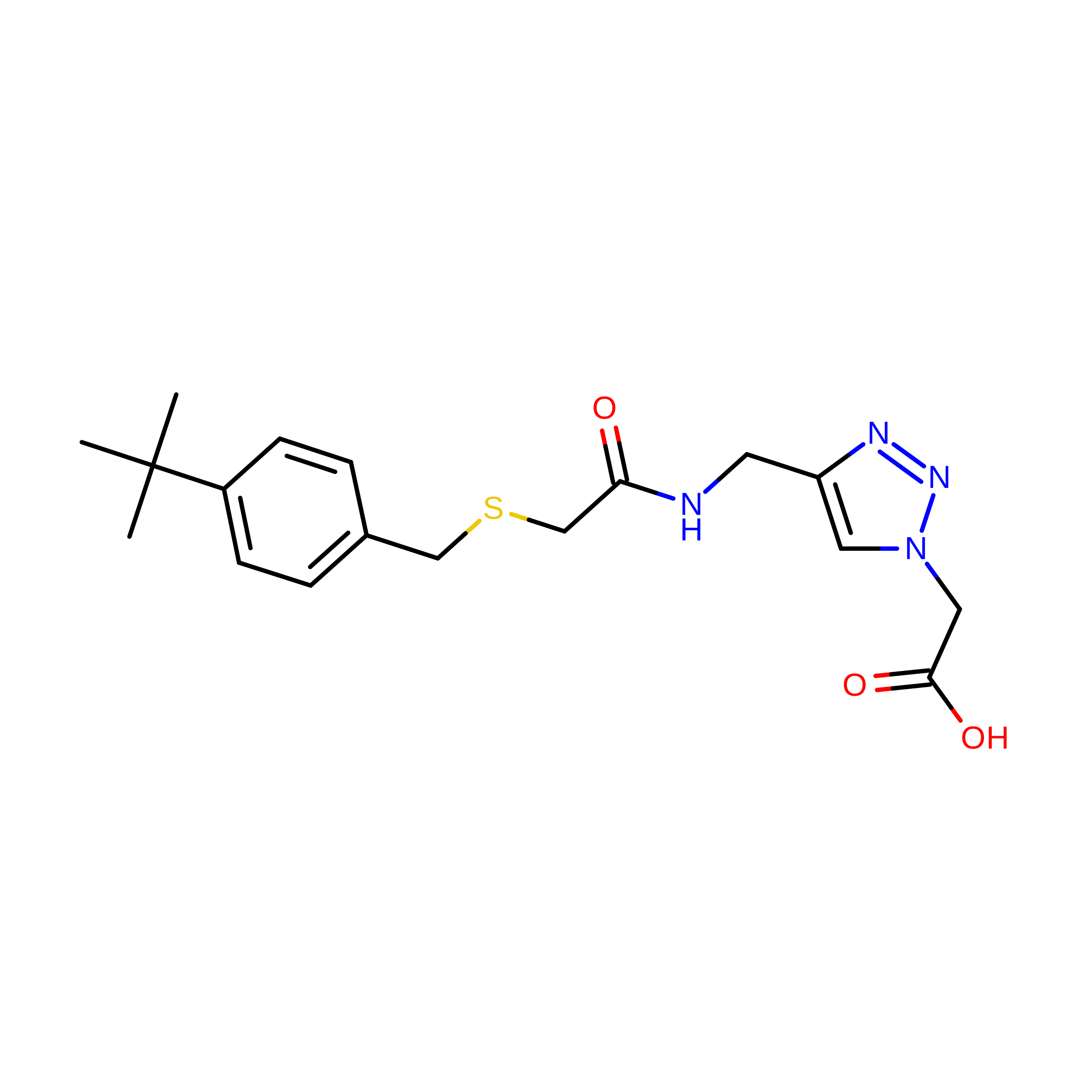
Structure-based virtual screening is a key tool in early drug discovery, with growing interest in the screening of multi-billion chemical compound libraries. However, the success of virtual screening crucially depends on the accuracy of the binding pose and binding affinity predicted by computational docking. Here we develop a highly accurate structure-based virtual screen method, RosettaVS, for predicting docking poses and binding affinities. Our approach outperforms other state-of-the-art methods on a wide range of benchmarks, partially due to our ability to model receptor flexibility. We incorporate this into a new open-source artificial intelligence accelerated virtual screening platform for drug discovery. Using this platform, we screen multi-billion compound libraries against two unrelated targets, a ubiquitin ligase target KLHDC2 and the human voltage-gated sodium channel Na V 1.7. For both targets, we discover hit compounds, including seven hits (14% hit rate) to KLHDC2 and four hits (44% hit rate) to Na V 1.7, all with single digit micromolar binding affinities. Screening in both cases is completed in less than seven days. Finally, a high resolution X-ray crystallographic structure validates the predicted docking pose for the KLHDC2 ligand complex, demonstrating the effectiveness of our method in lead discovery.
- Department of Biochemistry, University of Washington, Seattle, WA, USA.
Organizational Affiliation: