Download Mendeley
The mechanistic basis for interprotomer deglycosylation of antibodies by corynebacterial IgG-specific endoglycosidases.
Sastre, D.E., Bournazos, S., Huliciak, M., Grace, B.A.C., Boder, E.J., Du, J., Sultana, N., Azzam, T., Brown, T.J., Flowers, M.W., Lollar, P., Xu, T., Chernova, T.A., Keith, A.D., Keen, M., Saltzman, A., Martinez Gascuena, A., Trastoy, B., Guerin, M.E., Frank, F., Ortlund, E.A., Ravetch, J.V., Sundberg, E.J.(2025) Nat Commun 16: 6147-6147
- PubMed: 40610417 Search on PubMedSearch on PubMed Central
- DOI: https://doi.org/10.1038/s41467-025-60986-w
- Primary Citation Related Structures:
8URO - PubMed Abstract:
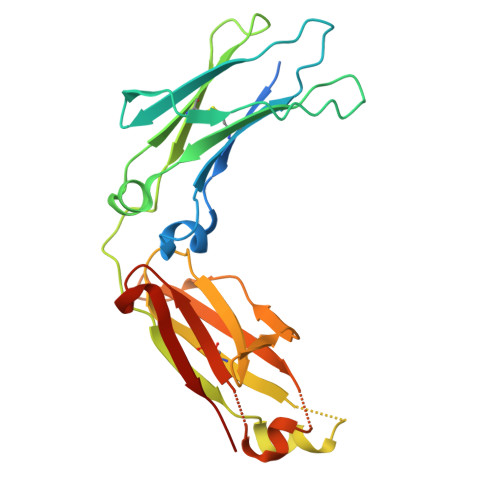
Corynebacterium diphtheriae clade species secrete single-domain endo-β-N-acetylglucosaminidases (ENGases) that specifically bind to human IgG antibodies and hydrolyze their N297-linked glycans. Here, we define the molecular mechanisms of IgG-specific deglycosylation for the entire family of corynebacterial IgG-specific ENGases, including but not limited to CU43 and CM49. By solving the crystal structure of CU43 in a 1:1 complex with the IgG1 Fc region, combined with targeted and saturation mutagenesis analysis and activity measurements using engineered antibodies, we establish an inter-protomeric mechanism of recognition and deglycosylation of IgG antibodies. Using in silico modeling, small-angle X-ray scattering and saturation mutagenesis we determine that CM49 uses a unique binding site on the Fc region, to process N297-linked glycans. Moreover, we demonstrate that CU43 treatment is highly effective in abrogating Fc effector functions in humanized mouse models, while preserving the neutralizing capacity of anti-influenza IgG antibodies, thereby conferring protection against lethal influenza challenge.
- Department of Biochemistry, Emory University School of Medicine, Atlanta, GA, USA. dsastre@emory.edu.
Organizational Affiliation: