Download Mendeley
Pan-beta-coronavirus subunit vaccine prevents SARS-CoV-2 Omicron, SARS-CoV, and MERS-CoV challenge.
Wang, G., Verma, A.K., Guan, X., Bu, F., Odle, A.E., Li, F., Liu, B., Perlman, S., Du, L.(2024) J Virol 98: e0037624-e0037624
- PubMed: 39189731 Search on PubMedSearch on PubMed Central
- DOI: https://doi.org/10.1128/jvi.00376-24
- Primary Citation Related Structures:
8UPX - PubMed Abstract:
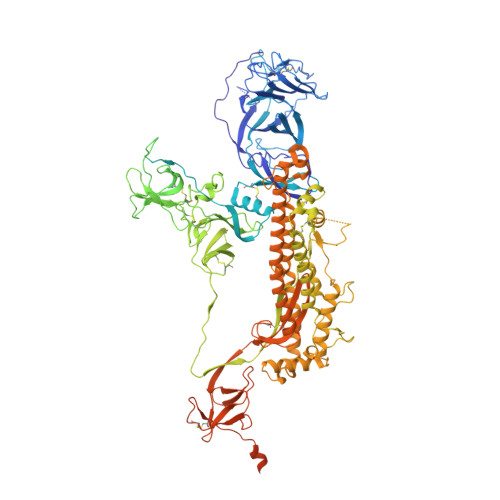
Three highly pathogenic coronaviruses (CoVs), SARS-CoV-2, SARS-CoV, and MERS-CoV, belonging to the genus beta-CoV, have caused outbreaks or pandemics. SARS-CoV-2 has evolved into many variants with increased resistance to the current vaccines. Spike (S) protein and its receptor-binding domain (RBD) fragment of these CoVs are important vaccine targets; however, the RBD of the SARS-CoV-2 Omicron variant is highly mutated, rending neutralizing antibodies elicited by ancestral-based vaccines targeting this region ineffective, emphasizing the need for effective vaccines with broad-spectrum efficacy against SARS-CoV-2 variants and other CoVs with pandemic potential. This study describes a pan-beta-CoV subunit vaccine, Om-S-MERS-RBD, by fusing the conserved and highly potent RBD of MERS-CoV into an RBD-truncated SARS-CoV-2 Omicron S protein, and evaluates its neutralizing immunogenicity and protective efficacy in mouse models. Om-S-MERS-RBD formed a conformational structure, maintained effective functionality and antigenicity, and bind efficiently to MERS-CoV receptor, human dipeptidyl peptidase 4, and MERS-CoV RBD or SARS-CoV-2 S-specific antibodies. Immunization of mice with Om-S-MERS-RBD and adjuvants (Alum plus monophosphoryl lipid A) induced broadly neutralizing antibodies against pseudotyped MERS-CoV, SARS-CoV, and SARS-CoV-2 original strain, as well as T-cell responses specific to RBD-truncated Omicron S protein. Moreover, the neutralizing activity against SARS-CoV-2 Omicron subvariants was effectively improved after priming with an Omicron-S-RBD protein. Adjuvanted Om-S-MERS-RBD protein protected mice against challenge with SARS-CoV-2 Omicron variant, MERS-CoV, and SARS-CoV, significantly reducing viral titers in the lungs. Overall, these findings indicated that Om-S-MERS-RBD protein could develop as an effective universal subunit vaccine to prevent infections with MERS-CoV, SARS-CoV, SARS-CoV-2, and its variants. Coronaviruses (CoVs), SARS-CoV-2, SARS-CoV, and MERS-CoV, the respective causative agents of coronavirus disease 2019, SARS, and MERS, continually threaten human health. The spike (S) protein and its receptor-binding domain (RBD) fragment of these CoVs are critical vaccine targets. Nevertheless, the highly mutated RBD of SARS-CoV-2 variants, especially Omicron, significantly reduces the efficacy of current vaccines against SARS-CoV-2 variants. Here a protein-based pan-beta-CoV subunit vaccine is designed by fusing the potent and conserved RBD of MERS-CoV into an RBD-truncated Omicron S protein. The resulting vaccine maintained effective functionality and antigenicity, induced broadly neutralizing antibodies against all of these highly pathogenic human CoVs, and elicited Omicron S-specific cellular immune responses, protecting immunized mice from SARS-CoV-2 Omicron, SARS-CoV, and MERS-CoV infections. Taken together, this study rationally designed a pan-beta-CoV subunit vaccine with broad-spectrum efficacy, which has the potential for development as an effective universal vaccine against SARS-CoV-2 variants and other CoVs with pandemic potential.
- Institute for Biomedical Sciences, Georgia State University, Atlanta, Georgia, USA.
Organizational Affiliation: