8UA8 | pdb_00008ua8

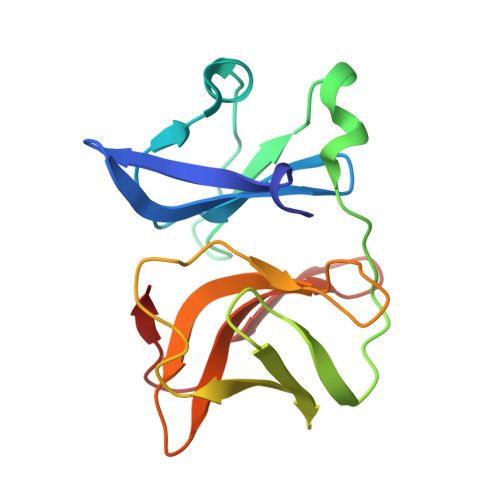
Structure of Semliki Forest virus VLP in complex with VLDLR LA2


Experimental Data Snapshot

  • Method: ELECTRON MICROSCOPY
  • Resolution: 3.70 Å
  • Aggregation State: PARTICLE 
  • Reconstruction Method: SINGLE PARTICLE 

wwPDB Validation   3D Report Full Report


This is version 1.3 of the entry. See complete history


Literature

Structural basis for VLDLR recognition by eastern equine encephalitis virus.

Yang, P.Li, W.Fan, X.Pan, J.Mann, C.J.Varnum, H.Clark, L.E.Clark, S.A.Coscia, A.Basu, H.Smith, K.N.Brusic, V.Abraham, J.

(2024) Nat Commun 15: 6548-6548

  • DOI: https://doi.org/10.1038/s41467-024-50887-9
  • Primary Citation of Related Structures:  
    8UA4, 8UA8, 8UA9

  • PubMed Abstract: 

    Eastern equine encephalitis virus (EEEV) is the most virulent alphavirus that infects humans, and many survivors develop neurological sequelae, including paralysis and intellectual disability. Alphavirus spike proteins comprise trimers of heterodimers of glycoproteins E2 and E1 that mediate binding to cellular receptors and fusion of virus and host cell membranes during entry. We recently identified very-low density lipoprotein receptor (VLDLR) and apolipoprotein E receptor 2 (ApoER2) as cellular receptors for EEEV and a distantly related alphavirus, Semliki Forest virus (SFV). Here, we use single-particle cryo-electron microscopy (cryo-EM) to determine structures of the EEEV and SFV spike glycoproteins bound to the VLDLR ligand-binding domain and found that EEEV and SFV interact with the same cellular receptor through divergent binding modes. Our studies suggest that the ability of LDLR-related proteins to interact with viral spike proteins through very small footprints with flexible binding modes results in a low evolutionary barrier to the acquisition of LDLR-related proteins as cellular receptors for diverse sets of viruses.


  • Organizational Affiliation
    • Department of Microbiology, Blavatnik Institute, Harvard Medical School, Boston, MA, USA.

Macromolecules
Find similar proteins by:  (by identity cutoff)  |  3D Structure
Entity ID: 1
MoleculeChains Sequence LengthOrganismDetailsImage
Glycoprotein E1
A, E, I, M
438Semliki Forest virusMutation(s): 0 
UniProt
Find proteins for P03315 (Semliki forest virus)
Explore P03315 
Go to UniProtKB:  P03315
Entity Groups  
Sequence Clusters30% Identity50% Identity70% Identity90% Identity95% Identity100% Identity
UniProt GroupP03315
Glycosylation
Glycosylation Sites: 1
Sequence Annotations
Expand
  • Reference Sequence
Find similar proteins by:  (by identity cutoff)  |  3D Structure
Entity ID: 2
MoleculeChains Sequence LengthOrganismDetailsImage
Glycoprotein E2
B, F, J, N
417Semliki Forest virusMutation(s): 0 
UniProt
Find proteins for P03315 (Semliki forest virus)
Explore P03315 
Go to UniProtKB:  P03315
Entity Groups  
Sequence Clusters30% Identity50% Identity70% Identity90% Identity95% Identity100% Identity
UniProt GroupP03315
Glycosylation
Glycosylation Sites: 2
Sequence Annotations
Expand
  • Reference Sequence
Find similar proteins by:  (by identity cutoff)  |  3D Structure
Entity ID: 3
MoleculeChains Sequence LengthOrganismDetailsImage
Assembly protein E3
C, G, K, O
54Semliki Forest virusMutation(s): 0 
UniProt
Find proteins for P03315 (Semliki forest virus)
Explore P03315 
Go to UniProtKB:  P03315
Entity Groups  
Sequence Clusters30% Identity50% Identity70% Identity90% Identity95% Identity100% Identity
UniProt GroupP03315
Glycosylation
Glycosylation Sites: 1
Sequence Annotations
Expand
  • Reference Sequence
Find similar proteins by:  (by identity cutoff)  |  3D Structure
Entity ID: 4
MoleculeChains Sequence LengthOrganismDetailsImage
Capsid protein
D, H, L, P
153Semliki Forest virusMutation(s): 0 
EC: 3.4.21.90
UniProt
Find proteins for P03315 (Semliki forest virus)
Explore P03315 
Go to UniProtKB:  P03315
Entity Groups  
Sequence Clusters30% Identity50% Identity70% Identity90% Identity95% Identity100% Identity
UniProt GroupP03315
Sequence Annotations
Expand
  • Reference Sequence
Find similar proteins by:  (by identity cutoff)  |  3D Structure
Entity ID: 5
MoleculeChains Sequence LengthOrganismDetailsImage
Very low-density lipoprotein receptorQ [auth R]37Homo sapiensMutation(s): 0 
Gene Names: VLDLR
UniProt & NIH Common Fund Data Resources
Find proteins for P98155 (Homo sapiens)
Explore P98155 
Go to UniProtKB:  P98155
PHAROS:  P98155
GTEx:  ENSG00000147852 
Entity Groups  
Sequence Clusters30% Identity50% Identity70% Identity90% Identity95% Identity100% Identity
UniProt GroupP98155
Sequence Annotations
Expand
  • Reference Sequence
Oligosaccharides

Help

Entity ID: 6
MoleculeChains Length2D Diagram Glycosylation3D Interactions
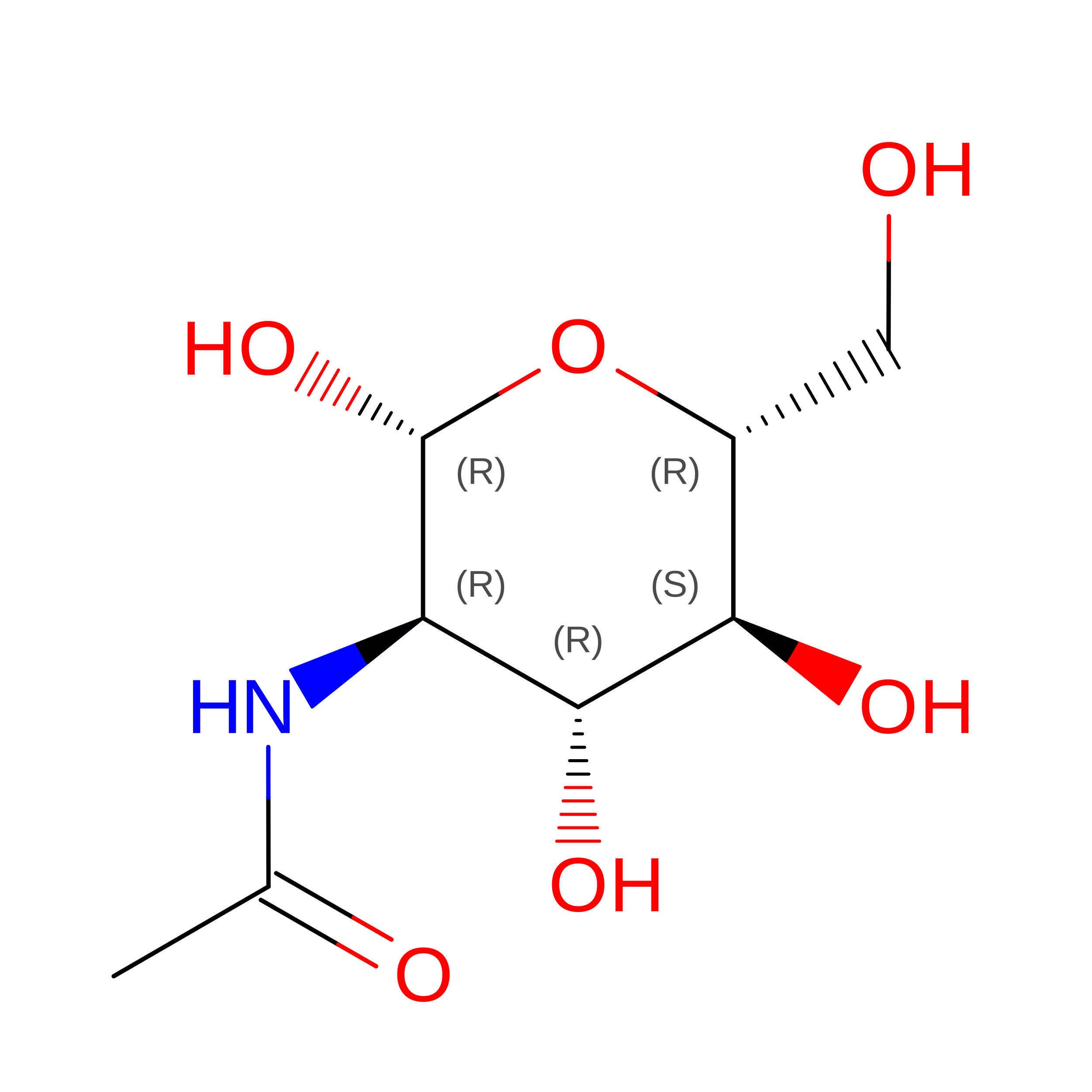
2-acetamido-2-deoxy-beta-D-glucopyranose-(1-4)-2-acetamido-2-deoxy-beta-D-glucopyranose
AA [auth a],
R [auth Q],
U,
V,
W,
AA [auth a],
R [auth Q],
U,
V,
W,
X
2N-Glycosylation
Glycosylation Resources
GlyTouCan:  G42666HT
GlyCosmos:  G42666HT
GlyGen:  G42666HT
Entity ID: 7
MoleculeChains Length2D Diagram Glycosylation3D Interactions
beta-D-mannopyranose-(1-4)-2-acetamido-2-deoxy-beta-D-glucopyranose-(1-4)-2-acetamido-2-deoxy-beta-D-glucopyranose
BA [auth b],
CA [auth c],
S,
T,
Y,
BA [auth b],
CA [auth c],
S,
T,
Y,
Z
3N-Glycosylation
Glycosylation Resources
GlyTouCan:  G15407YE
GlyCosmos:  G15407YE
GlyGen:  G15407YE
Experimental Data & Validation

Experimental Data

  • Method: ELECTRON MICROSCOPY
  • Resolution: 3.70 Å
  • Aggregation State: PARTICLE 
  • Reconstruction Method: SINGLE PARTICLE 
EM Software:
TaskSoftware PackageVersion
MODEL REFINEMENTPHENIX

Structure Validation

View Full Validation Report


Entry History & Funding Information

Deposition Data


Funding OrganizationLocationGrant Number
Burroughs Wellcome FundUnited States--

Revision History  (Full details and data files)

  • Version 1.0: 2024-08-14
    Type: Initial release
  • Version 1.1: 2024-10-23
    Changes: Data collection, Structure summary
  • Version 1.2: 2025-03-19
    Changes: Data collection, Database references
  • Version 1.3: 2025-05-28
    Changes: Data collection