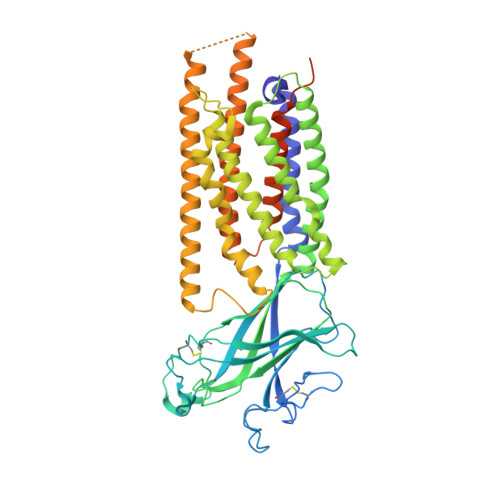
8TZS | pdb_00008tzs

Structure of human WLS

  • Classification: MEMBRANE PROTEIN
  • Organism(s): Homo sapiens
  • Expression System: Homo sapiens
  • Mutation(s): No 
  • Membrane Protein: Yes  PDBTM

  • Deposited: 2023-08-27 Released: 2023-10-18 
  • Deposition Author(s): Qi, X., Hu, Q., Li, X.
  • Funding Organization(s): National Institutes of Health/National Institute of General Medical Sciences (NIH/NIGMS), Welch Foundation

Experimental Data Snapshot

  • Method: ELECTRON MICROSCOPY
  • Resolution: 3.84 Å
  • Aggregation State: PARTICLE 
  • Reconstruction Method: SINGLE PARTICLE 

wwPDB Validation 3D Report Full Report

Validation slider image for 8TZS

This is version 1.3 of the entry. See complete history

Literature

Molecular basis of Wnt biogenesis, secretion, and Wnt7-specific signaling.

Qi, X.Hu, Q.Elghobashi-Meinhardt, N.Long, T.Chen, H.Li, X.

(2023) Cell 186: 5028-5040.e14

  • DOI: https://doi.org/10.1016/j.cell.2023.09.021
  • Primary Citation Related Structures: 
    8TZO, 8TZP, 8TZR, 8TZS

  • PubMed Abstract: 

    Wnt proteins are enzymatically lipidated by Porcupine (PORCN) in the ER and bind to Wntless (WLS) for intracellular transport and secretion. Mechanisms governing the transfer of these low-solubility Wnts from the ER to the extracellular space remain unclear. Through structural and functional analyses of Wnt7a, a crucial Wnt involved in central nervous system angiogenesis and blood-brain barrier maintenance, we have elucidated the principles of Wnt biogenesis and Wnt7-specific signaling. The Wnt7a-WLS complex binds to calreticulin (CALR), revealing that CALR functions as a chaperone to facilitate Wnt transfer from PORCN to WLS during Wnt biogenesis. Our structures, functional analyses, and molecular dynamics simulations demonstrate that a phospholipid in the core of Wnt-bound WLS regulates the association and dissociation between Wnt and WLS, suggesting a lipid-mediated Wnt secretion mechanism. Finally, the structure of Wnt7a bound to RECK, a cell-surface Wnt7 co-receptor, reveals how RECK CC4 engages the N-terminal domain of Wnt7a to activate Wnt7-specific signaling.


  • Organizational Affiliation
    • Department of Molecular Genetics, University of Texas Southwestern Medical Center, Dallas, TX 75390, USA. Electronic address: xiaofeng.qi@utsouthwestern.edu.

Macromolecule Content 

  • Total Structure Weight: 62.32 kDa 
  • Atom Count: 3,914 
  • Modeled Residue Count: 480 
  • Deposited Residue Count: 541 
  • Unique protein chains: 1

Macromolecules

Find similar proteins by:|  3D Structure
Entity ID: 1
MoleculeChains  Sequence LengthOrganismDetailsImage
Protein wntless homolog541Homo sapiensMutation(s): 0 
Gene Names: WLS
Membrane Entity: Yes 
UniProt & NIH Common Fund Data Resources
Find proteins for Q5T9L3 (Homo sapiens)
Explore Q5T9L3 
Go to UniProtKB:  Q5T9L3
PHAROS:  Q5T9L3
GTEx:  ENSG00000116729 
Entity Groups
Sequence Clusters30% Identity50% Identity70% Identity90% Identity95% Identity100% Identity
UniProt GroupQ5T9L3
Sequence Annotations
Expand
Reference Sequence

Experimental Data & Validation

Experimental Data

  • Method: ELECTRON MICROSCOPY
  • Resolution: 3.84 Å
  • Aggregation State: PARTICLE 
  • Reconstruction Method: SINGLE PARTICLE 
EM Software:
TaskSoftware PackageVersion
MODEL REFINEMENTPHENIX

Structure Validation

View Full Validation Report


Entry History 

& Funding Information

Deposition Data


Funding OrganizationLocationGrant Number
National Institutes of Health/National Institute of General Medical Sciences (NIH/NIGMS)United StatesGM135343
National Institutes of Health/National Institute of General Medical Sciences (NIH/NIGMS)United StatesHL160487
Welch FoundationUnited StatesI-1957

Revision History  (Full details and data files)

  • Version 1.0: 2023-10-18
    Type: Initial release
  • Version 1.1: 2024-05-08
    Changes: Database references
  • Version 1.2: 2024-11-06
    Changes: Data collection, Structure summary
  • Version 1.3: 2025-06-04
    Changes: Data collection