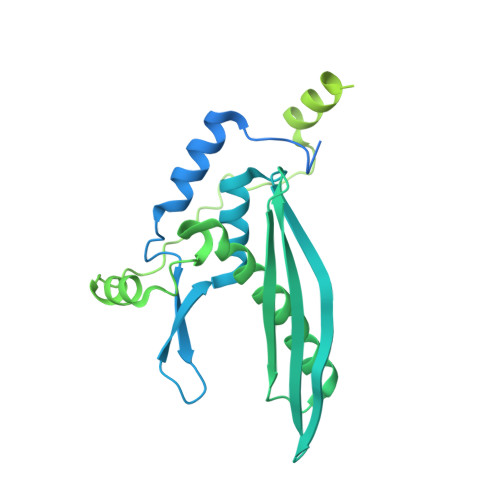
8TKQ | pdb_00008tkq

Cryo-EM structure of human full-length RAD52

  • Classification: RECOMBINATION
  • Organism(s): Homo sapiens
  • Expression System: Escherichia coli
  • Mutation(s): No 

  • Deposited: 2023-07-25 Released: 2024-08-14 
  • Deposition Author(s): Schnicker, N.J., Razzaghi, M., Spies, M.
  • Funding Organization(s): National Institutes of Health/National Cancer Institute (NIH/NCI), National Institutes of Health/National Institute of General Medical Sciences (NIH/NIGMS)

Experimental Data Snapshot

  • Method: ELECTRON MICROSCOPY
  • Resolution: 2.50 Å
  • Aggregation State: PARTICLE 
  • Reconstruction Method: SINGLE PARTICLE 

Starting Model: experimental
View more details

wwPDB Validation   3D Report Full Report


This is version 1.2 of the entry. See complete history


Literature

The RAD52 double-ring remodels replication forks restricting fork reversal.

Honda, M.Razzaghi, M.Gaur, P.Malacaria, E.Marozzi, G.Di Biagi, L.Aiello, F.A.Paintsil, E.A.Stanfield, A.J.Deppe, B.J.Gakhar, L.Schnicker, N.J.Spies, M.A.Pichierri, P.Spies, M.

(2025) Nature 641: 512-519

  • DOI: https://doi.org/10.1038/s41586-025-08753-1
  • Primary Citation of Related Structures:  
    8TKQ

  • PubMed Abstract: 

    Human RAD52 is a multifunctional DNA repair protein involved in several cellular events that support genome stability, including protection of stalled DNA replication forks from excessive degradation 1-4 . In its gatekeeper role, RAD52 binds to and stabilizes stalled replication forks during replication stress, protecting them from reversal by SMARCAL1 motor 3 . The structural and molecular mechanism of the RAD52-mediated fork protection remains elusive. Here, using P1 nuclease sensitivity, biochemical and single-molecule analyses, we show that RAD52 dynamically remodels replication forks through its strand exchange activity. The presence of the single-stranded DNA binding protein RPA at the fork modulates the kinetics of the strand exchange without impeding the reaction outcome. Mass photometry and single-particle cryo-electron microscopy show that the replication fork promotes a unique nucleoprotein structure containing head-to-head arrangement of two undecameric RAD52 rings with an extended positively charged surface that accommodates all three arms of the replication fork. We propose that the formation and continuity of this surface is important for the strand exchange reaction and for competition with SMARCAL1.


  • Organizational Affiliation
    • Department of Biochemistry and Molecular Biology, University of Iowa Carver College of Medicine, Iowa City, IA, USA.

Macromolecules
Find similar proteins by:  (by identity cutoff)  |  3D Structure
Entity ID: 1
MoleculeChains Sequence LengthOrganismDetailsImage
DNA repair protein RAD52 homolog
A, B, C, D, E
A, B, C, D, E, F, G, H, I, J, K
438Homo sapiensMutation(s): 0 
Gene Names: RAD52
UniProt & NIH Common Fund Data Resources
Find proteins for P43351 (Homo sapiens)
Explore P43351 
Go to UniProtKB:  P43351
PHAROS:  P43351
GTEx:  ENSG00000002016 
Entity Groups  
Sequence Clusters30% Identity50% Identity70% Identity90% Identity95% Identity100% Identity
UniProt GroupP43351
Sequence Annotations
Expand
  • Reference Sequence
Experimental Data & Validation

Experimental Data

  • Method: ELECTRON MICROSCOPY
  • Resolution: 2.50 Å
  • Aggregation State: PARTICLE 
  • Reconstruction Method: SINGLE PARTICLE 
EM Software:
TaskSoftware PackageVersion
RECONSTRUCTIONcryoSPARC3.3.2
MODEL REFINEMENTPHENIX

Structure Validation

View Full Validation Report


Entry History & Funding Information

Deposition Data


Funding OrganizationLocationGrant Number
National Institutes of Health/National Cancer Institute (NIH/NCI)United StatesR01CA232425-05
National Institutes of Health/National Institute of General Medical Sciences (NIH/NIGMS)United StatesR35GM131704-05

Revision History  (Full details and data files)

  • Version 1.0: 2024-08-14
    Type: Initial release
  • Version 1.1: 2025-04-16
    Changes: Data collection, Database references, Structure summary
  • Version 1.2: 2025-05-14
    Changes: Data collection, Database references