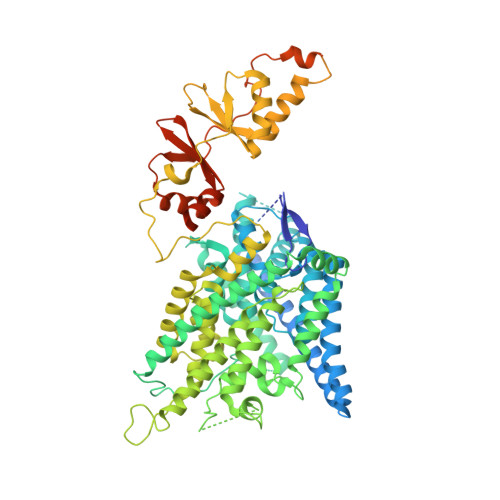
8TA5 | pdb_00008ta5

Title: Cryo-EM structure of the human CLC-2 chloride channel transmembrane domain with asymmetric C-terminal


Experimental Data Snapshot

  • Method: ELECTRON MICROSCOPY
  • Resolution: 2.76 Å
  • Aggregation State: PARTICLE 
  • Reconstruction Method: SINGLE PARTICLE 

Starting Model: in silico
View more details

wwPDB Validation 3D Report Full Report

Validation slider image for 8TA5

This is version 2.0 of the entry. See complete history

Literature

CryoEM structures of the human CLC-2 voltage-gated chloride channel reveal a ball-and-chain gating mechanism.

Xu, M.Neelands, T.Powers, A.S.Liu, Y.Miller, S.D.Pintilie, G.D.Bois, J.D.Dror, R.O.Chiu, W.Maduke, M.

(2024) Elife 12

  • DOI: https://doi.org/10.7554/eLife.90648
  • Primary Citation Related Structures: 
    8TA2, 8TA3, 8TA4, 8TA5, 8TA6

  • PubMed Abstract: 

    CLC-2 is a voltage-gated chloride channel that contributes to electrical excitability and ion homeostasis in many different tissues. Among the nine mammalian CLC homologs, CLC-2 is uniquely activated by hyperpolarization, rather than depolarization, of the plasma membrane. The molecular basis for the divergence in polarity of voltage gating among closely related homologs has been a long-standing mystery, in part because few CLC channel structures are available. Here, we report cryoEM structures of human CLC-2 at 2.46 - 2.76 Å, in the presence and absence of the selective inhibitor AK-42. AK-42 binds within the extracellular entryway of the Cl - -permeation pathway, occupying a pocket previously proposed through computational docking studies. In the apo structure, we observed two distinct conformations involving rotation of one of the cytoplasmic C-terminal domains (CTDs). In the absence of CTD rotation, an intracellular N-terminal 15-residue hairpin peptide nestles against the TM domain to physically occlude the Cl - -permeation pathway. This peptide is highly conserved among species variants of CLC-2 but is not present in other CLC homologs. Previous studies suggested that the N-terminal domain of CLC-2 influences channel properties via a "ball-and-chain" gating mechanism, but conflicting data cast doubt on such a mechanism, and thus the structure of the N-terminal domain and its interaction with the channel has been uncertain. Through electrophysiological studies of an N-terminal deletion mutant lacking the 15-residue hairpin peptide, we support a model in which the N-terminal hairpin of CLC-2 stabilizes a closed state of the channel by blocking the cytoplasmic Cl - -permeation pathway.


  • Organizational Affiliation
    • Department of Molecular and Cellular Physiology, Stanford University, Stanford, United States.

Macromolecule Content 

  • Total Structure Weight: 197.28 kDa 
  • Atom Count: 9,387 
  • Modeled Residue Count: 1,210 
  • Deposited Residue Count: 1,796 
  • Unique protein chains: 1

Macromolecules

Find similar proteins by:|  3D Structure
Entity ID: 1
MoleculeChains  Sequence LengthOrganismDetailsImage
Chloride channel protein 2
A, B
898Homo sapiensMutation(s): 0 
Gene Names: CLCN2
Membrane Entity: Yes 
UniProt & NIH Common Fund Data Resources
Find proteins for P51788 (Homo sapiens)
Explore P51788 
Go to UniProtKB:  P51788
PHAROS:  P51788
GTEx:  ENSG00000114859 
Entity Groups
Sequence Clusters30% Identity50% Identity70% Identity90% Identity95% Identity100% Identity
UniProt GroupP51788
Sequence Annotations
Expand
Reference Sequence

Experimental Data & Validation

Experimental Data

  • Method: ELECTRON MICROSCOPY
  • Resolution: 2.76 Å
  • Aggregation State: PARTICLE 
  • Reconstruction Method: SINGLE PARTICLE 
EM Software:
TaskSoftware PackageVersion
MODEL REFINEMENTUCSF ChimeraX1.6
RECONSTRUCTIONcryoSPARC3.2

Structure Validation

View Full Validation Report


Entry History 

& Funding Information

Deposition Data


Funding OrganizationLocationGrant Number
National Institutes of Health/National Institute of General Medical Sciences (NIH/NIGMS)United StatesGM079429
National Institutes of Health/National Institute of General Medical Sciences (NIH/NIGMS)United StatesGM129541
National Institutes of Health/National Institute of Neurological Disorders and Stroke (NIH/NINDS)United StatesNS113611
National Institutes of Health/National Institute of Neurological Disorders and Stroke (NIH/NINDS)United StatesNS125767

Revision History  (Full details and data files)

  • Version 1.0: 2024-01-31
    Type: Initial release
  • Version 1.1: 2024-02-28
    Changes: Database references
  • Version 2.0: 2024-03-20
    Type: Coordinate replacement
    Reason: Model completeness
    Changes: Advisory, Atomic model, Data collection, Derived calculations, Non-polymer description, Refinement description, Structure summary