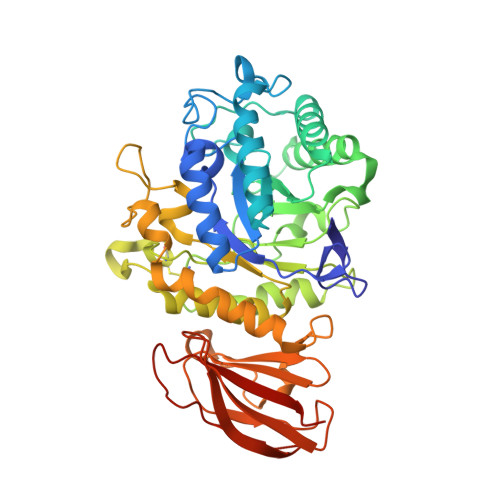
8T9W | pdb_00008t9w

Crystal structure of a GH140 apiosidase derived from a lignocellulolytic enriched mangrove metagenome.

  • Classification: HYDROLASE
  • Organism(s): metagenome
  • Expression System: Escherichia coli
  • Mutation(s): No 

  • Deposited: 2023-06-26 Released: 2024-02-07 
  • Deposition Author(s): Liberato, M.V., Squina, F.
  • Funding Organization(s): Sao Paulo Research Foundation (FAPESP), Brazilian National Council for Scientific and Technological Development (CNPq)

Experimental Data Snapshot

  • Method: X-RAY DIFFRACTION
  • Resolution: 2.20 Å
  • R-Value Free: 
    0.235 (Depositor), 0.236 (DCC) 
  • R-Value Work: 
    0.202 (Depositor), 0.203 (DCC) 
  • R-Value Observed: 
    0.204 (Depositor) 

Starting Model: experimental
View more details

wwPDB Validation 3D Report Full Report

Validation slider image for 8T9W

This is version 1.2 of the entry. See complete history

Literature

Discovery, structural characterization, and functional insights into a novel apiosidase from the GH140 family, isolated from a lignocellulolytic-enriched mangrove microbial community.

Liberato, M.V.Paixao, D.A.A.Tomazetto, G.Ndeh, D.Bolam, D.N.Squina, F.M.

(2024) Biotechnol Lett 46: 201-211

  • DOI: https://doi.org/10.1007/s10529-023-03460-1
  • Primary Citation Related Structures: 
    8T9W

  • PubMed Abstract: 

    Apiosidases are enzymes that cleave the glycosidic bond between the monosaccharides linked to apiose, a branched chain furanose found in the cell walls of vascular plants and aquatic monocots. There is biotechnological interest in this enzyme group because apiose is the flavor-active compound of grapes, fruit juice, and wine, and the monosaccharide is found to be a plant secondary metabolite with pharmaceutical properties. However, functional and structural studies of this enzyme family are scarce. Recently, a glycoside hydrolase family member GH140 was isolated from Bacteroides thetaiotaomicron and identified as an endo-apiosidase. The structural characterization and functional identification of a second GH140 family enzyme, termed MmApi, discovered through mangrove soil metagenomic approach, are described. Among the various substrates tested, MmApi exhibited activity on an apiose-containing oligosaccharide derived from the pectic polysaccharide rhamnogalacturonan-II. While the crystallographic model of MmApi was similar to the endo-apiosidase from Bacteroides thetaiotaomicron, differences in the shape of the binding sites indicated that MmApi could cleave apioses within oligosaccharides of different compositions. This enzyme represents a novel tool for researchers interested in studying the physiology and structure of plant cell walls and developing biocatalytic strategies for drug and flavor production.


  • Organizational Affiliation
    • Programa de Processos Tecnológicos e Ambientais, Universidade de Sorocaba, Sorocaba, Brazil.

Macromolecule Content 

  • Total Structure Weight: 198.36 kDa 
  • Atom Count: 14,908 
  • Modeled Residue Count: 1,726 
  • Deposited Residue Count: 1,736 
  • Unique protein chains: 1

Macromolecules

Find similar proteins by:|  3D Structure
Entity ID: 1
MoleculeChains  Sequence LengthOrganismDetailsImage
Apiosidase
A, B, C, D
434metagenomeMutation(s): 0 

Experimental Data & Validation

Experimental Data

  • Method: X-RAY DIFFRACTION
  • Resolution: 2.20 Å
  • R-Value Free:  0.235 (Depositor), 0.236 (DCC) 
  • R-Value Work:  0.202 (Depositor), 0.203 (DCC) 
  • R-Value Observed: 0.204 (Depositor) 
Space Group: P 21 21 21
Unit Cell:
Length ( Å )Angle ( ˚ )
a = 112.093α = 90
b = 113.391β = 90
c = 158.156γ = 90
Software Package:
Software NamePurpose
PHENIXrefinement
Aimlessdata scaling
XDSdata reduction
PHASERphasing

Structure Validation

View Full Validation Report


Entry History 

& Funding Information

Deposition Data


Funding OrganizationLocationGrant Number
Sao Paulo Research Foundation (FAPESP)Brazil2014/04105-4
Sao Paulo Research Foundation (FAPESP)Brazil2015/14009-5
Brazilian National Council for Scientific and Technological Development (CNPq)Brazil306279/2020-7

Revision History  (Full details and data files)

  • Version 1.0: 2024-02-07
    Type: Initial release
  • Version 1.1: 2024-03-06
    Changes: Database references
  • Version 1.2: 2024-11-13
    Changes: Structure summary