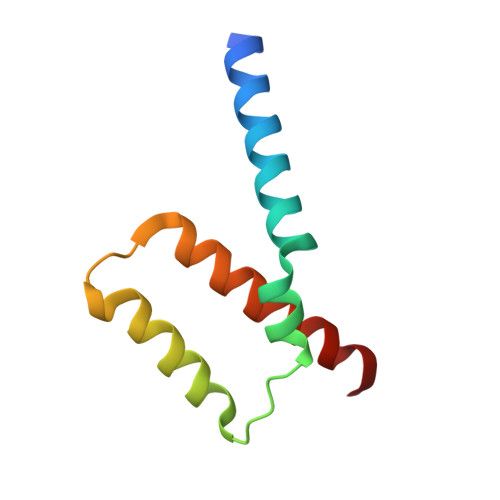
8SPZ | pdb_00008spz

Crystal structure of Bax core domain BH3-groove dimer - hexameric fraction with dioctanoyl phosphatidylserine


Experimental Data Snapshot

  • Method: X-RAY DIFFRACTION
  • Resolution: 2.40 Å
  • R-Value Free: 
    0.341 (Depositor), 0.341 (DCC) 
  • R-Value Work: 
    0.269 (Depositor), 0.269 (DCC) 
  • R-Value Observed: 
    0.276 (Depositor) 

Starting Model: experimental
View more details

wwPDB Validation 3D Report Full Report

Validation slider image for 8SPZ

This is version 1.1 of the entry. See complete history

Literature

Sequence differences between BAX and BAK core domains manifest as differences in their interactions with lipids.

Miller, M.S.Cowan, A.D.Brouwer, J.M.Smyth, S.T.Peng, L.Wardak, A.Z.Uren, R.T.Luo, C.Roy, M.J.Shah, S.Tan, Z.Reid, G.E.Colman, P.M.Czabotar, P.E.

(2024) FEBS J 291: 2335-2353

  • DOI: https://doi.org/10.1111/febs.17031
  • Primary Citation Related Structures: 
    8G1T, 8SPE, 8SPF, 8SPZ, 8SRX, 8SRY, 8SVK

  • PubMed Abstract: 

    The B-cell lymphoma 2 (BCL2) family members, BCL2-associated protein X (BAX) and BCL2 homologous antagonist killer (BAK), are required for programmed cell death via the mitochondrial pathway. When cells are stressed, damaged or redundant, the balance of power between the BCL2 family of proteins shifts towards BAX and BAK, allowing their transition from an inactive, monomeric state to a membrane-active oligomeric form that releases cytochrome c from the mitochondrial intermembrane space. That oligomeric state has an essential intermediate, a symmetric homodimer of BAX or BAK. Here we describe crystal structures of dimers of the core domain of BAX, comprising its helices α2-α5. These structures provide an atomic resolution description of the interactions that drive BAX homo-dimerisation and insights into potential interaction between core domain dimers and membrane lipids. The previously identified BAK lipid-interacting sites are not conserved with BAX and are likely to determine the differences between them in their interactions with lipids. We also describe structures of heterodimers of BAK/BAX core domains, yielding further insight into the differences in lipid binding between BAX and BAK.


  • Organizational Affiliation
    • Walter and Eliza Hall Institute of Medical Research, Parkville, Vic., Australia.

Macromolecule Content 

  • Total Structure Weight: 36.18 kDa 
  • Atom Count: 2,233 
  • Modeled Residue Count: 283 
  • Deposited Residue Count: 324 
  • Unique protein chains: 1

Macromolecules

Find similar proteins by:|  3D Structure
Entity ID: 1
MoleculeChains  Sequence LengthOrganismDetailsImage
Apoptosis regulator BAX
A, B, C, D
81Homo sapiensMutation(s): 0 
Gene Names: BAXBCL2L4
UniProt & NIH Common Fund Data Resources
Find proteins for Q07812 (Homo sapiens)
Explore Q07812 
Go to UniProtKB:  Q07812
PHAROS:  Q07812
GTEx:  ENSG00000087088 
Entity Groups
Sequence Clusters30% Identity50% Identity70% Identity90% Identity95% Identity100% Identity
UniProt GroupQ07812
Sequence Annotations
Expand
Reference Sequence

Experimental Data & Validation

Experimental Data

  • Method: X-RAY DIFFRACTION
  • Resolution: 2.40 Å
  • R-Value Free:  0.341 (Depositor), 0.341 (DCC) 
  • R-Value Work:  0.269 (Depositor), 0.269 (DCC) 
  • R-Value Observed: 0.276 (Depositor) 
Space Group: P 21 21 2
Unit Cell:
Length ( Å )Angle ( ˚ )
a = 52.815α = 90
b = 88.065β = 90
c = 73.298γ = 90
Software Package:
Software NamePurpose
PHENIXrefinement
XDSdata reduction
XSCALEdata scaling
PHASERphasing

Structure Validation

View Full Validation Report


Entry History 

& Funding Information

Deposition Data


Funding OrganizationLocationGrant Number
National Health and Medical Research Council (NHMRC, Australia)Australia--

Revision History  (Full details and data files)

  • Version 1.0: 2023-12-27
    Type: Initial release
  • Version 1.1: 2024-06-19
    Changes: Database references