Download Mendeley
Structural determinants of peanut induced anaphylaxis.
Smith, S.A., Shrem, R.A., Lanca, B.B.C., Zhang, J., Wong, J.J.W., Croote, D., Peebles Jr., R.S., Spiller, B.W.(2025) J Allergy Clin Immunol
- PubMed: 39805366 Search on PubMedSearch on PubMed Central
- DOI: https://doi.org/10.1016/j.jaci.2024.12.1095
- Primary Citation Related Structures:
8SHV, 8SHW, 8SI1, 8SJ4, 8SJ6, 8SJA - PubMed Abstract:
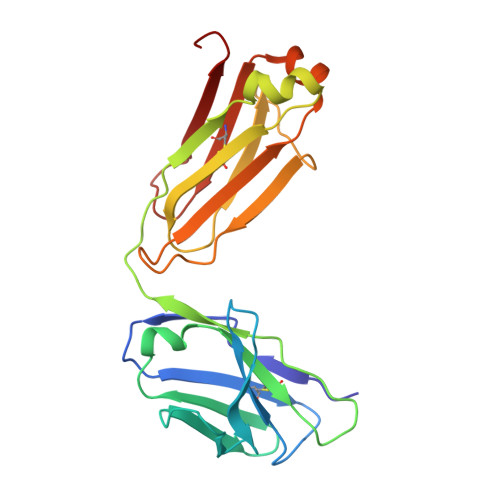
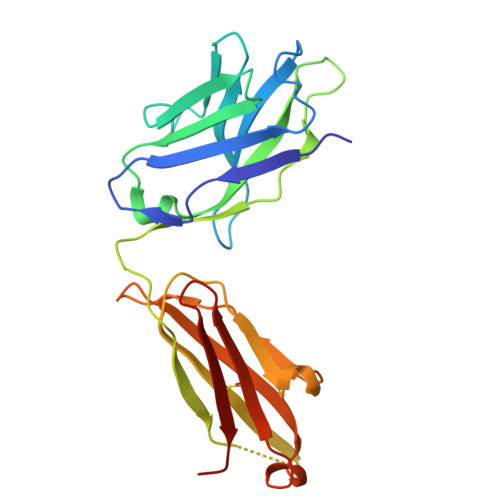
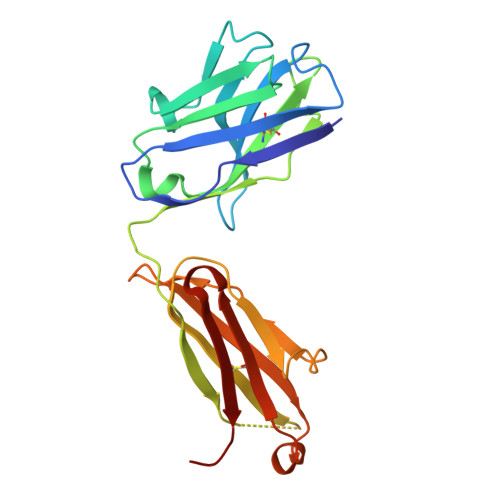
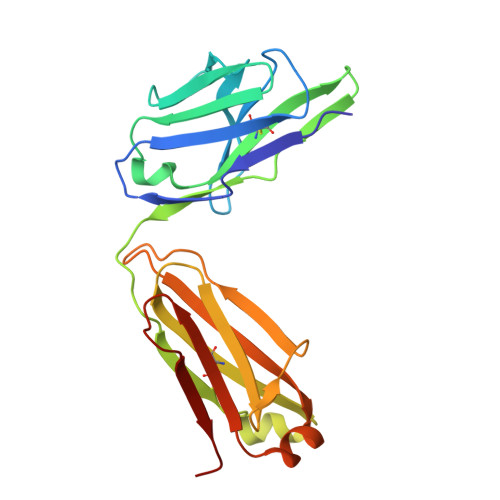
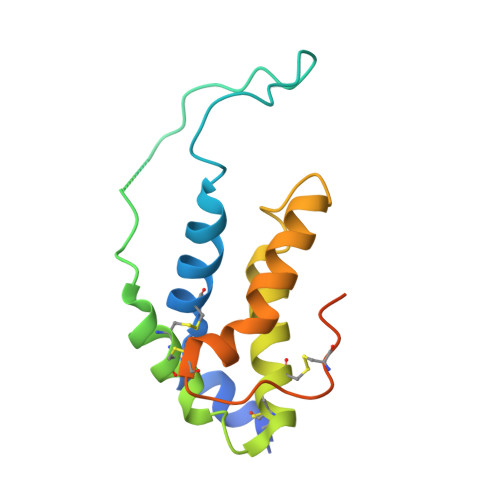
Human IgE mAbs recognizing peanut allergens have recently become available, but we lack a detailed understanding of how these IgEs target allergens. We sought to determine the molecular details of the antibody-allergen interaction for a panel of clinically important human IgE mAbs and to develop strategies to disrupt disease causing antibody-allergen interactions. We identified candidates from a panel of epitope binned human IgE mAbs that recognize 2 important and homologous peanut allergens, Ara h 2 and Ara h 6. Crystal structures were determined revealing the interfaces (antigenic sites) of exemplars of 5 common IgE bins. Among the common antigenic sites on Ara h 2 and Ara h 6, 2 sites (A and B) are highly conserved between the allergens, explaining the cross-reactivity of antibodies that recognize these sites. Three sites (C, D, and F) involve residues that are not conserved between the allergens. Of the 5 common sites, 3 sites (B, C, and D) involve residues that are near each other only when the allergens are properly folded, such that these sites are conformational. Two additional sites (sites A and F) involve largely linear stretches of amino acids. Site F targeted antibody, 38B7, binds to a peptide sequence DPYSP OH S, in which hydroxylation of the last proline is critical for binding. This sequence is repeated 2 or 3 times depending on the Ara h 2 isoform, enabling 38B7 to induce anaphylaxis as a single mAb, without a second antibody. We have mutated key residues in each site and created a panel of hypoallergens, having reduced IgE mAb binding and lacking the ability to induce anaphylaxis in our murine model. We created a structural map of the IgE antibody response to the most important peanut allergen proteins to enable the design of new allergy immunotherapies and vaccines.
- Department of Medicine, Vanderbilt University Medical Center, Nashville, Tenn; Department of Pathology, Microbiology and Immunology, Vanderbilt University Medical Center, Nashville, Tenn.
Organizational Affiliation: