Download Mendeley
Higher-Level Structural Classification of Pseudomonas Cyclic Lipopeptides through Their Bioactive Conformation.
Kovacs, B., Prasad, D., De Roo, V., Vanheede, M., Muangkaew, P., Madder, A., Hofte, M., De Mot, R., Geudens, N., Martins, J.C.(2025) Adv Sci (Weinh) : e20365-e20365
- PubMed: 41391051 Search on PubMed
- DOI: https://doi.org/10.1002/advs.202520365
- Primary Citation Related Structures:
8Q1L, 8S2A, 8S2B, 8S2C, 8S2D, 8S4L, 8S8N, 9EPS - PubMed Abstract:
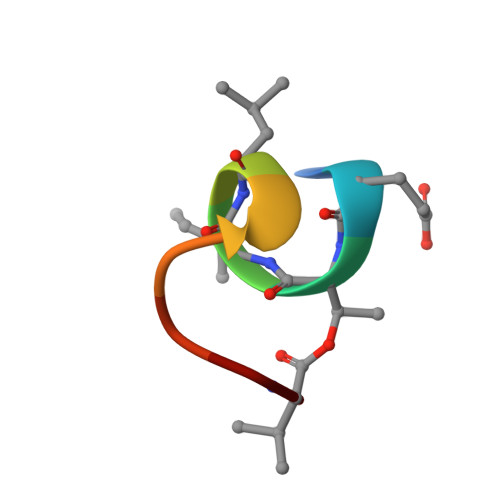
Cyclic lipodepsipeptides (CLiPs) from Pseudomonas are membrane-targeting specialized metabolites with diverse ecological roles and antimicrobial activities. Over the past decades, significant efforts have been made to reveal their chemical constitution and configuration, thus providing the starting point to establishing structure-function correlations, deriving molecular-level understanding of their mode of action, and ultimately harnessing their potential in plant biocontrol and clinical applications. The sheer diversity in chemical structures, combined with a few scattered reports of 3D structures, has limited advances in these areas. The solution conformations of eight antimicrobial, non-phytotoxic Pseudomonas CLiPs, each representing a distinct family, are presented, obtained using a consistent NMR and molecular dynamics protocol in dodecylphosphocholine micelles. All CLiP conformations share a left-handed α-helix forming a stapled or catch-pole helix motif depending on the number of residues in the macrocycle. This structural dichotomy is validated through a synthetic analogue of the naturally occurring orfamide A featuring an alternative, more constricted macrocycle. The two motifs define distinct superfamilies encompassing most known Pseudomonas CLiPs, offering a new, coherent framework for their structural classification that is also reflected in the organization of their biosynthetic gene cluster. The findings support future homology modelling and molecular design efforts for these metabolites.
- NMR and Structure Analysis Unit, Department of Organic and Macromolecular Chemistry, Faculty of Sciences, Ghent University, Ghent, 9000, Belgium.
Organizational Affiliation: