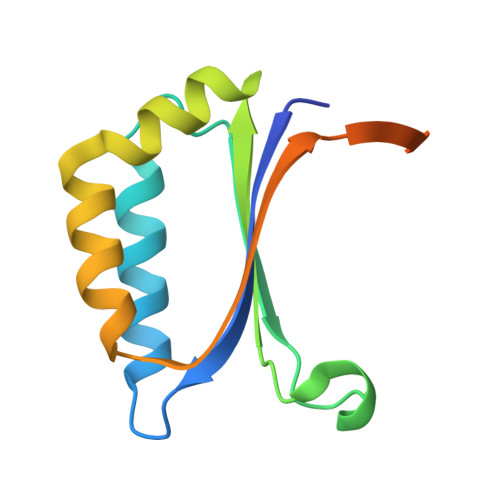
8S4E | pdb_00008s4e

Dimeric Alpha-beta barrel protein from Brassica rapa subsp.pekinensis


Experimental Data Snapshot

  • Method: X-RAY DIFFRACTION
  • Resolution: 1.98 Å
  • R-Value Free: 
    0.207 (Depositor), 0.219 (DCC) 
  • R-Value Work: 
    0.170 (Depositor), 0.185 (DCC) 
  • R-Value Observed: 
    0.172 (Depositor) 

Starting Model: in silico
View more details

wwPDB Validation   3D Report Full Report


This is version 1.0 of the entry. See complete history


Literature

SilE-R and SilE-S-DABB Proteins Catalying Enantiospecific Hydrolysis of Organosilyl Ethers.

Pick, L.M.Oehme, V.Hartmann, J.Wenzlaff, J.Tang, Q.Grogan, G.Ansorge-Schumacher, M.B.

(2024) Angew Chem Int Ed Engl 63: e202404105-e202404105

  • DOI: https://doi.org/10.1002/anie.202404105
  • Primary Citation of Related Structures:  
    8S4E

  • PubMed Abstract: 

    Silyl ethers fulfil a fundamental role in synthetic organic chemistry as protecting groups and their selective cleavage is an important factor in their application. We present here for the first time two enzymes, SilE-R and SilE-S, which are able to hydrolyse silyl ethers. They belong to the stress-response dimeric A/B barrel domain (DABB) family and are able to cleave the Si-O bond with opposite enantiopreference. Silyl ethers containing aromatic, cyclic or aliphatic alcohols and, depending on the alcohol moiety, silyl functions as large as TBDMS are accepted. The X-ray crystal structure of SilE-R, determined to a resolution of 1.98 Å, in combination with mutational studies, revealed an active site featuring two histidine residues, H8 and H79, which likely act synergistically as nucleophile and Brønsted base in the hydrolytic mechanism, which has not previously been described for enzymes. Although the natural function of SilE-R and SilE-S is unknown, we propose that these 'silyl etherases' may have significant potential for synthetic applications.


  • Organizational Affiliation
    • Professur für Molekulare Biotechnologie, Technische Universität Dresden, 01062, Dresden, Germany.

Macromolecules
Find similar proteins by:  (by identity cutoff)  |  3D Structure
Entity ID: 1
MoleculeChains Sequence LengthOrganismDetailsImage
Genome assembly, chromosome: A10
A, B
124Brassica rapaMutation(s): 0 
Gene Names: BRAA10T43907ZBRAPAZ1V2_A10P19140.2BRARA_J01461
UniProt
Find proteins for A0A397XUN4 (Brassica campestris)
Explore A0A397XUN4 
Go to UniProtKB:  A0A397XUN4
Entity Groups  
Sequence Clusters30% Identity50% Identity70% Identity90% Identity95% Identity100% Identity
UniProt GroupA0A397XUN4
Sequence Annotations
Expand
  • Reference Sequence
Experimental Data & Validation

Experimental Data

  • Method: X-RAY DIFFRACTION
  • Resolution: 1.98 Å
  • R-Value Free:  0.207 (Depositor), 0.219 (DCC) 
  • R-Value Work:  0.170 (Depositor), 0.185 (DCC) 
  • R-Value Observed: 0.172 (Depositor) 
Space Group: P 32 2 1
Unit Cell:
Length ( Å )Angle ( ˚ )
a = 92.37α = 90
b = 92.37β = 90
c = 70.86γ = 120
Software Package:
Software NamePurpose
REFMACrefinement
XDSdata reduction
SCALAdata scaling
MOLREPphasing

Structure Validation

View Full Validation Report


Entry History & Funding Information

Deposition Data


Funding OrganizationLocationGrant Number
Engineering and Physical Sciences Research CouncilUnited KingdomEP/T01430X/1

Revision History  (Full details and data files)

  • Version 1.0: 2025-01-15
    Type: Initial release