Download Mendeley
Toll-like receptor signaling outcome is determined by the stoichiometry of the endogenous TRIFosome.
Moncrieffe, M.C., Suresh, P., Boyle, J., Cui, Y., Nawalpuri, B., Verstak, B., Zhang, Y.P., Zhang, Z., Taylor, M., Egelman, E.H., Gay, N., Klenerman, D., Bryant, C.(2026) Sci Adv 12: eaeb9507-eaeb9507
- PubMed: 41790885 Search on PubMedSearch on PubMed Central
- DOI: https://doi.org/10.1126/sciadv.aeb9507
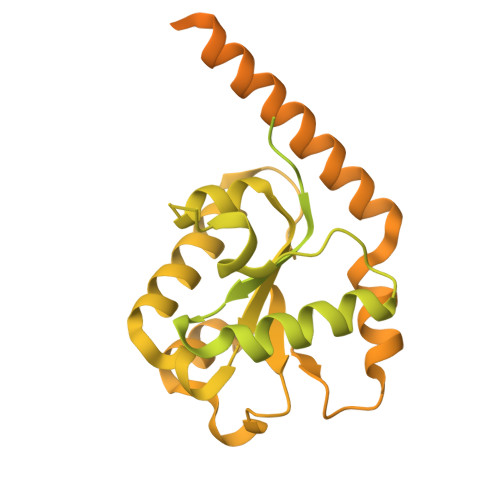
- Primary Citation Related Structures:
8RLM - PubMed Abstract:
Toll-like receptors (TLRs) drive innate immunity via assembly of macromolecular signal transduction platforms [supramolecular organizing centers (SMOCs)] coordinated by adaptor proteins such as Toll/interleukin-1 receptor (IL-1R) domain-containing adaptor-inducing interferon-β (TRIF), but whether oligomeric TRIFosomes form is unknown. Here, using cryo-electron microscopy and biophysical characterization of full-length TRIF in vitro, we show that it forms filamentous oligomers, which associate with the TRIF signaling partners receptor interacting protein 1 (RIP1) and RIP3 kinases, suggesting that oligomeric TRIFosomes could form. Endogenous TRIF, however, is predominantly monomeric in the absence of ligand, only forming TRIFosome oligomers in macrophages after stimulation of TLR4 or TLR3 when large, macromolecular signaling complexes form. TRIFosomes are fully formed 45 min after TLR3 or 60 min after TLR4 stimulation, commensurate with activation of nuclear factor κB in these cells. TLR3/4 activation triggers rapid interferon signaling prior to TRIFosome formation through monomeric TRIF, unexpectedly suggesting that a macromolecular platform of TRIF is not required to drive this signaling pathway. Collectively, these data show TRIFosome macromolecular platform formation and, unexpectedly, that TLR signaling can be SMOC-independent in addition to being SMOC-dependent.
- Department of Biochemistry, University of Cambridge, Cambridge, UK.
Organizational Affiliation: