Download Mendeley
The Arthropoda-specific Tramtrack group BTB protein domains use previously unknown interface to form hexamers.
Bonchuk, A.N., Balagurov, K.I., Baradaran, R., Boyko, K.M., Sluchanko, N.N., Khrustaleva, A.M., Burtseva, A.D., Arkova, O.V., Khalisova, K.K., Popov, V.O., Naschberger, A., Georgiev, P.G.(2024) Elife 13
- PubMed: 39221775 Search on PubMedSearch on PubMed Central
- DOI: https://doi.org/10.7554/eLife.96832
- Primary Citation Related Structures:
8RC6 - PubMed Abstract:
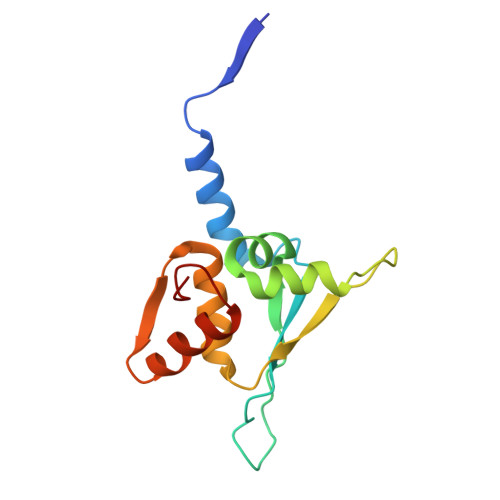
BTB (bric-a-brack, Tramtrack, and broad complex) is a diverse group of protein-protein interaction domains found within metazoan proteins. Transcription factors contain a dimerizing BTB subtype with a characteristic N-terminal extension. The Tramtrack group (TTK) is a distinct type of BTB domain, which can multimerize. Single-particle cryo-EM microscopy revealed that the TTK-type BTB domains assemble into a hexameric structure consisting of three canonical BTB dimers connected through a previously uncharacterized interface. We demonstrated that the TTK-type BTB domains are found only in Arthropods and have undergone lineage-specific expansion in modern insects. The Drosophila genome encodes 24 transcription factors with TTK-type BTB domains, whereas only four have non-TTK-type BTB domains. Yeast two-hybrid analysis revealed that the TTK-type BTB domains have an unusually broad potential for heteromeric associations presumably through a dimer-dimer interaction interface. Thus, the TTK-type BTB domains are a structurally and functionally distinct group of protein domains specific to Arthropodan transcription factors.
- Department of the Control of Genetic Processes, Institute of Gene Biology Russian Academy of Sciences, Moscow, Russian Federation.
Organizational Affiliation: