Download Mendeley
How the Larger Methionine-Rich Domain of CueO from Hafnia alvei Enhances Cuprous Oxidation.
Contaldo, U., Santucci, P., Vergnes, A., Leone, P., Becam, J., Biaso, F., Ilbert, M., Ezraty, B., Lojou, E., Mazurenko, I.(2025) JACS Au 5: 1833-1844
- PubMed: 40313819 Search on PubMedSearch on PubMed Central
- DOI: https://doi.org/10.1021/jacsau.5c00076
- Primary Citation Related Structures:
8R4F, 8R4H - PubMed Abstract:
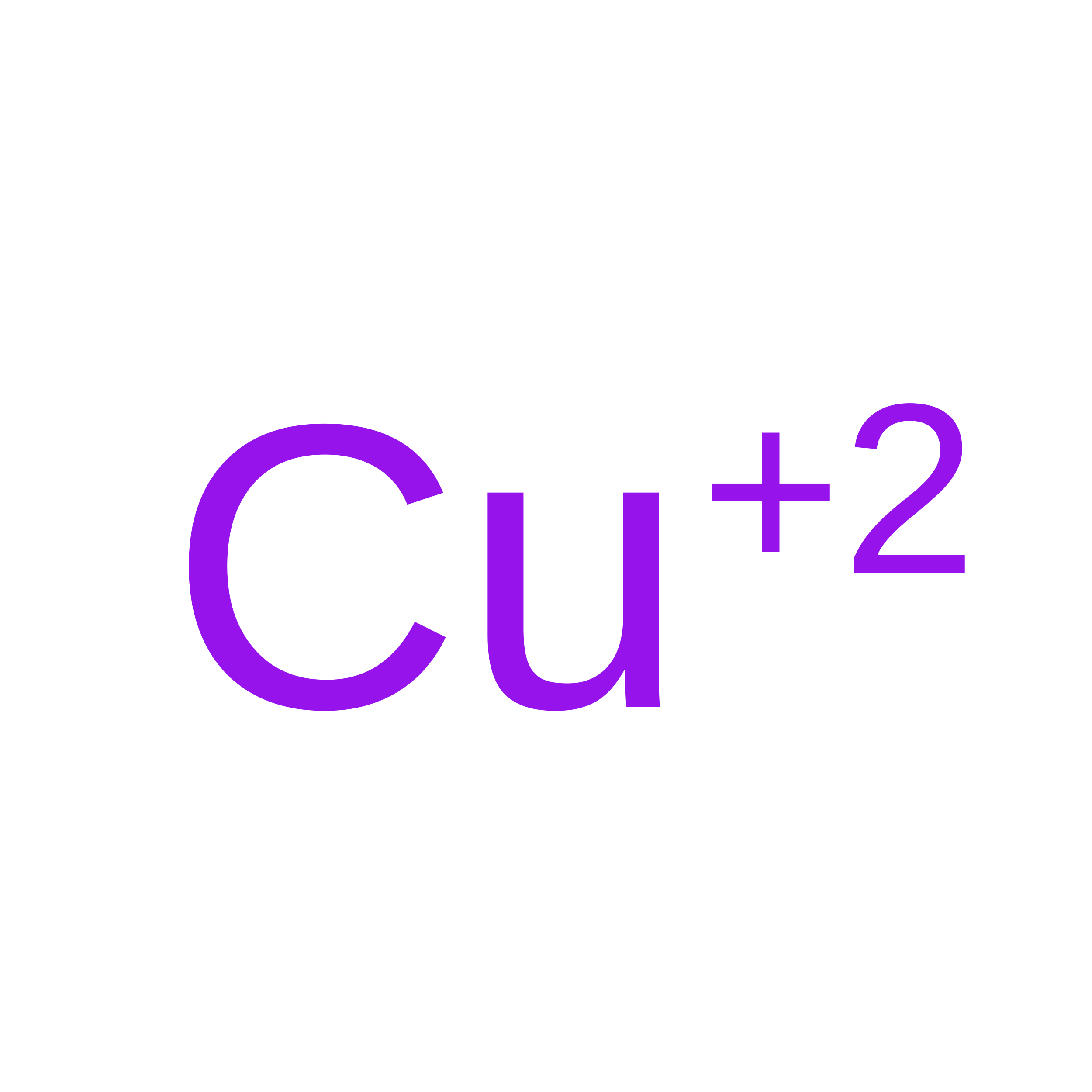
CueOs, members of the multicopper oxidase family, play a crucial role in bacterial copper detoxification. These enzymes feature a unique methionine-rich (Met-rich) domain, which is essential for the oxidation of Cu + to Cu 2+ . Recent studies using CueO from Escherichia coli ( Ec CueO) suggest that the Met-rich domain facilitates Cu + recruitment from highly chelated species. To further explore this hypothesis, we produced and characterized a novel CueO from the bacterium Hafnia alvei ( Ha CueO). Ha CueO possesses a significantly larger Met-rich domain than Ec CueO, providing new insights into the role of this domain in cuprous oxidase activity. We first showed that Ha CueO was as efficient in copper detoxification as Ec CueO in vivo. The structures of both wild-type Ha CueO and a variant lacking the Met-rich domain were resolved by X-ray crystallography and simulated by molecular dynamics, offering a detailed structural basis for understanding their functions. Cuprous oxidase activity was then quantified either from free electrogenerated Cu + with CueO immobilized on an electrode or from different Cu + -complexes with CueO in solution. These methods enabled the fine-tuning of Cu + chelation strength. Consistent with findings for Ec CueO, it was confirmed that the Met-rich domain of Ha CueO is dispensable for Cu + oxidation when weakly chelated Cu + is used. However, its role becomes crucial as chelation strength increases. Comparative analyses of cuprous oxidase activity between Ha CueO and Ec CueO revealed that Ha CueO outperforms Ec CueO, demonstrating superior efficiency in oxidizing Cu + from chelated forms. This enhanced activity correlates with the higher methionine content in Ha CueO, which appears to play a pivotal role in facilitating Cu + oxidation under conditions of stronger chelation.
- CNRS, Laboratoire de Bioénergétique et Ingénierie des Protéines (BIP), Institut de Microbiologie de la Méditerranée, Aix Marseille Université, 13402 Marseille, France.
Organizational Affiliation: