Download Mendeley
Cryo-EM structure of 1-deoxy-D-xylulose 5-phosphate synthase DXPS from Plasmodium falciparum reveals a distinct N-terminal domain.
Gawriljuk, V.O., Godoy, A.S., Oerlemans, R., Welker, L.A.T., Hirsch, A.K.H., Groves, M.R.(2024) Nat Commun 15: 6642-6642
- PubMed: 39103329 Search on PubMedSearch on PubMed Central
- DOI: https://doi.org/10.1038/s41467-024-50671-9
- Primary Citation Related Structures:
8R2H - PubMed Abstract:
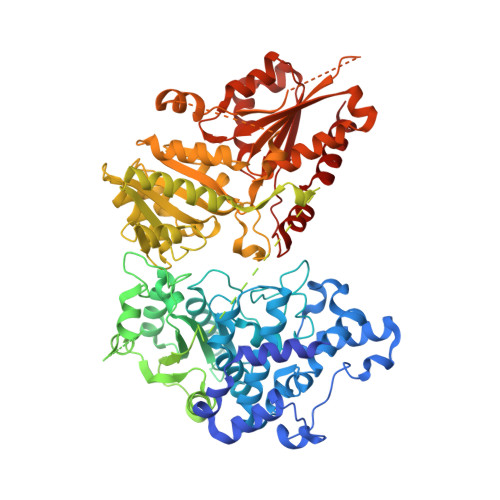
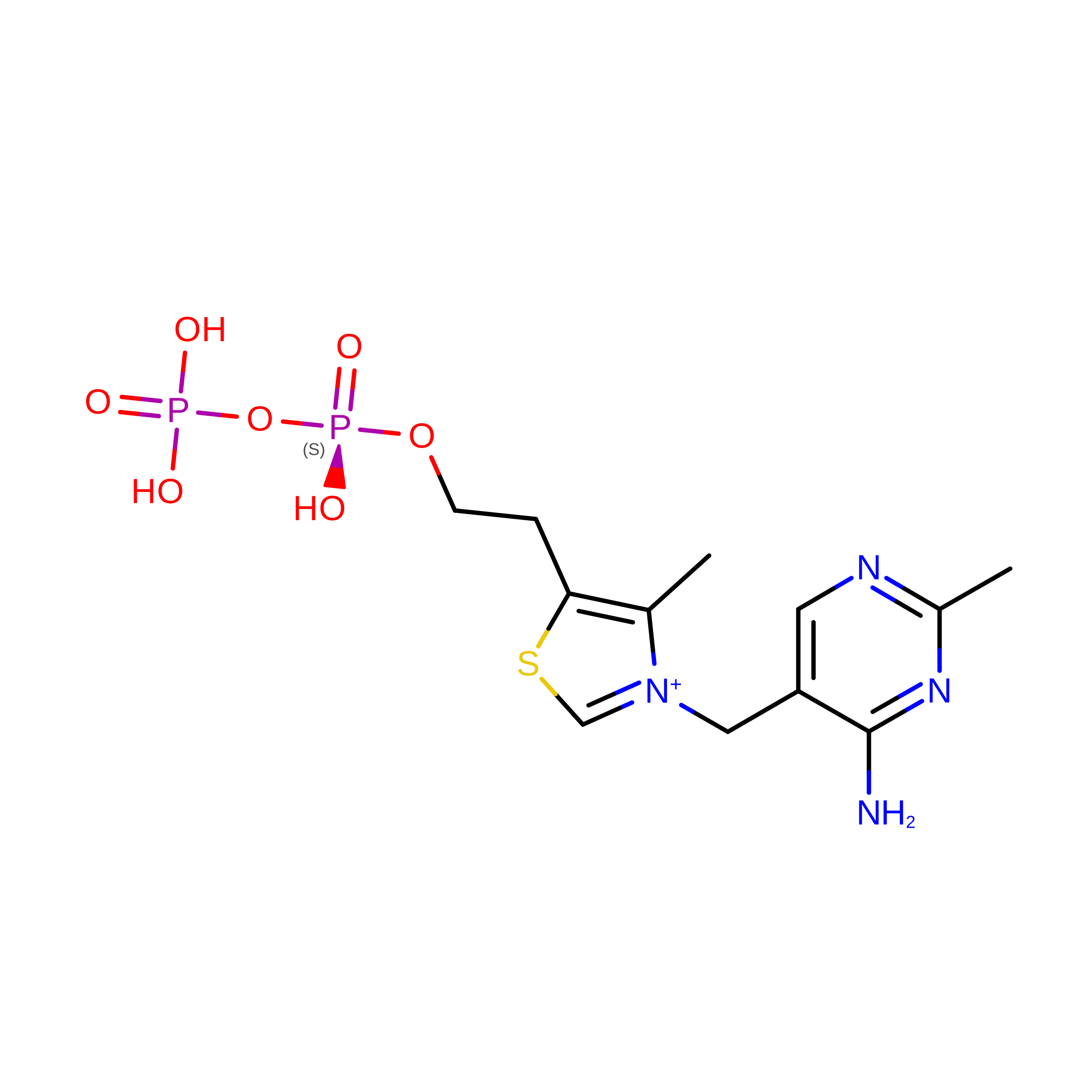
Plasmodium falciparum is the main causative agent of malaria, a deadly disease that mainly affects children under five years old. Artemisinin-based combination therapies have been pivotal in controlling the disease, but resistance has arisen in various regions, increasing the risk of treatment failure. The non-mevalonate pathway is essential for the isoprenoid synthesis in Plasmodium and provides several under-explored targets to be used in the discovery of new antimalarials. 1-deoxy-D-xylulose-5-phosphate synthase (DXPS) is the first and rate-limiting enzyme of the pathway. Despite its importance, there are no structures available for any Plasmodium spp., due to the complex sequence which contains large regions of high disorder, making crystallisation a difficult task. In this manuscript, we use cryo-electron microscopy to solve the P. falciparum DXPS structure at a final resolution of 2.42 Å. Overall, the structure resembles other DXPS enzymes but includes a distinct N-terminal domain exclusive to the Plasmodium genus. Mutational studies show that destabilization of the cap domain interface negatively impacts protein stability and activity. Additionally, a density for the co-factor thiamine diphosphate is found in the active site. Our work highlights the potential of cryo-EM to obtain structures of P. falciparum proteins that are unfeasible by means of crystallography.
- Chemical and Pharmaceutical Biology, Groningen Research Institute of Pharmacy, University of Groningen, Antonius Deusinglaan 1, 9713 AV, Groningen, The Netherlands.
Organizational Affiliation: