8Q4L | pdb_00008q4l

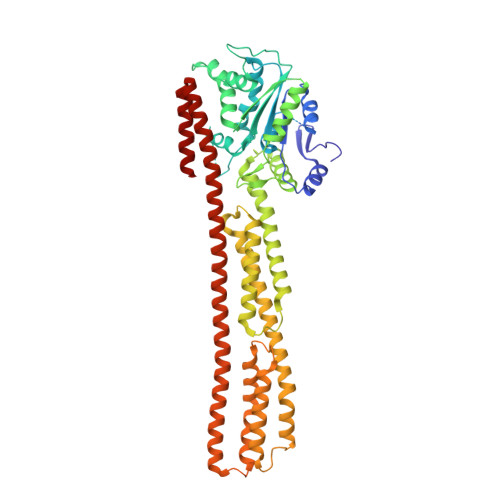
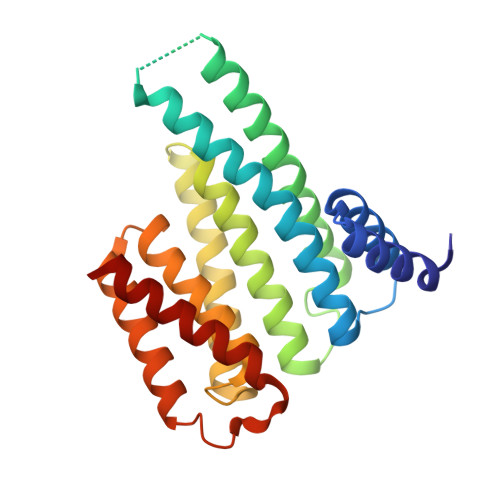
GBP1 bound by 14-3-3sigma


Experimental Data Snapshot

  • Method: ELECTRON MICROSCOPY
  • Resolution: 5.12 Å
  • Aggregation State: PARTICLE 
  • Reconstruction Method: SINGLE PARTICLE 

wwPDB Validation 3D Report Full Report

Validation slider image for 8Q4L

This is version 1.1 of the entry. See complete history

Literature

PIM1 controls GBP1 activity to limit self-damage and to guard against pathogen infection.

Fisch, D.Pfleiderer, M.M.Anastasakou, E.Mackie, G.M.Wendt, F.Liu, X.Clough, B.Lara-Reyna, S.Encheva, V.Snijders, A.P.Bando, H.Yamamoto, M.Beggs, A.D.Mercer, J.Shenoy, A.R.Wollscheid, B.Maslowski, K.M.Galej, W.P.Frickel, E.M.

(2023) Science 382: eadg2253-eadg2253

  • DOI: https://doi.org/10.1126/science.adg2253
  • Primary Citation Related Structures: 
    8Q4L

  • PubMed Abstract: 

    Disruption of cellular activities by pathogen virulence factors can trigger innate immune responses. Interferon-γ (IFN-γ)-inducible antimicrobial factors, such as the guanylate binding proteins (GBPs), promote cell-intrinsic defense by attacking intracellular pathogens and by inducing programmed cell death. Working in human macrophages, we discovered that GBP1 expression in the absence of IFN-γ killed the cells and induced Golgi fragmentation. IFN-γ exposure improved macrophage survival through the activity of the kinase PIM1. PIM1 phosphorylated GBP1, leading to its sequestration by 14-3-3σ, which thereby prevented GBP1 membrane association. During Toxoplasma gondii infection, the virulence protein TgIST interfered with IFN-γ signaling and depleted PIM1, thereby increasing GBP1 activity. Although infected cells can restrain pathogens in a GBP1-dependent manner, this mechanism can protect uninfected bystander cells. Thus, PIM1 can provide a bait for pathogen virulence factors, guarding the integrity of IFN-γ signaling.


  • Organizational Affiliation
    • Host-Toxoplasma Interaction Laboratory, The Francis Crick Institute, London, UK.

Macromolecule Content 

  • Total Structure Weight: 118.55 kDa 
  • Atom Count: 4,664 
  • Modeled Residue Count: 940 
  • Deposited Residue Count: 1,039 
  • Unique protein chains: 2

Macromolecules

Find similar proteins by:|  3D Structure
Entity ID: 1
MoleculeChains  Sequence LengthOrganismDetailsImage
Guanylate-binding protein 1577Homo sapiensMutation(s): 0 
Gene Names: GBP1
EC: 3.6.1 (UniProt), 3.6.5 (UniProt)
UniProt & NIH Common Fund Data Resources
Find proteins for P32455 (Homo sapiens)
Explore P32455 
Go to UniProtKB:  P32455
PHAROS:  P32455
GTEx:  ENSG00000117228 
Entity Groups
Sequence Clusters30% Identity50% Identity70% Identity90% Identity95% Identity100% Identity
UniProt GroupP32455
Sequence Annotations
Expand
Reference Sequence
Find similar proteins by:|  3D Structure
Entity ID: 2
MoleculeChains  Sequence LengthOrganismDetailsImage
14-3-3 protein sigma
B, C
231Homo sapiensMutation(s): 0 
Gene Names: SFN
UniProt & NIH Common Fund Data Resources
Find proteins for P31947 (Homo sapiens)
Explore P31947 
Go to UniProtKB:  P31947
PHAROS:  P31947
GTEx:  ENSG00000175793 
Entity Groups
Sequence Clusters30% Identity50% Identity70% Identity90% Identity95% Identity100% Identity
UniProt GroupP31947
Sequence Annotations
Expand
Reference Sequence

Experimental Data & Validation

Experimental Data

  • Method: ELECTRON MICROSCOPY
  • Resolution: 5.12 Å
  • Aggregation State: PARTICLE 
  • Reconstruction Method: SINGLE PARTICLE 

Structure Validation

View Full Validation Report


Entry History 

& Funding Information

Deposition Data


Funding OrganizationLocationGrant Number
Boehringer Ingelheim Fonds (BIF)Germany--
Human Frontier Science Program (HFSP)FranceLT0006/2022-L
European Molecular Biology Organization (EMBO)European UnionALTF 491-2022
Wellcome TrustUnited Kingdom217202/Z/19/Z
Medical Research Council (MRC, United Kingdom)United KingdomMR/V030930/1
Medical Research Council (MRC, United Kingdom)United KingdomMR/T029323/1
Wellcome TrustUnited KingdomFC001076
Medical Research Council (MRC, United Kingdom)United KingdomFC001076
Cancer Research UKUnited KingdomFC001076

Revision History  (Full details and data files)

  • Version 1.0: 2023-10-11
    Type: Initial release
  • Version 1.1: 2023-10-18
    Changes: Database references