8P04 | pdb_00008p04

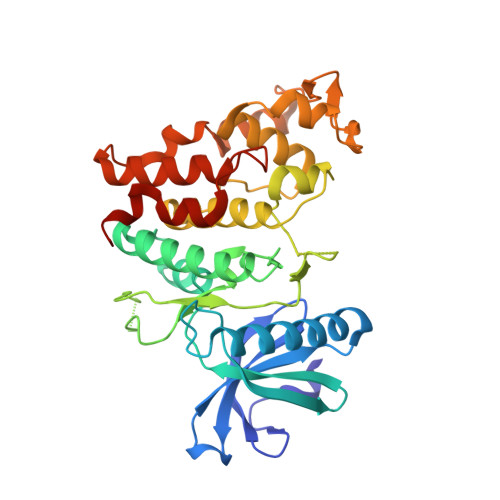
Crystal structure of human CLK1 in complex with Leucettinib-92


Experimental Data Snapshot

  • Method: X-RAY DIFFRACTION
  • Resolution: 2.60 Å
  • R-Value Free: 
    0.259 (Depositor), 0.270 (DCC) 
  • R-Value Work: 
    0.209 (Depositor) 
  • R-Value Observed: 
    0.212 (Depositor) 

Starting Model: experimental
View more details

wwPDB Validation 3D Report Full Report

Validation slider image for 8P04

Ligand Structure Quality Assessment 


This is version 2.1 of the entry. See complete history

Literature

Leucettinibs, a Class of DYRK/CLK Kinase Inhibitors Inspired by the Marine Sponge Natural Product Leucettamine B.

Deau, E.Lindberg, M.F.Miege, F.Roche, D.George, N.George, P.Kramer, A.Knapp, S.Meijer, L.

(2023) J Med Chem 66: 10694-10714

  • DOI: https://doi.org/10.1021/acs.jmedchem.3c00884
  • Primary Citation Related Structures: 
    8P04, 8P05

  • PubMed Abstract: 

    Dual-specificity, tyrosine phosphorylation-regulated kinases (DYRKs) and cdc2-like kinases (CLKs) recently attracted attention due to their central involvement in various pathologies. We here describe a family of DYRK/CLK inhibitors derived from Leucettines and the marine natural product Leucettamine B. Forty-five N 2-functionalized 2-aminoimidazolin-4-ones bearing a fused [6 + 5]-heteroarylmethylene were synthesized. Benzothiazol-6-ylmethylene was selected as the most potent residue among 15 different heteroarylmethylenes. 186 N 2-substituted 2-aminoimidazolin-4-ones bearing a benzothiazol-6-ylmethylene, collectively named Leucettinibs, were synthesized and extensively characterized. Subnanomolar IC 50 (0.5-20 nM on DYRK1A) inhibitors were identified and one Leucettinib was modeled in DYRK1A and co-crystallized with CLK1 and the weaker inhibited off-target CSNK2A1. Kinase-inactive isomers of Leucettinibs (>3-10 μM on DYRK1A), named iso-Leucettinibs, were synthesized and characterized as suitable negative control compounds for functional experiments. Leucettinibs, but not iso-Leucettinibs, inhibit the phosphorylation of DYRK1A substrates in cells. Leucettinibs provide new research tools and potential leads for further optimization toward therapeutic drug candidates.


  • Organizational Affiliation
    • Perha Pharmaceuticals, Perharidy, 29680 Roscoff, France.

Macromolecule Content 

  • Total Structure Weight: 39.96 kDa 
  • Atom Count: 2,539 
  • Modeled Residue Count: 321 
  • Deposited Residue Count: 339 
  • Unique protein chains: 1

Macromolecules

Find similar proteins by:|  3D Structure
Entity ID: 1
MoleculeChains  Sequence LengthOrganismDetailsImage
Dual specificity protein kinase CLK1339Homo sapiensMutation(s): 0 
Gene Names: CLK1CLK
EC: 2.7.12.1
UniProt & NIH Common Fund Data Resources
Find proteins for P49759 (Homo sapiens)
Explore P49759 
Go to UniProtKB:  P49759
PHAROS:  P49759
GTEx:  ENSG00000013441 
Entity Groups
Sequence Clusters30% Identity50% Identity70% Identity90% Identity95% Identity100% Identity
UniProt GroupP49759
Sequence Annotations
Expand
Reference Sequence

Small Molecules

Ligands 1 Unique
IDChains Name / Formula / InChI Key2D Diagram3D Interactions
WAK
(Subject of Investigation/LOI)

Query on WAK


Download:Ideal Coordinates CCD File
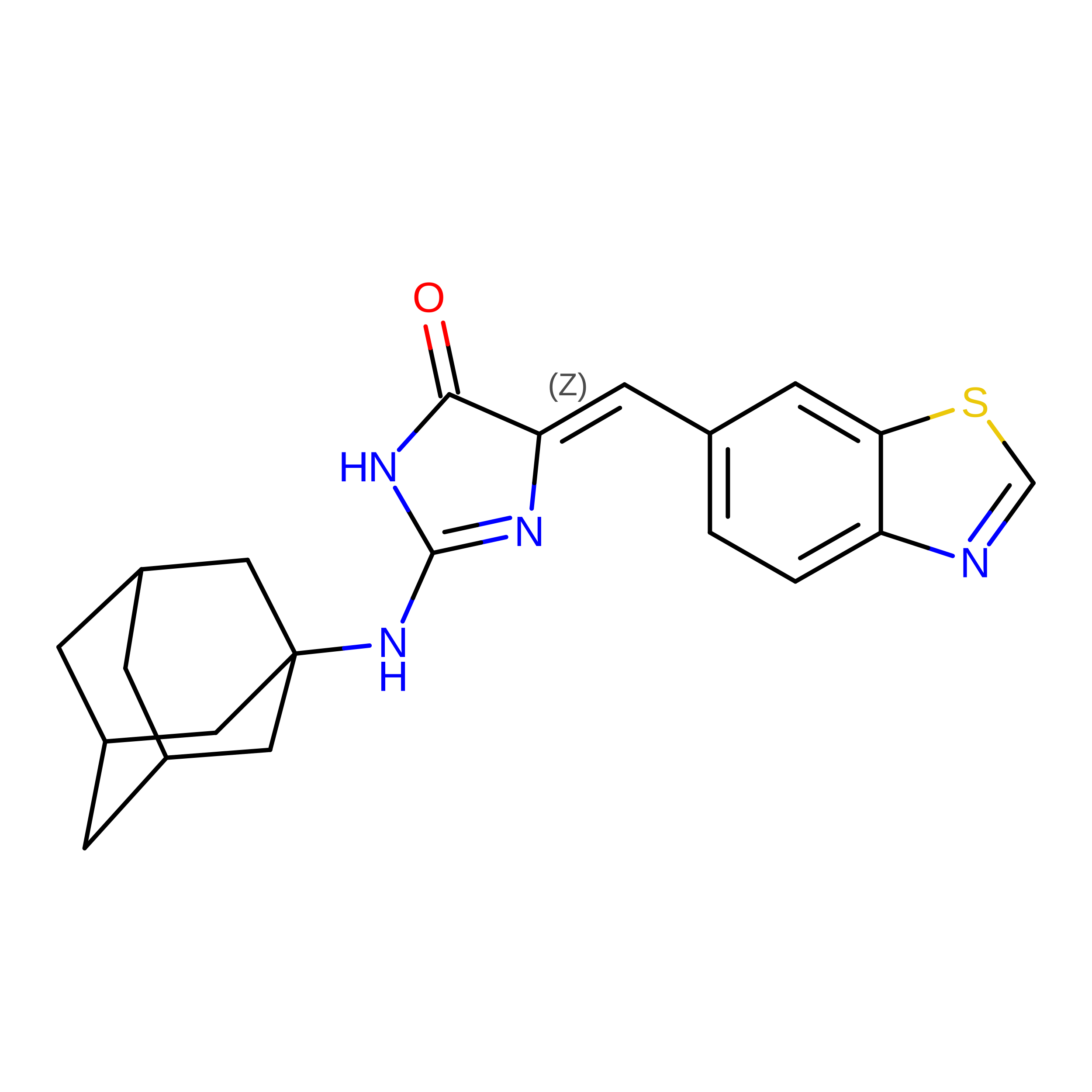
B [auth A](4~{Z})-2-(1-adamantylamino)-4-(1,3-benzothiazol-6-ylmethylidene)-1~{H}-imidazol-5-one
C21 H22 N4 O S
HEVBCYZPXGZFGS-KDBINBPISA-N

Experimental Data & Validation

Experimental Data

  • Method: X-RAY DIFFRACTION
  • Resolution: 2.60 Å
  • R-Value Free:  0.259 (Depositor), 0.270 (DCC) 
  • R-Value Work:  0.209 (Depositor) 
  • R-Value Observed: 0.212 (Depositor) 
Space Group: C 1 2 1
Unit Cell:
Length ( Å )Angle ( ˚ )
a = 92.134α = 90
b = 64.026β = 118.49
c = 70.571γ = 90
Software Package:
Software NamePurpose
PHENIXrefinement
Aimlessdata scaling
XDSdata reduction
MOLREPphasing

Structure Validation

View Full Validation Report


Ligand Structure Quality Assessment 


Entry History 

& Funding Information

Deposition Data


Funding OrganizationLocationGrant Number
Not funded--

Revision History  (Full details and data files)

  • Version 1.0: 2023-05-17
    Type: Initial release
  • Version 2.0: 2023-05-24
    Changes: Atomic model, Author supporting evidence, Data collection, Derived calculations, Non-polymer description
  • Version 2.1: 2023-11-22
    Changes: Data collection, Database references