Download Mendeley
Rational design of GH11 xylanase to balance the activity-stability trade-off.
Li, Z., Li, X., Zhou, Y., Lu, M., Li, M., Zhu, Y., Wan, Q.(2025) Int J Biol Macromol 311: 143063-143063
- PubMed: 40253048 Search on PubMed
- DOI: https://doi.org/10.1016/j.ijbiomac.2025.143063
- Primary Citation Related Structures:
8KEU - PubMed Abstract:
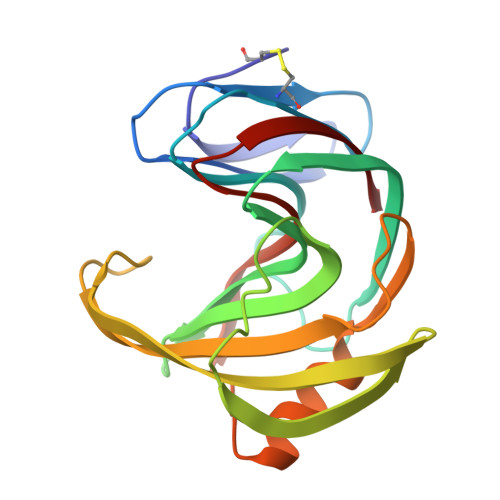
Enhancements of enzyme stability often compromise activity; thus, achieving an optimal balance between stability and activity poses a significant challenge in enzyme engineering. Our study investigated the stability-activity trade-off using the GH11 xylanase XynII as a model. A rational design strategy integrating crystal structure analysis and molecular dynamics simulations was used to distinguish regions important for structural stability and catalytic activity. Structural stability and activity were significantly enhanced by the introduction of two disulfide bonds involving four residues (T2C/T28C/R81C/T168C), which conferred a 75 % increase in activity, a 12.1 °C increase in T m , and an 80-fold improvement in half-life compared to the wild-type enzyme. The incorporation of two additional mutations (Q125A/I129S) was shown to increase the catalytic activity by 30 % by enhancing the dynamics of the active site. Our results illustrate a successful strategy for simultaneously increasing activity and stability by optimizing the dynamics of the catalytic region and the rigidity of the noncatalytic region.
- School of Biological Science, Jining Medical University, Rizhao 276827, China.
Organizational Affiliation: