Download Mendeley
Structural basis of transfer RNA processing by bacterial minimal RNase P.
Teramoto, T., Koyasu, T., Yokogawa, T., Adachi, N., Mayanagi, K., Nakamura, T., Senda, T., Kakuta, Y.(2025) Nat Commun 16: 5456-5456
- PubMed: 40593470 Search on PubMedSearch on PubMed Central
- DOI: https://doi.org/10.1038/s41467-025-60002-1
- Primary Citation Related Structures:
8KD9, 8KDA - PubMed Abstract:
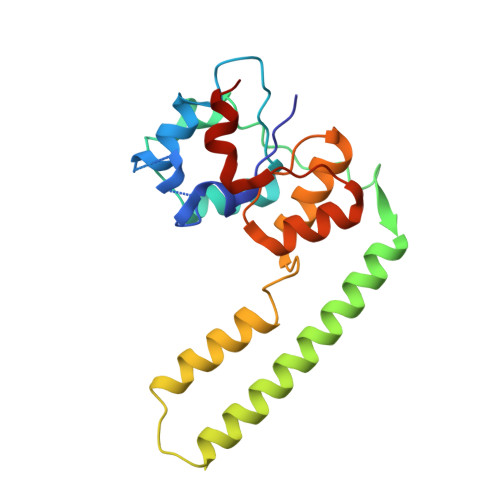
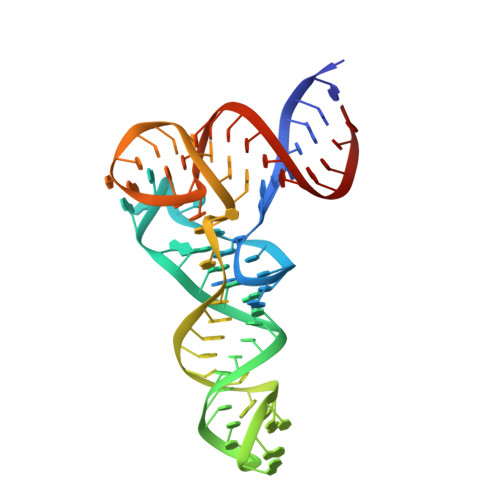
Precursor tRNAs (pre-tRNAs) require nucleolytic removal of 5'-leader and 3'-trailer sequences for maturation, which is essential for proper tRNA function. The endoribonuclease RNase P exists in diverse forms, including RNA- and protein-based RNase P, and removes 5'-leader sequences from pre-tRNAs. Some bacteria and archaea possess a unique minimal protein-based RNase P enzyme, HARP, which forms dodecamers with twelve active sites. Here, we present cryogenic electron microscopy structures of HARP dodecamers complexed with five pre-tRNAs, and we show that HARP oligomerization enables specific recognition of the invariant distance between the acceptor stem 5'-end and the TψC-loop, functioning as a molecular ruler-a feature representing convergent evolution among RNase P enzymes. The HARP dodecamer uses only five active sites for 5'-leader cleavage, while we identify a 3'-trailer cleavage activity in the remaining seven sites. This elucidation reveals how small proteins evolve through oligomerization to adapt a pivotal biological function (5'-leader processing) and acquire a novel function (3'-trailer processing).
- Laboratory of Biophysical Chemistry, Department of Bioscience and Biotechnology, Faculty of Agriculture, Kyushu University, 744 Moto-oka, Nishi-ku, Fukuoka, 819-0395, Japan. teramotot@agr.kyushu-u.ac.jp.
Organizational Affiliation: