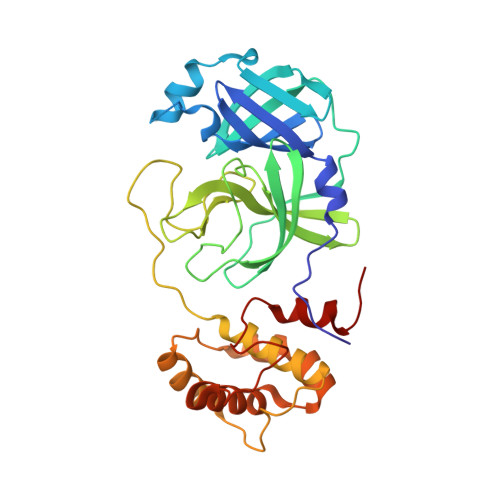
8K6B | pdb_00008k6b

Crystal structure of SARS-CoV-2 3CLpro M49K/M165V mutant


Experimental Data Snapshot

  • Method: X-RAY DIFFRACTION
  • Resolution: 1.50 Å
  • R-Value Free: 
    0.208 (Depositor), 0.193 (DCC) 
  • R-Value Work: 
    0.196 (Depositor) 
  • R-Value Observed: 
    0.197 (Depositor) 

Starting Model: experimental
View more details

wwPDB Validation 3D Report Full Report

Validation slider image for 8K6B

This is version 1.0 of the entry. See complete history

Literature

Resistance mechanisms of SARS-CoV-2 3CLpro to the non-covalent inhibitor WU-04.

Zhang, L.Xie, X.Luo, H.Qian, R.Yang, Y.Yu, H.Huang, J.Shi, P.Y.Hu, Q.

(2024) Cell Discov 10: 40-40

  • DOI: https://doi.org/10.1038/s41421-024-00673-0
  • Primary Citation Related Structures: 
    8K67, 8K68, 8K6A, 8K6B, 8K6C, 8K6D

  • PubMed Abstract: 

    Drug resistance poses a significant challenge in the development of effective therapies against SARS-CoV-2. Here, we identified two double mutations, M49K/M165V and M49K/S301P, in the 3C-like protease (3CLpro) that confer resistance to a novel non-covalent inhibitor, WU-04, which is currently in phase III clinical trials (NCT06197217). Crystallographic analysis indicates that the M49K mutation destabilizes the WU-04-binding pocket, impacting the binding of WU-04 more significantly than the binding of 3CLpro substrates. The M165V mutation directly interferes with WU-04 binding. The S301P mutation, which is far from the WU-04-binding pocket, indirectly affects WU-04 binding by restricting the rotation of 3CLpro's C-terminal tail and impeding 3CLpro dimerization. We further explored 3CLpro mutations that confer resistance to two clinically used inhibitors: ensitrelvir and nirmatrelvir, and revealed a trade-off between the catalytic activity, thermostability, and drug resistance of 3CLpro. We found that mutations at the same residue (M49) can have distinct effects on the 3CLpro inhibitors, highlighting the importance of developing multiple antiviral agents with different skeletons for fighting SARS-CoV-2. These findings enhance our understanding of SARS-CoV-2 resistance mechanisms and inform the development of effective therapeutics.


  • Organizational Affiliation
    • Zhejiang University, Hangzhou, Zhejiang, China.

Macromolecule Content 

  • Total Structure Weight: 33.79 kDa 
  • Atom Count: 2,529 
  • Modeled Residue Count: 298 
  • Deposited Residue Count: 306 
  • Unique protein chains: 1

Macromolecules

Find similar proteins by:|  3D Structure
Entity ID: 1
MoleculeChains  Sequence LengthOrganismDetailsImage
3C-like proteinase nsp5306Severe acute respiratory syndrome coronavirus 2Mutation(s): 2 
Gene Names: rep1a-1b
EC: 3.4.22.69
UniProt
Find proteins for P0DTD1 (Severe acute respiratory syndrome coronavirus 2)
Explore P0DTD1 
Go to UniProtKB:  P0DTD1
Entity Groups
Sequence Clusters30% Identity50% Identity70% Identity90% Identity95% Identity100% Identity
UniProt GroupP0DTD1
Sequence Annotations
Expand
Reference Sequence

Experimental Data & Validation

Experimental Data

  • Method: X-RAY DIFFRACTION
  • Resolution: 1.50 Å
  • R-Value Free:  0.208 (Depositor), 0.193 (DCC) 
  • R-Value Work:  0.196 (Depositor) 
  • R-Value Observed: 0.197 (Depositor) 
Space Group: I 1 2 1
Unit Cell:
Length ( Å )Angle ( ˚ )
a = 51.582α = 90
b = 80.113β = 96.866
c = 90.317γ = 90
Software Package:
Software NamePurpose
PHENIXrefinement
CrysalisProdata collection
CrysalisProdata reduction
CrysalisProdata scaling
PHENIXphasing

Structure Validation

View Full Validation Report


Entry History 

& Funding Information

Deposition Data


Funding OrganizationLocationGrant Number
Other privateChina--

Revision History  (Full details and data files)

  • Version 1.0: 2024-06-05
    Type: Initial release