Download Mendeley
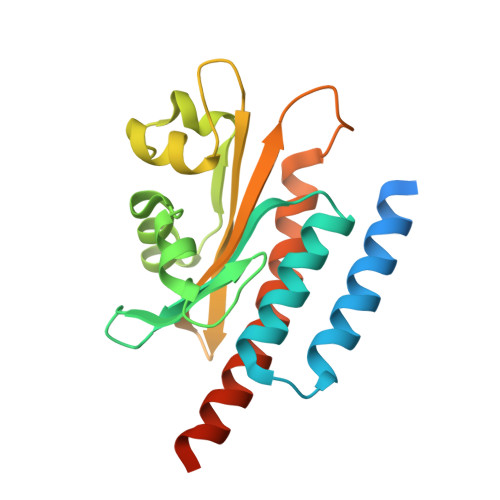
Formation of NifA-P II complex represses ammonium-sensitive nitrogen fixation in diazotrophic proteobacteria lacking NifL.
Zeng, Y., Guo, L., Gao, Y., Cui, L., Wang, M., Huang, L., Jiang, M., Liu, Y., Zhu, Y., Xiang, H., Li, D.F., Zheng, Y.(2024) Cell Rep 43: 114476-114476
- PubMed: 38985671 Search on PubMed
- DOI: https://doi.org/10.1016/j.celrep.2024.114476
- Primary Citation Related Structures:
8JRC - PubMed Abstract:
Biological nitrogen fixation catalyzed by nitrogenase contributes greatly to the global nitrogen cycle. Nitrogenase expression is subject to regulation in response to nitrogen availability. However, the mechanism through which the transcriptional activator NifA regulates nitrogenase expression by interacting with P II nitrogen regulatory proteins remains unclear in diazotrophic proteobacteria lacking NifL. Here, we demonstrate that in Rhodopseudomonas palustris grown with ammonium, NifA bound deuridylylated P II proteins to form an inactive NifA-P II complex, thereby inhibiting the expression of nitrogenase. Upon nitrogen limitation, the dissociation of uridylylated P II proteins from NifA resulted in the full restoration of NifA activity, and, simultaneously, uridylylation of the significantly up-regulated P II protein GlnK2 led to the increased expression of NifA in R. palustris. This insight into how NifA interacts with P II proteins and controls nitrogenase expression sets the stage for creating highly efficient diazotrophs, reducing the need for energy-intensive chemical fertilizers and helping to diminish carbon emissions.
- State Key Laboratory of Microbial Resources, Institute of Microbiology, Chinese Academy of Sciences, Beijing 100101, China.
Organizational Affiliation: