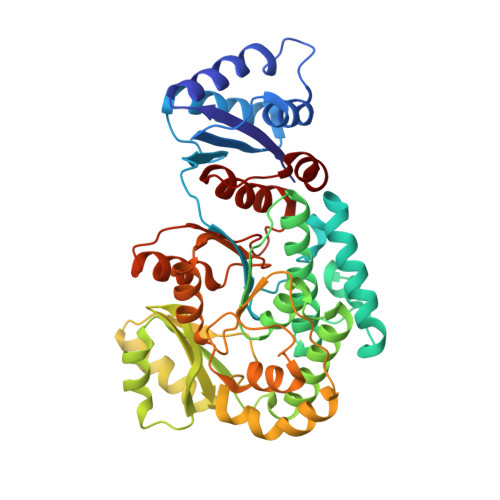
8JPT | pdb_00008jpt

Crystal Structure of the acyltransferase domain from the eighth module of the spinosad polyketide synthase


Experimental Data Snapshot

  • Method: X-RAY DIFFRACTION
  • Resolution: 3.26 Å
  • R-Value Free: 
    0.258 (Depositor), 0.260 (DCC) 
  • R-Value Work: 
    0.198 (Depositor), 0.210 (DCC) 
  • R-Value Observed: 
    0.201 (Depositor) 

Starting Model: in silico
View more details

wwPDB Validation   3D Report Full Report


This is version 1.1 of the entry. See complete history


Literature

Structural and computational insights into the substrate specificity of acyltransferase domains from modular polyketide synthases.

Huang, S.Ji, H.Zheng, J.

(2024) FEBS J 291: 3839-3855

  • DOI: https://doi.org/10.1111/febs.17206
  • Primary Citation of Related Structures:  
    8JPT, 8JPU

  • PubMed Abstract: 

    Polyketides are natural products synthesized by polyketide synthases (PKSs), where acyltransferase (AT) domains play a crucial role in selection of extender units. Engineering of AT domains enables the site-specific incorporation of non-natural extender units, leading to generation of novel derivatives. Here, we determined the crystal structures of AT domains from the fifth module of tylosin PKS (TylAT5) derived from Streptomyces fradiae and the eighth module of spinosad PKS (SpnAT8) derived from Saccharopolyspora spinosa, and combined them with molecular dynamics simulations and enzyme kinetic studies to elucidate the molecular basis of substrate selection. The ethylmalonyl-CoA-specific conserved motif TAGH of TylAT5 and the MMCoA-specific conserved motif YASH of SpnAT8 were identified within the substrate-binding pocket, and several key residues close to the substrate acyl moiety were located. Through site-directed mutagenesis of four residues near the active site, we successfully reprogrammed the specificity of these two AT domains toward malonyl-CoA. Mutations in TylAT5 enhanced its catalytic activity 2.6-fold toward malonyl-CoA, and mutations in SpnAT8 eliminated the substrate promiscuity. These results extend our understanding of AT substrate specificity and would benefit the engineering of PKSs.


  • Organizational Affiliation
    • State Key Laboratory of Microbial Metabolism, School of Life Sciences and Biotechnology, Shanghai Jiao Tong University, China.

Macromolecules
Find similar proteins by:  (by identity cutoff)  |  3D Structure
Entity ID: 1
MoleculeChains Sequence LengthOrganismDetailsImage
Polyene macrolide polyketide synthase
A, B, C
418Saccharopolyspora spinosaMutation(s): 0 
Gene Names: spnEA8926_6425
EC: 2.3.1.94
UniProt
Find proteins for Q9ALM2 (Saccharopolyspora spinosa)
Explore Q9ALM2 
Go to UniProtKB:  Q9ALM2
Entity Groups  
Sequence Clusters30% Identity50% Identity70% Identity90% Identity95% Identity100% Identity
UniProt GroupQ9ALM2
Sequence Annotations
Expand
  • Reference Sequence
Experimental Data & Validation

Experimental Data

  • Method: X-RAY DIFFRACTION
  • Resolution: 3.26 Å
  • R-Value Free:  0.258 (Depositor), 0.260 (DCC) 
  • R-Value Work:  0.198 (Depositor), 0.210 (DCC) 
  • R-Value Observed: 0.201 (Depositor) 
Space Group: C 1 2 1
Unit Cell:
Length ( Å )Angle ( ˚ )
a = 196.345α = 90
b = 154.723β = 92.09
c = 65.209γ = 90
Software Package:
Software NamePurpose
REFMACrefinement
HKL-2000data scaling
HKL-2000data reduction
PHASERphasing

Structure Validation

View Full Validation Report


Entry History & Funding Information

Deposition Data


Funding OrganizationLocationGrant Number
National Natural Science Foundation of China (NSFC)China32070040

Revision History  (Full details and data files)

  • Version 1.0: 2024-06-19
    Type: Initial release
  • Version 1.1: 2025-07-02
    Changes: Database references, Structure summary