Download Mendeley
Unveiling the structural mechanism of a G-quadruplex pH-Driven switch.
Galer, P., Wang, B., Plavec, J., Sket, P.(2023) Biochimie 214: 73-82
- PubMed: 37573019 Search on PubMed
- DOI: https://doi.org/10.1016/j.biochi.2023.08.002
- Primary Citation Related Structures:
8JIC, 8JIH - PubMed Abstract:
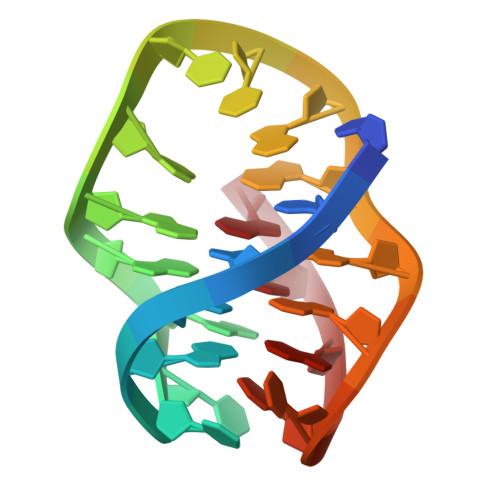
The human telomere oligonucleotide, d[TAGGG(TTAGGG) 2 TTAGG] (TAGGG), can adopt two distinct 2-G-quartet G-quadruplex structures at pH 7.0 and 5.0, referred to as the TD and KDH + forms, respectively. By using a combination of NMR and computational techniques, we determined high-resolution structures of both forms, which revealed unique loop architectures, base triples, and base pairs that play a crucial role in the pH-driven structural transformation of TAGGG. Our study demonstrated that TAGGG represents a reversible pH-driven switch system where the stability and pH-induced structural transformation of the G-quadruplexes are influenced by the terminal residues and base triples. Gaining insight into the factors that regulate the formation of G-quadruplexes and their pH-sensitive structural equilibrium holds great potential for the rational design of novel DNA based pH-driven switches. These advancements in understanding create exciting opportunities for applications in the field of nanotechnology, specifically in the development of bio-nano-motors.
- Slovenian NMR Center, National Institute of Chemistry, Hajdrihova 19, SI-1000, Ljubljana, Slovenia.
Organizational Affiliation: