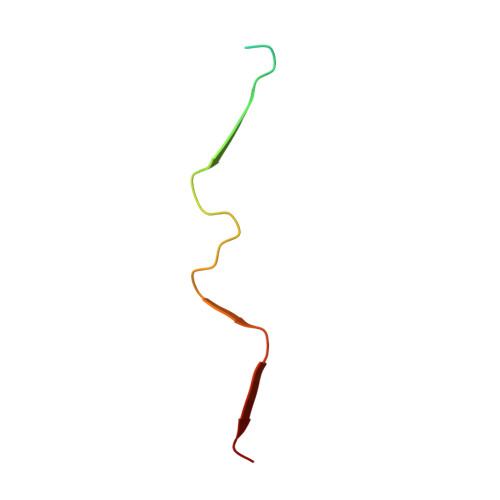
8J47 | pdb_00008j47

CryoEM Structure of 40-Residue Arctic (E22G) Beta-Amyloid Fibril Derived by Co-Analysis with Solid-State NMR | E22G Abeta40


Experimental Data Snapshot

  • Method: ELECTRON MICROSCOPY
  • Resolution: 2.50 Å
  • Aggregation State: FILAMENT 
  • Reconstruction Method: HELICAL 

wwPDB Validation 3D Report Full Report

Validation slider image for 8J47

This is version 1.1 of the entry. See complete history

Literature

E22G A beta 40 fibril structure and kinetics illuminate how A beta 40 rather than A beta 42 triggers familial Alzheimer's.

Tehrani, M.J.Matsuda, I.Yamagata, A.Kodama, Y.Matsunaga, T.Sato, M.Toyooka, K.McElheny, D.Kobayashi, N.Shirouzu, M.Ishii, Y.

(2024) Nat Commun 15: 7045-7045

  • DOI: https://doi.org/10.1038/s41467-024-51294-w
  • Primary Citation Related Structures: 
    8J47

  • PubMed Abstract: 

    Arctic (E22G) mutation in amyloid-β (Aβ enhances Aβ40 fibril accumulation in Alzheimer's disease (AD). Unlike sporadic AD, familial AD (FAD) patients with the mutation exhibit more Aβ40 in the plaque core. However, structural details of E22G Aβ40 fibrils remain elusive, hindering therapeutic progress. Here, we determine a distinctive W-shaped parallel β-sheet structure through co-analysis by cryo-electron microscopy (cryoEM) and solid-state nuclear magnetic resonance (SSNMR) of in-vitro-prepared E22G Aβ40 fibrils. The E22G Aβ40 fibrils displays typical amyloid features in cotton-wool plaques in the FAD, such as low thioflavin-T fluorescence and a less compact unbundled morphology. Furthermore, kinetic and MD studies reveal previously unidentified in-vitro evidence that E22G Aβ40, rather than Aβ42, may trigger Aβ misfolding in the FAD, and prompt subsequent misfolding of wild-type (WT) Aβ40/Aβ42 via cross-seeding. The results provide insight into how the Arctic mutation promotes AD via Aβ40 accumulation and cross-propagation.


  • Organizational Affiliation
    • School of Life Science and Technology, Tokyo Institute of Technology, 4259 Nagatsuta-cho, Midori-ku, Yokohama, Kanagawa, 226-8503, Japan.

Macromolecule Content 

  • Total Structure Weight: 42.64 kDa 
  • Atom Count: 2,080 
  • Modeled Residue Count: 290 
  • Deposited Residue Count: 400 
  • Unique protein chains: 1

Macromolecules

Find similar proteins by:|  3D Structure
Entity ID: 1
MoleculeChains  Sequence LengthOrganismDetailsImage
E22G Amyloid-beta40Homo sapiensMutation(s): 0 
UniProt
Find proteins for B7Z313 (Homo sapiens)
Explore B7Z313 
Go to UniProtKB:  B7Z313
Entity Groups
Sequence Clusters30% Identity50% Identity70% Identity90% Identity95% Identity100% Identity
UniProt GroupB7Z313
Sequence Annotations
Expand
Reference Sequence

Experimental Data & Validation

Experimental Data

  • Method: ELECTRON MICROSCOPY
  • Resolution: 2.50 Å
  • Aggregation State: FILAMENT 
  • Reconstruction Method: HELICAL 
EM Software:
TaskSoftware PackageVersion
MODEL REFINEMENTPHENIX

Structure Validation

View Full Validation Report


Entry History 

& Funding Information

Deposition Data


Funding OrganizationLocationGrant Number
National Institutes of Health/National Institute of General Medical Sciences (NIH/NIGMS)United States5U01GM098033
Japan Science and TechnologyJapanJPMJMI17A2, Japan
Japan Society for the Promotion of Science (JSPS)JapanJP22K18328, Japan
Japan Society for the Promotion of Science (JSPS)JapanJP21H05733

Revision History  (Full details and data files)

  • Version 1.0: 2024-09-11
    Type: Initial release
  • Version 1.1: 2024-09-18
    Changes: Data collection, Database references