Download Mendeley
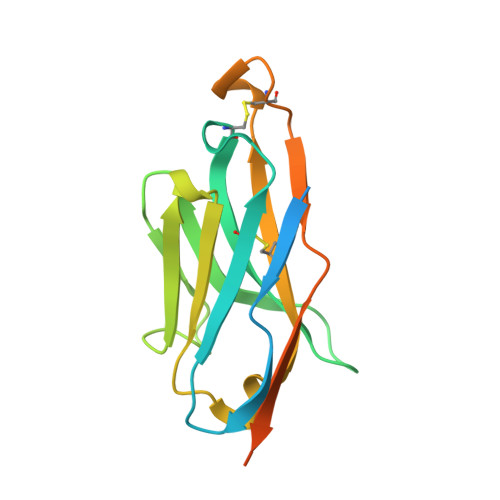
Molecular Evolution of Antiparathion Nanobody with Enhanced Sensitivity and Specificity Based on Structural Analysis.
Li, J.D., Shen, X., Xu, Z.L., Liang, Y.F., Shen, Y.D., Yang, J.Y., Wang, H.(2023) J Agric Food Chem 71: 14758-14768
- PubMed: 37768036 Search on PubMed
- DOI: https://doi.org/10.1021/acs.jafc.3c05176
- Primary Citation Related Structures:
8IRW - PubMed Abstract:
Nanobody (Nb) has gained significant attention in immunoassays owing to its numerous advantages, particularly its ease of molecular evolution. However, the limited understanding of how high sensitivity and specificity attained for antihapten Nbs hamper the development of high-performance Nbs. Herein, the antiparathion Nb (Nb9) we prepared previously was chosen as the model, and an approach based on X-ray crystallography, molecular docking, and rational site-directed saturation mutation for constructing a rapid and effective platform for nanobody evolution was described. Based on the structural analysis, two mutants, namely Nb-D5 (IC 50 = 2.4 ± 0.2 ng/mL) and Nb-D12 (IC 50 = 2.7 ± 0.1 ng/mL), were selected out from a six-sites directed saturation mutation library, 3.5-fold and 3.1-fold sensitivity enhancement over Nb9 to parathion, respectively. Besides, Nb-D12 exhibited improved sensitivity for quinalphos, triazophos, and coumaphos (5.4-35.4 ng/mL), indicating its broader detection potential. Overall, our study advances an effective strategy for the future rational evolution of Nbs with desirable performance.
- Guangdong Provincial Key Laboratory of Food Quality and Safety, National-Local Joint Engineering Research Center for Processing and Safety Control of Livestock and Poultry Products, College of Food Science, South China Agricultural University, Guangzhou 510642, China.
Organizational Affiliation: