Download Mendeley
Structure-function analysis of tRNA t 6 A-catalysis, assembly, and thermostability of Aquifex aeolicus TsaD 2 B 2 tetramer in complex with TsaE.
Lu, S., Jin, M., Yu, Z., Zhang, W.(2024) J Biol Chem 300: 107962-107962
- PubMed: 39510188 Search on PubMed
- DOI: https://doi.org/10.1016/j.jbc.2024.107962
- Primary Citation Related Structures:
8IEY, 8IFX - PubMed Abstract:
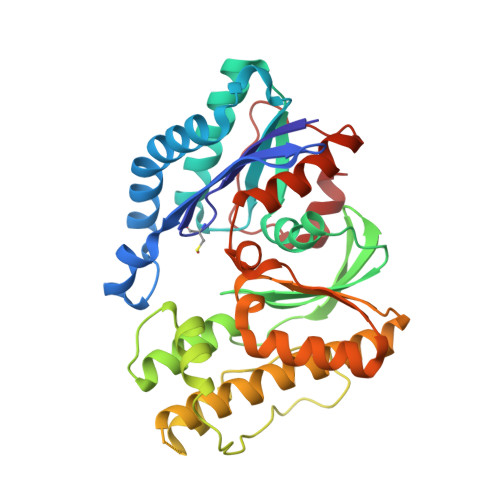
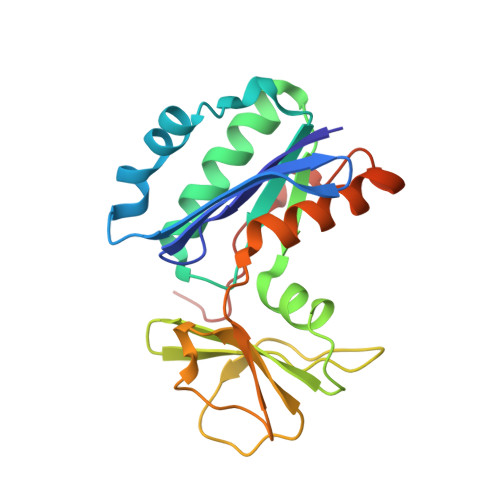
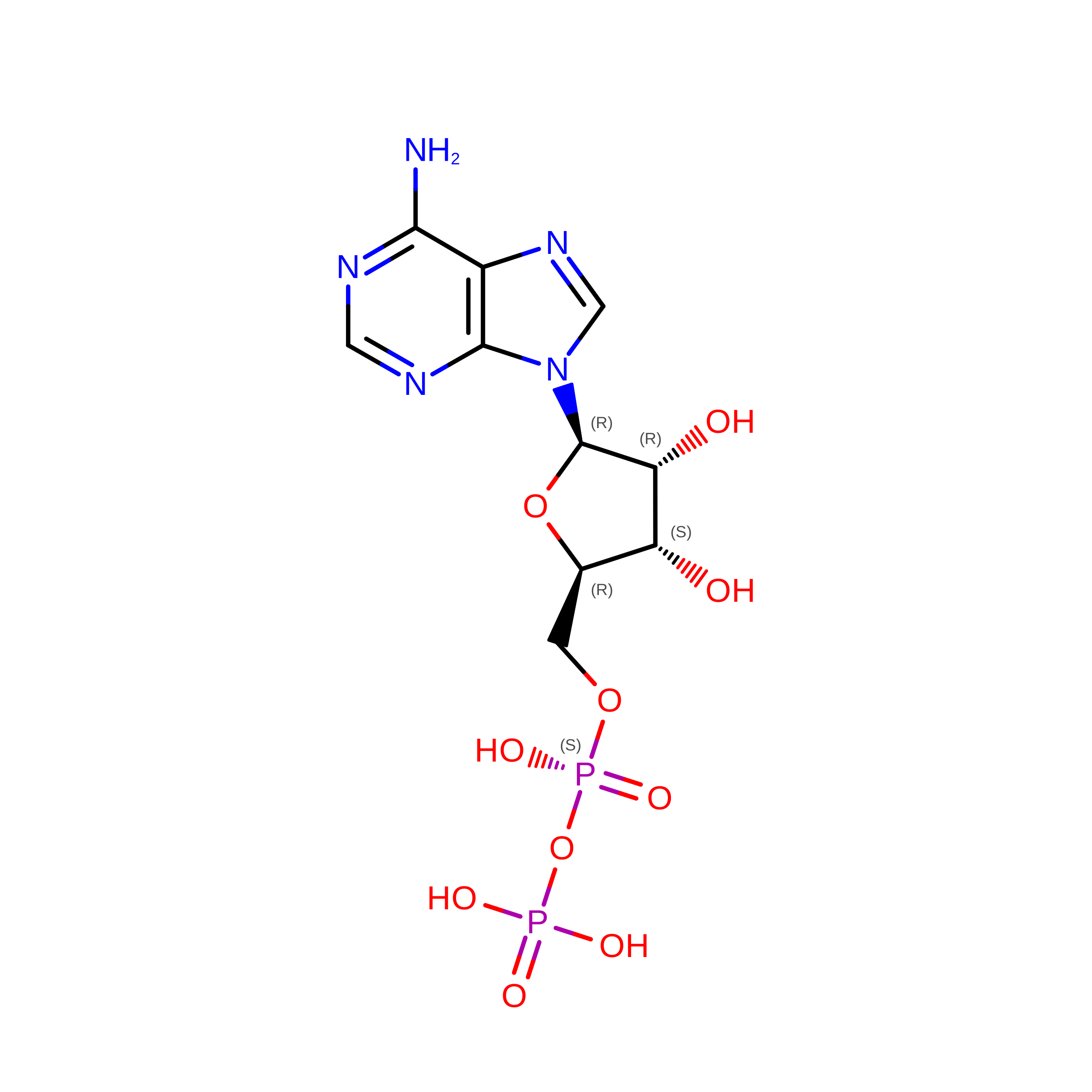
The universal N 6 -threonylcarbamoyladenosine (t 6 A) at position 37 of tRNAs is one of core post-transcriptional modifications that are needed for promoting translational fidelity. In bacteria, TsaC utilizes L-threonine, bicarbonate and ATP to generate an intermediate threonylcarbamoyladenylate (TC-AMP), of which the TC-moiety is transferred to N6 atom of tRNA A37 to generate t 6 A by TsaD with support of TsaB and TsaE. TsaD and TsaB form a TsaDB dimer to which tRNA and TsaE are competitively bound. The catalytic mechanism of TsaD and auxiliary roles of TsaB and TsaE remain to be fully elucidated. In this study, we reconstituted tRNA t 6 A biosynthesis using recombinant TsaC, TsaD-TsaB and TsaE from thermophilic Aquifex aeolicus and determined crystal structures of apo-form and ADP-bound form of TsaD 2 B 2 tetramer. Our TsaD 2 B 2 -TsaE-tRNA model coupled functional validations reveal that the binding of tRNA or TsaE to TsaDB is regulated by C-terminal tail of TsaB and a helical hairpin α1-α2 of TsaD. A. aeolicus TsaD 2 B 2 or TsaDB possesses a basal divalent ion-dependent t 6 A-catalytic activity that is stimulated by TsaE at the cost of ATP consumption. Our data suggest that binding of TsaE to TsaDB induces conformational changes of α1, α2, α6, α7 and α8 of TsaD and C-terminal tail of TsaB, leading to release of tRNA t 6 A and AMP. ATP hydrolysis-driven dissociation of TsaE from TsaDB resets an active conformation of TsaDB. Dimerization of thermophilic TsaDB enhances thermostability and promotes t 6 A-catalytic activity of TsaD 2 B 2 -tRNA, of which GC base pairs in anticodon stem are needed for correct folding of thermophilic tRNA at higher temperatures.
- School of Life Sciences, Key Laboratory of Cell Activities and Stress Adaptation of the Ministry of Education, Lanzhou University, Lanzhou, 730000, China.
Organizational Affiliation: