Download Mendeley
Structural and Biochemical Insights into Bis(2-hydroxyethyl) Terephthalate Degrading Carboxylesterase Isolated from Psychrotrophic Bacterium Exiguobacterium antarcticum.
Hwang, J., Yoo, W., Shin, S.C., Kim, K.K., Kim, H.W., Do, H., Lee, J.H.(2023) Int J Mol Sci 24
- PubMed: 37569396 Search on PubMedSearch on PubMed Central
- DOI: https://doi.org/10.3390/ijms241512022
- Primary Citation Related Structures:
8HEA - PubMed Abstract:
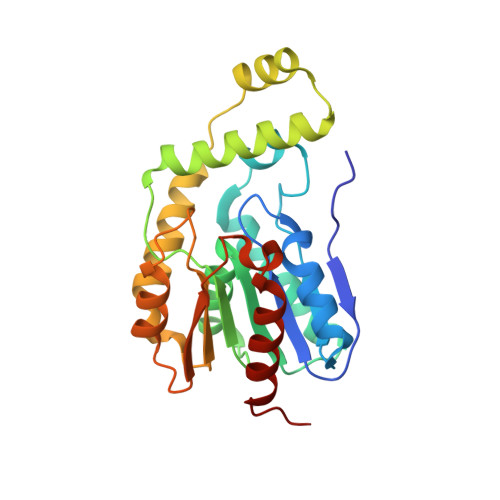
This study aimed to elucidate the crystal structure and biochemically characterize the carboxylesterase Ea Est2, a thermotolerant biocatalyst derived from Exiguobacterium antarcticum , a psychrotrophic bacterium. Sequence and phylogenetic analyses showed that Ea Est2 belongs to the Family XIII group of carboxylesterases. Ea Est2 has a broad range of substrate specificities for short-chain p -nitrophenyl ( p NP) esters, 1-naphthyl acetate (1-NA), and 1-naphthyl butyrate (1-NB). Its optimal pH is 7.0, losing its enzymatic activity at temperatures above 50 °C. Ea Est2 showed degradation activity toward bis(2-hydroxyethyl) terephthalate (BHET), a polyethylene terephthalate degradation intermediate. We determined the crystal structure of Ea Est2 at a 1.74 Å resolution in the ligand-free form to investigate BHET degradation at a molecular level. Finally, the biochemical stability and immobilization of a crosslinked enzyme aggregate (CLEA) were assessed to examine its potential for industrial application. Overall, the structural and biochemical characterization of Ea Est2 demonstrates its industrial potency as a biocatalyst.
- Research Unit of Cryogenic Novel Material, Korea Polar Research Institute, Incheon 21990, Republic of Korea.
Organizational Affiliation: