8H8N | pdb_00008h8n

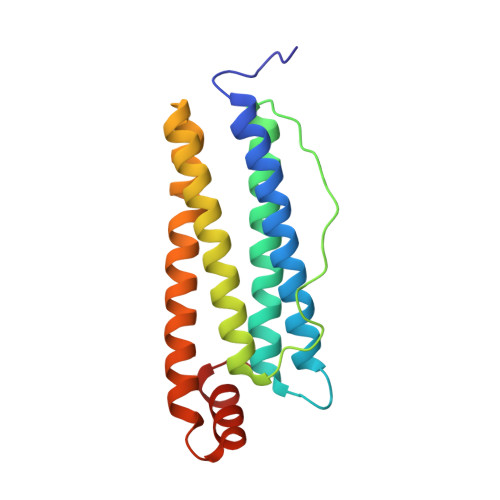
Crystal structure of apo-R52Y/E56Y/R59Y/E63Y-rHLFr


Experimental Data Snapshot

  • Method: X-RAY DIFFRACTION
  • Resolution: 1.50 Å
  • R-Value Free: 
    0.178 (Depositor), 0.178 (DCC) 
  • R-Value Work: 
    0.160 (Depositor), 0.160 (DCC) 

Starting Model: experimental
View more details

wwPDB Validation 3D Report Full Report

Validation slider image for 8H8N

This is version 1.1 of the entry. See complete history

Literature

Elucidating Conformational Dynamics and Thermostability of Designed Aromatic Clusters by Using Protein Cages.

Hishikawa, Y.Noya, H.Nagatoishi, S.Yoshidome, T.Maity, B.Tsumoto, K.Abe, S.Ueno, T.

(2023) Chemistry 29: e202300488-e202300488

  • DOI: https://doi.org/10.1002/chem.202300488
  • Primary Citation Related Structures: 
    8H8L, 8H8M, 8H8N, 8H8O

  • PubMed Abstract: 

    Multiple aromatic residues assemble to form higher ordered structures known as "aromatic clusters" in proteins and play essential roles in biological systems. However, the stabilization mechanism and dynamic behavior of aromatic clusters remain unclear. This study describes designed aromatic interactions confined within a protein cage to reveal how aromatic clusters affect protein stability. The crystal structures and calorimetric measurements indicate that the formation of inter-subunit phenylalanine clusters enhance the interhelix interactions and increase the melting temperature. Theoretical calculations suggest that this is caused by the transformation of the T-shaped geometry into π-π stacking at high temperatures, and the hydration entropic gain. Thus, the isolated nanoenvironment in a protein cage allows reconstruction and detailed analysis of multiple clustering residues for elucidating the mechanisms of various biomolecular interactions in nature which can be applied to design of bionanomaterials.


  • Organizational Affiliation
    • School of Life Science and Technology, Tokyo Institute of Technology, Nagatsuta-cho 4259-B55, Midori-ku, 226-8501, Yokohama, Japan.

Macromolecule Content 

  • Total Structure Weight: 21.11 kDa 
  • Atom Count: 1,775 
  • Modeled Residue Count: 174 
  • Deposited Residue Count: 174 
  • Unique protein chains: 1

Macromolecules

Find similar proteins by:|  3D Structure
Entity ID: 1
MoleculeChains  Sequence LengthOrganismDetailsImage
Ferritin light chain174Equus caballusMutation(s): 4 
Gene Names: FTL
UniProt
Find proteins for P02791 (Equus caballus)
Explore P02791 
Go to UniProtKB:  P02791
Entity Groups
Sequence Clusters30% Identity50% Identity70% Identity90% Identity95% Identity100% Identity
UniProt GroupP02791
Sequence Annotations
Expand
Reference Sequence

Small Molecules

Ligands 4 Unique
IDChains Name / Formula / InChI Key2D Diagram3D Interactions
CD

Query on CD


Download:Ideal Coordinates CCD File
D [auth A]
E [auth A]
F [auth A]
G [auth A]
H [auth A]
D [auth A],
E [auth A],
F [auth A],
G [auth A],
H [auth A],
I [auth A],
J [auth A],
K [auth A]
CADMIUM ION
Cd
WLZRMCYVCSSEQC-UHFFFAOYSA-N
SO4

Query on SO4


Download:Ideal Coordinates CCD File
L [auth A]SULFATE ION
O4 S
QAOWNCQODCNURD-UHFFFAOYSA-L
EDO

Query on EDO


Download:Ideal Coordinates CCD File
B [auth A],
C [auth A]
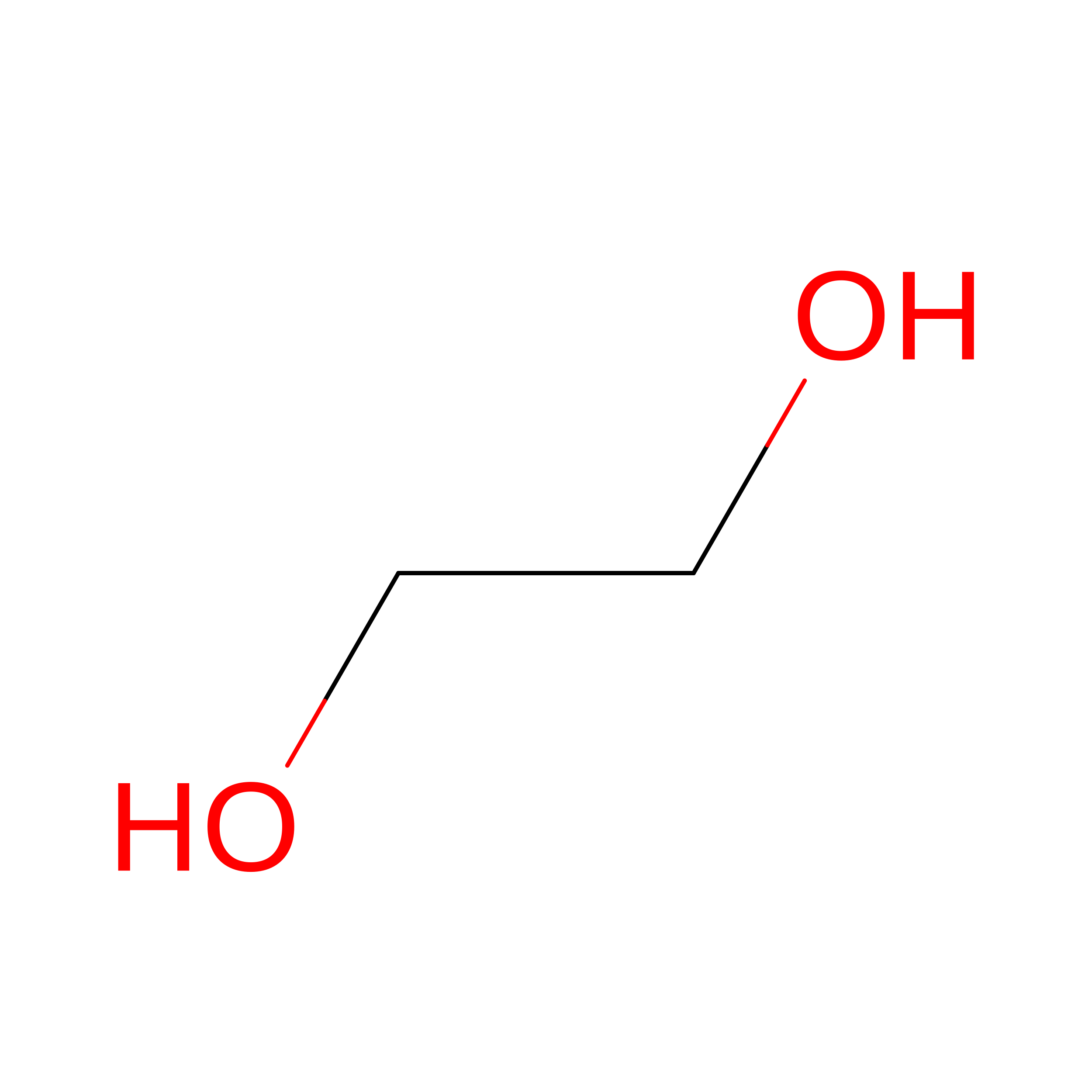
1,2-ETHANEDIOL
C2 H6 O2
LYCAIKOWRPUZTN-UHFFFAOYSA-N
CL

Query on CL


Download:Ideal Coordinates CCD File
M [auth A]CHLORIDE ION
Cl
VEXZGXHMUGYJMC-UHFFFAOYSA-M

Experimental Data & Validation

Experimental Data

  • Method: X-RAY DIFFRACTION
  • Resolution: 1.50 Å
  • R-Value Free:  0.178 (Depositor), 0.178 (DCC) 
  • R-Value Work:  0.160 (Depositor), 0.160 (DCC) 
Space Group: F 4 3 2
Unit Cell:
Length ( Å )Angle ( ˚ )
a = 181.877α = 90
b = 181.877β = 90
c = 181.877γ = 90
Software Package:
Software NamePurpose
REFMACrefinement
CrysalisProdata reduction
Aimlessdata scaling
MOLREPphasing

Structure Validation

View Full Validation Report


Entry History 

& Funding Information

Deposition Data


Funding OrganizationLocationGrant Number
Japan Society for the Promotion of Science (JSPS)Japan--

Revision History  (Full details and data files)

  • Version 1.0: 2023-10-04
    Type: Initial release
  • Version 1.1: 2026-03-04
    Changes: Refinement description, Structure summary