8GOP | pdb_00008gop

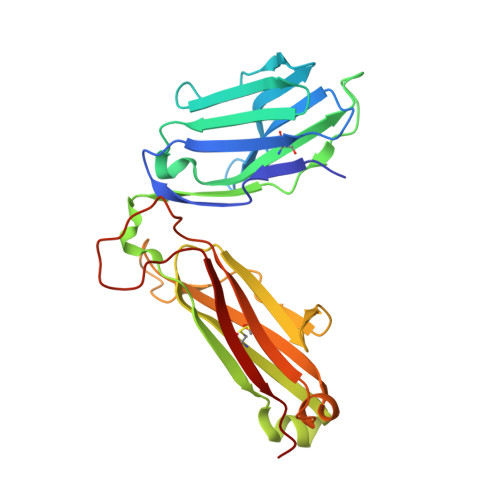
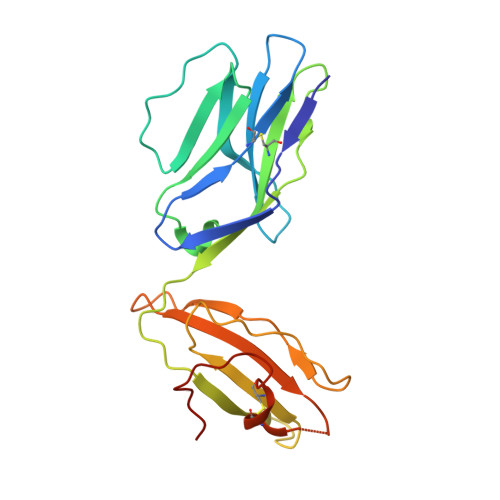
SARS-CoV-2 specific private TCR RLQ7

  • Classification: IMMUNE SYSTEM
  • Organism(s): Homo sapiens
  • Expression System: Escherichia coli
  • Mutation(s): No 

  • Deposited: 2022-08-25 Released: 2023-03-01 
  • Deposition Author(s): Wu, D., Mariuzza, R.A.
  • Funding Organization(s): National Institutes of Health/National Institute Of Allergy and Infectious Diseases (NIH/NIAID), National Institutes of Health/National Institute of General Medical Sciences (NIH/NIGMS), National Natural Science Foundation of China (NSFC)

Experimental Data Snapshot

  • Method: X-RAY DIFFRACTION
  • Resolution: 2.80 Å
  • R-Value Free: 
    0.286 (Depositor), 0.277 (DCC) 
  • R-Value Work: 
    0.231 (Depositor), 0.224 (DCC) 
  • R-Value Observed: 
    0.233 (Depositor) 

Starting Model: experimental
View more details

wwPDB Validation 3D Report Full Report

Validation slider image for 8GOP

This is version 1.4 of the entry. See complete history

Literature

Structural insights into protection against a SARS-CoV-2 spike variant by T cell receptor (TCR) diversity.

Wu, D.Efimov, G.A.Bogolyubova, A.V.Pierce, B.G.Mariuzza, R.A.

(2023) J Biological Chem 299: 103035-103035

  • DOI: https://doi.org/10.1016/j.jbc.2023.103035
  • Primary Citation Related Structures: 
    8GOM, 8GON, 8GOP

  • PubMed Abstract: 

    T cells play a crucial role in combatting SARS-CoV-2 and forming long-term memory responses to this coronavirus. The emergence of SARS-CoV-2 variants that can evade T cell immunity has raised concerns about vaccine efficacy and the risk of reinfection. Some SARS-CoV-2 T cell epitopes elicit clonally restricted CD8 + T cell responses characterized by T cell receptors (TCRs) that lack structural diversity. Mutations in such epitopes can lead to loss of recognition by most T cells specific for that epitope, facilitating viral escape. Here, we studied an HLA-A2-restricted spike protein epitope (RLQ) that elicits CD8 + T cell responses in COVID-19 convalescent patients characterized by highly diverse TCRs. We previously reported the structure of an RLQ-specific TCR (RLQ3) with greatly reduced recognition of the most common natural variant of the RLQ epitope (T1006I). Opposite to RLQ3, TCR RLQ7 recognizes T1006I with even higher functional avidity than the WT epitope. To explain the ability of RLQ7, but not RLQ3, to tolerate the T1006I mutation, we determined structures of RLQ7 bound to RLQ-HLA-A2 and T1006I-HLA-A2. These complexes show that there are multiple structural solutions to recognizing RLQ and thereby generating a clonally diverse T cell response to this epitope that assures protection against viral escape and T cell clonal loss.


  • Organizational Affiliation
    • Laboratory of Structural Immunology, Department of Hepatopancreatobiliary Surgery, The First Affiliated Hospital, Hengyang Medical School, University of South China, Hengyang, Hunan, China; W.M. Keck Laboratory for Structural Biology, University of Maryland Institute for Bioscience and Biotechnology Research, Rockville, Maryland, USA; Department of Cell Biology and Molecular Genetics, University of Maryland, College Park, Maryland, USA.

Macromolecule Content 

  • Total Structure Weight: 51.09 kDa 
  • Atom Count: 3,608 
  • Modeled Residue Count: 443 
  • Deposited Residue Count: 453 
  • Unique protein chains: 2

Macromolecules

Find similar proteins by:|  3D Structure
Entity ID: 1
MoleculeChains  Sequence LengthOrganismDetailsImage
SARS-CoV-2 specific private TCR RLQ7 betaA [auth B]246Homo sapiensMutation(s): 0 
Find similar proteins by:|  3D Structure
Entity ID: 2
MoleculeChains  Sequence LengthOrganismDetailsImage
SARS-CoV-2 specific private TCR RLQ7 alphaB [auth A]207Homo sapiensMutation(s): 0 

Experimental Data & Validation

Experimental Data

  • Method: X-RAY DIFFRACTION
  • Resolution: 2.80 Å
  • R-Value Free:  0.286 (Depositor), 0.277 (DCC) 
  • R-Value Work:  0.231 (Depositor), 0.224 (DCC) 
  • R-Value Observed: 0.233 (Depositor) 
Space Group: P 1 21 1
Unit Cell:
Length ( Å )Angle ( ˚ )
a = 52.178α = 90
b = 68.054β = 90.24
c = 63.878γ = 90
Software Package:
Software NamePurpose
PHENIXrefinement
PDB_EXTRACTdata extraction
XDSdata reduction
HKL-2000data scaling
PHENIXphasing

Structure Validation

View Full Validation Report


Entry History 

& Funding Information

Deposition Data


Funding OrganizationLocationGrant Number
National Institutes of Health/National Institute Of Allergy and Infectious Diseases (NIH/NIAID)United StatesAI129893
National Institutes of Health/National Institute of General Medical Sciences (NIH/NIGMS)United StatesGM126299
National Natural Science Foundation of China (NSFC)China32100985

Revision History  (Full details and data files)

  • Version 1.0: 2023-03-01
    Type: Initial release
  • Version 1.1: 2023-03-08
    Changes: Database references
  • Version 1.2: 2023-03-29
    Changes: Database references
  • Version 1.3: 2023-11-29
    Changes: Data collection, Refinement description
  • Version 1.4: 2024-10-30
    Changes: Structure summary