Download Mendeley
CFTR function, pathology and pharmacology at single-molecule resolution.
Levring, J., Terry, D.S., Kilic, Z., Fitzgerald, G., Blanchard, S., Chen, J.(2023) Nature 616: 606-614
- PubMed: 36949202 Search on PubMedSearch on PubMed Central
- DOI: https://doi.org/10.1038/s41586-023-05854-7
- Primary Citation Related Structures:
8FZQ - PubMed Abstract:
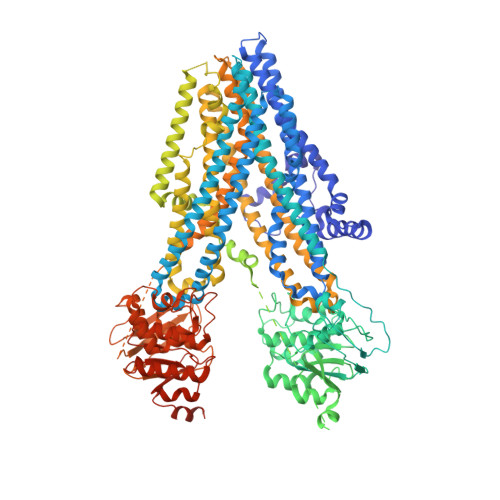
The cystic fibrosis transmembrane conductance regulator (CFTR) is an anion channel that regulates salt and fluid homeostasis across epithelial membranes 1 . Alterations in CFTR cause cystic fibrosis, a fatal disease without a cure 2,3 . Electrophysiological properties of CFTR have been analysed for decades 4-6 . The structure of CFTR, determined in two globally distinct conformations, underscores its evolutionary relationship with other ATP-binding cassette transporters. However, direct correlations between the essential functions of CFTR and extant structures are lacking at present. Here we combine ensemble functional measurements, single-molecule fluorescence resonance energy transfer, electrophysiology and kinetic simulations to show that the two nucleotide-binding domains (NBDs) of human CFTR dimerize before channel opening. CFTR exhibits an allosteric gating mechanism in which conformational changes within the NBD-dimerized channel, governed by ATP hydrolysis, regulate chloride conductance. The potentiators ivacaftor and GLPG1837 enhance channel activity by increasing pore opening while NBDs are dimerized. Disease-causing substitutions proximal (G551D) or distal (L927P) to the ATPase site both reduce the efficiency of NBD dimerization. These findings collectively enable the framing of a gating mechanism that informs on the search for more efficacious clinical therapies.
- Laboratory of Membrane Biology and Biophysics, The Rockefeller University, New York, NY, USA.
Organizational Affiliation: