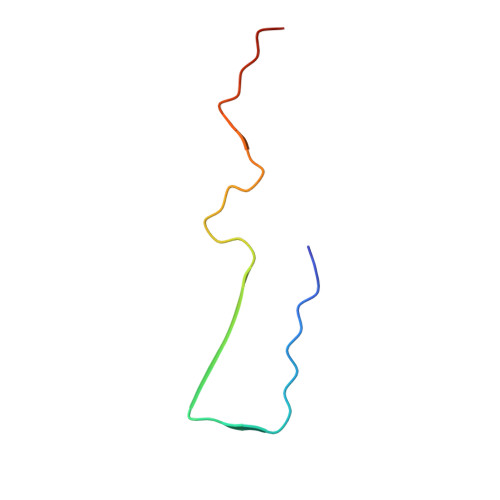
8FF2 | pdb_00008ff2

Amyloid-beta (1-40) fibrils derived from a CAA patient


Experimental Data Snapshot

  • Method: ELECTRON MICROSCOPY
  • Resolution: 2.87 Å
  • Aggregation State: FILAMENT 
  • Reconstruction Method: HELICAL 

Starting Model: experimental
View more details

wwPDB Validation 3D Report Full Report

Validation slider image for 8FF2

This is version 1.2 of the entry. See complete history

Literature

An electrostatic cluster guides A beta 40 fibril formation in sporadic and Dutch-type cerebral amyloid angiopathy.

Fu, Z.Crooks, E.J.Irizarry, B.A.Zhu, X.Chowdhury, S.Van Nostrand, W.E.Smith, S.O.

(2024) J Struct Biol 216: 108092-108092

  • DOI: https://doi.org/10.1016/j.jsb.2024.108092
  • Primary Citation Related Structures: 
    8FF2, 8FF3

  • PubMed Abstract: 

    Cerebral amyloid angiopathy (CAA) is associated with the accumulation of fibrillar Aβ peptides upon and within the cerebral vasculature, which leads to loss of vascular integrity and contributes to disease progression in Alzheimer's disease (AD). We investigate the structure of human-derived Aβ40 fibrils obtained from patients diagnosed with sporadic or familial Dutch-type (E22Q) CAA. Using cryo-EM, two primary structures are identified containing elements that have not been observed in in vitro Aβ40 fibril structures. One population has an ordered N-terminal fold comprised of two β-strands stabilized by electrostatic interactions involving D1, E22, D23 and K28. This charged cluster is disrupted in the second population, which exhibits a disordered N-terminus and is favored in fibrils derived from the familial Dutch-type CAA patient. These results illustrate differences between human-derived CAA and AD fibrils, and how familial CAA mutations can guide fibril formation.


  • Organizational Affiliation
    • Center for Structural Biology, Department of Biochemistry and Cell Biology, Stony Brook University, Stony Brook, NY 11794-5215, United States; Laboratory of Molecular Neurobiology and Biophysics, The Rockefeller University, New York, NY 10065, United States.

Macromolecule Content 

  • Total Structure Weight: 43.36 kDa 
  • Atom Count: 2,910 
  • Modeled Residue Count: 380 
  • Deposited Residue Count: 400 
  • Unique protein chains: 1

Macromolecules

Find similar proteins by:|  3D Structure
Entity ID: 1
MoleculeChains  Sequence LengthOrganismDetailsImage
Amyloid-beta precursor protein40Homo sapiensMutation(s): 0 
UniProt & NIH Common Fund Data Resources
Find proteins for P05067 (Homo sapiens)
Explore P05067 
Go to UniProtKB:  P05067
PHAROS:  P05067
GTEx:  ENSG00000142192 
Entity Groups
Sequence Clusters30% Identity50% Identity70% Identity90% Identity95% Identity100% Identity
UniProt GroupP05067
Sequence Annotations
Expand
Reference Sequence

Experimental Data & Validation

Experimental Data

  • Method: ELECTRON MICROSCOPY
  • Resolution: 2.87 Å
  • Aggregation State: FILAMENT 
  • Reconstruction Method: HELICAL 
EM Software:
TaskSoftware PackageVersion
MODEL REFINEMENTPHENIX1.19.1
MODEL REFINEMENTISOLDE1.4
RECONSTRUCTIONRELION3.1.1

Structure Validation

View Full Validation Report


Entry History 

& Funding Information

Deposition Data


Funding OrganizationLocationGrant Number
National Institutes of Health/National Institute on Aging (NIH/NIA)United StatesAG027317
National Institutes of Health/National Institute on Aging (NIH/NIA)United StatesAG061775

Revision History  (Full details and data files)

  • Version 1.0: 2023-12-06
    Type: Initial release
  • Version 1.1: 2024-04-24
    Changes: Database references
  • Version 1.2: 2024-05-01
    Changes: Database references