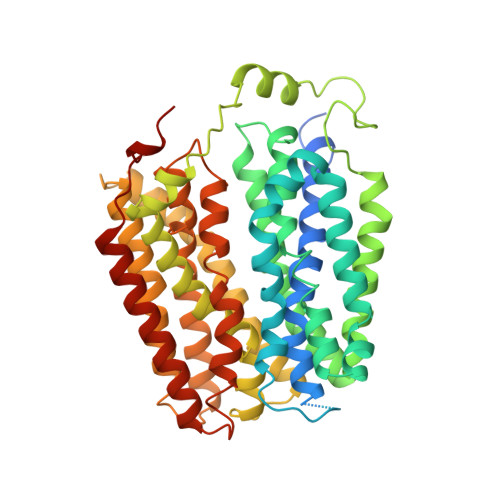
8DWI | pdb_00008dwi

Molecular Mechanism of Sialic Acid Transport Mediated by Sialin

  • Classification: MEMBRANE PROTEIN
  • Organism(s): Homo sapiens
  • Expression System: Escherichia coli
  • Mutation(s): No 
  • Membrane Protein: Yes  OPMPDBTMmpstruc

  • Deposited: 2022-08-01 Released: 2023-01-25 
  • Deposition Author(s): Hu, W., Zheng, H.
  • Funding Organization(s): National Institutes of Health/National Institute of General Medical Sciences (NIH/NIGMS), National Institutes of Health/National Institute on Aging (NIH/NIA), National Institutes of Health/National Heart, Lung, and Blood Institute (NIH/NHLBI)

Experimental Data Snapshot

  • Method: ELECTRON MICROSCOPY
  • Resolution: 3.40 Å
  • Aggregation State: PARTICLE 
  • Reconstruction Method: SINGLE PARTICLE 

wwPDB Validation 3D Report Full Report

Validation slider image for 8DWI

This is version 2.2 of the entry. See complete history

Literature

The molecular mechanism of sialic acid transport mediated by Sialin.

Hu, W.Chi, C.Song, K.Zheng, H.

(2023) Sci Adv 9: eade8346-eade8346

  • DOI: https://doi.org/10.1126/sciadv.ade8346
  • Primary Citation Related Structures: 
    8DWI

  • PubMed Abstract: 

    Malfunction of the sialic acid transporter caused by various genetic mutations in the SLC17A5 gene encoding Sialin leads to a spectrum of neurodegenerative conditions called free sialic acid storage disorders. Unfortunately, how Sialin transports sialic acid/proton (H + ) and how pathogenic mutations impair its function are poorly defined. Here, we present the structure of human Sialin in an inward-facing partially open conformation determined by cryo-electron microscopy, representing the first high-resolution structure of any human SLC17 member. Our analysis reveals two unique features in Sialin: (i) The H + coupling/sensing requires two highly conserved Glu residues (E171 and E175) instead of one (E175) as implied in previous studies; and (ii) the normal function of Sialin requires the stabilization of a cytosolic helix, which has not been noticed in the literature. By mapping known pathogenic mutations, we provide mechanistic explanations for corresponding functional defects. We propose a structure-based mechanism for sialic acid transport mediated by Sialin.


  • Organizational Affiliation
    • Department of Biochemistry and Molecular Genetics, University of Colorado Anschutz Medical Campus, School of Medicine, Aurora, CO, USA.

Macromolecule Content 

  • Total Structure Weight: 54.68 kDa 
  • Atom Count: 3,192 
  • Modeled Residue Count: 424 
  • Deposited Residue Count: 495 
  • Unique protein chains: 1

Macromolecules

Find similar proteins by:|  3D Structure
Entity ID: 1
MoleculeChains  Sequence LengthOrganismDetailsImage
Sialin495Homo sapiensMutation(s): 0 
Gene Names: SLC17A5
Membrane Entity: Yes 
UniProt & NIH Common Fund Data Resources
Find proteins for Q9NRA2 (Homo sapiens)
Explore Q9NRA2 
Go to UniProtKB:  Q9NRA2
PHAROS:  Q9NRA2
GTEx:  ENSG00000119899 
Entity Groups
Sequence Clusters30% Identity50% Identity70% Identity90% Identity95% Identity100% Identity
UniProt GroupQ9NRA2
Sequence Annotations
Expand
Reference Sequence

Experimental Data & Validation

Experimental Data

  • Method: ELECTRON MICROSCOPY
  • Resolution: 3.40 Å
  • Aggregation State: PARTICLE 
  • Reconstruction Method: SINGLE PARTICLE 
EM Software:
TaskSoftware PackageVersion
MODEL REFINEMENTPHENIX

Structure Validation

View Full Validation Report


Entry History 

& Funding Information

Deposition Data


Funding OrganizationLocationGrant Number
National Institutes of Health/National Institute of General Medical Sciences (NIH/NIGMS)United StatesGM126626
National Institutes of Health/National Institute on Aging (NIH/NIA)United StatesAG064672
National Institutes of Health/National Heart, Lung, and Blood Institute (NIH/NHLBI)United StatesHL133230

Revision History  (Full details and data files)

  • Version 1.0: 2023-01-25
    Type: Initial release
  • Version 1.1: 2023-02-01
    Changes: Database references
  • Version 2.0: 2023-02-22
    Type: Coordinate replacement
    Reason: Model completeness
    Changes: Advisory, Atomic model, Data collection, Database references, Derived calculations, Polymer sequence, Refinement description, Source and taxonomy, Structure summary
  • Version 2.1: 2024-06-12
    Changes: Data collection
  • Version 2.2: 2025-05-14
    Changes: Data collection, Structure summary