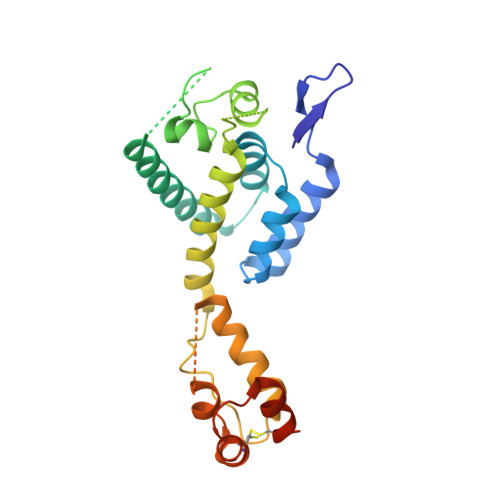
8D3B | pdb_00008d3b

Hexameric HIV-1 (M-group) Q50Y/R120 mutant


Experimental Data Snapshot

  • Method: X-RAY DIFFRACTION
  • Resolution: 3.30 Å
  • R-Value Free: 
    0.275 (Depositor), 0.273 (DCC) 
  • R-Value Work: 
    0.239 (Depositor), 0.239 (DCC) 
  • R-Value Observed: 
    0.241 (Depositor) 

Starting Model: experimental
View more details

wwPDB Validation 3D Report Full Report

Validation slider image for 8D3B

This is version 1.3 of the entry. See complete history

Literature

Evasion of cGAS and TRIM5 defines pandemic HIV.

Zuliani-Alvarez, L.Govasli, M.L.Rasaiyaah, J.Monit, C.Perry, S.O.Sumner, R.P.McAlpine-Scott, S.Dickson, C.Rifat Faysal, K.M.Hilditch, L.Miles, R.J.Bibollet-Ruche, F.Hahn, B.H.Boecking, T.Pinotsis, N.James, L.C.Jacques, D.A.Towers, G.J.

(2022) Nat Microbiol 7: 1762-1776

  • DOI: https://doi.org/10.1038/s41564-022-01247-0
  • Primary Citation Related Structures: 
    7QDF, 7T12, 7T13, 7T14, 7T15, 8D3B

  • PubMed Abstract: 

    Of the 13 known independent zoonoses of simian immunodeficiency viruses to humans, only one, leading to human immunodeficiency virus (HIV) type 1(M) has become pandemic, causing over 80 million human infections. To understand the specific features associated with pandemic human-to-human HIV spread, we compared replication of HIV-1(M) with non-pandemic HIV-(O) and HIV-2 strains in myeloid cell models. We found that non-pandemic HIV lineages replicate less well than HIV-1(M) owing to activation of cGAS and TRIM5-mediated antiviral responses. We applied phylogenetic and X-ray crystallography structural analyses to identify differences between pandemic and non-pandemic HIV capsids. We found that genetic reversal of two specific amino acid adaptations in HIV-1(M) enables activation of TRIM5, cGAS and innate immune responses. We propose a model in which the parental lineage of pandemic HIV-1(M) evolved a capsid that prevents cGAS and TRIM5 triggering, thereby allowing silent replication in myeloid cells. We hypothesize that this capsid adaptation promotes human-to-human spread through avoidance of innate immune response activation.


  • Organizational Affiliation
    • Division of Infection and Immunity, UCL, London, UK.

Macromolecule Content 

  • Total Structure Weight: 153.92 kDa 
  • Atom Count: 9,071 
  • Modeled Residue Count: 1,164 
  • Deposited Residue Count: 1,392 
  • Unique protein chains: 1

Macromolecules

Find similar proteins by:|  3D Structure
Entity ID: 1
MoleculeChains  Sequence LengthOrganismDetailsImage
Capsid protein p24
A, B, C, D, E
A, B, C, D, E, F
232Human immunodeficiency virus 1Mutation(s): 5 
Gene Names: gag
UniProt
Find proteins for P35962 (Human immunodeficiency virus type 1 group M subtype B (isolate YU-2))
Explore P35962 
Go to UniProtKB:  P35962
Entity Groups
Sequence Clusters30% Identity50% Identity70% Identity90% Identity95% Identity100% Identity
UniProt GroupP35962
Sequence Annotations
Expand
Reference Sequence

Experimental Data & Validation

Experimental Data

  • Method: X-RAY DIFFRACTION
  • Resolution: 3.30 Å
  • R-Value Free:  0.275 (Depositor), 0.273 (DCC) 
  • R-Value Work:  0.239 (Depositor), 0.239 (DCC) 
  • R-Value Observed: 0.241 (Depositor) 
Space Group: C 1 2 1
Unit Cell:
Length ( Å )Angle ( ˚ )
a = 90.92α = 90
b = 157.31β = 107.28
c = 120.4γ = 90
Software Package:
Software NamePurpose
Aimlessdata scaling
PHASERphasing
PHENIXrefinement
PDB_EXTRACTdata extraction
iMOSFLMdata reduction

Structure Validation

View Full Validation Report


Entry History 

& Funding Information

Deposition Data


Funding OrganizationLocationGrant Number
Australian Research Council (ARC)AustraliaDP180101384
National Health and Medical Research Council (NHMRC, Australia)AustraliaGNT1158338
Wellcome TrustUnited Kingdom214344/Z/18/Z
Wellcome TrustUnited Kingdom108183
Wellcome TrustUnited Kingdom220863
European Research Council (ERC)European Union339223

Revision History  (Full details and data files)

  • Version 1.0: 2022-10-19
    Type: Initial release
  • Version 1.1: 2022-11-09
    Changes: Database references
  • Version 1.2: 2023-10-18
    Changes: Data collection, Refinement description
  • Version 1.3: 2024-11-06
    Changes: Structure summary