8CN6 | pdb_00008cn6

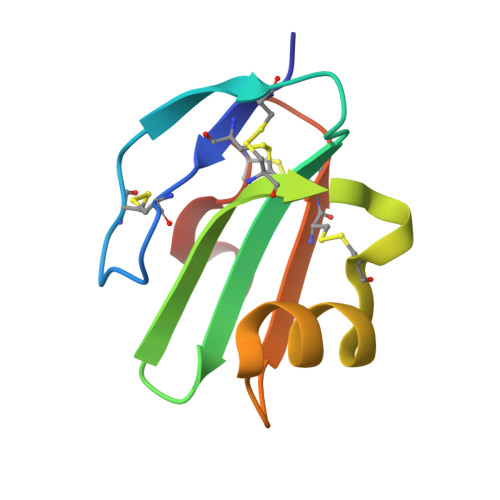
CD59 in complex with CP-06 peptide


Experimental Data Snapshot

  • Method: X-RAY DIFFRACTION
  • Resolution: 2.43 Å
  • R-Value Free: 
    0.298 (Depositor), 0.298 (DCC) 
  • R-Value Work: 
    0.235 (Depositor), 0.234 (DCC) 

Starting Model: experimental
View more details

wwPDB Validation 3D Report Full Report

Validation slider image for 8CN6

This is version 1.1 of the entry. See complete history

Literature

Macrocyclic Peptide Probes for Immunomodulatory Protein CD59: Potent Modulators of Bacterial Toxin Activity and Antibody-Dependent Cytotoxicity.

Bickel, J.K.Ahmed, A.I.S.Pidd, A.B.Morgan, R.M.McAllister, T.E.Horrell, S.Couves, E.C.Nagaraj, H.Bartlett, E.J.El Omari, K.Kawamura, A.Bubeck, D.Tate, E.W.

(2025) Angew Chem Int Ed Engl : e202422673-e202422673

  • DOI: https://doi.org/10.1002/anie.202422673
  • Primary Citation Related Structures: 
    8CN6

  • PubMed Abstract: 

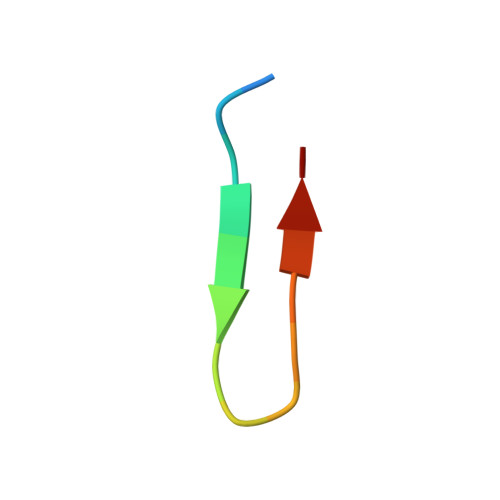
    CD59 is an immunomodulatory cell surface receptor associated with human disease. Despite its importance in complement regulation and bacterial pathogenesis, CD59 remains a challenging therapeutic target. Research to date has focused on antibody or protein-based strategies. Here we present a new approach to target CD59 using macrocyclic peptides with low nanomolar affinity for CD59. Through X-ray crystallographic studies and structure-activity relationship (SAR) studies, we identify key interactions that are essential for binding and activity. We find that the macrocyclic peptide CP-06 adopts a beta-hairpin structure and binds CD59 through an intermolecular beta-sheet, mimicking protein-protein interactions of biologically relevant CD59 interaction partners. We create dimeric and lipidated macrocyclic peptide conjugates as enhanced cell-active CD59 inhibitors and show that these probes can be used to modulate both complement-mediated killing of human cells and lytic activity of bacterial virulence factors. Together, our data provide a starting point for future development of macrocyclic peptides to target CD59 activity in diverse cellular contexts.


  • Organizational Affiliation
    • Department of Chemistry, Molecular Sciences Research Hub, Imperial College London, London, W12 0BZ, UK.

Macromolecule Content 

  • Total Structure Weight: 59.11 kDa 
  • Atom Count: 4,063 
  • Modeled Residue Count: 507 
  • Deposited Residue Count: 510 
  • Unique protein chains: 2

Macromolecules

Find similar proteins by:|  3D Structure
Entity ID: 1
MoleculeChains  Sequence LengthOrganismDetailsImage
CD59 glycoprotein
A, B, C, D, E
A, B, C, D, E, F
77Homo sapiensMutation(s): 0 
Gene Names: CD59MIC11MIN1MIN2MIN3MSK21
UniProt & NIH Common Fund Data Resources
Find proteins for P13987 (Homo sapiens)
Explore P13987 
Go to UniProtKB:  P13987
PHAROS:  P13987
GTEx:  ENSG00000085063 
Entity Groups
Sequence Clusters30% Identity50% Identity70% Identity90% Identity95% Identity100% Identity
UniProt GroupP13987
Sequence Annotations
Expand
Reference Sequence
Find similar proteins by:  Sequence   |   3D Structure  
Entity ID: 2
MoleculeChains  Sequence LengthOrganismDetailsImage
Cyclic peptide CP-06G [auth J],
H [auth G],
I [auth H]
16synthetic constructMutation(s): 0 

Experimental Data & Validation

Experimental Data

  • Method: X-RAY DIFFRACTION
  • Resolution: 2.43 Å
  • R-Value Free:  0.298 (Depositor), 0.298 (DCC) 
  • R-Value Work:  0.235 (Depositor), 0.234 (DCC) 
Space Group: P 1 21 1
Unit Cell:
Length ( Å )Angle ( ˚ )
a = 30.94α = 90
b = 85.88β = 90.03
c = 96.57γ = 90
Software Package:
Software NamePurpose
REFMACrefinement
xia2data reduction
Aimlessdata scaling
PHASERphasing

Structure Validation

View Full Validation Report


Entry History 

& Funding Information

Deposition Data


Funding OrganizationLocationGrant Number
European Research Council (ERC)European Union864751
Cancer Research UKUnited KingdomC24523/A26234
Engineering and Physical Sciences Research CouncilUnited KingdomEP/L015498/1

Revision History  (Full details and data files)

  • Version 1.0: 2024-11-13
    Type: Initial release
  • Version 1.1: 2025-05-28
    Changes: Database references