Download Mendeley
The battle for silver binding: How the interplay between the SilE, SilF, and SilB proteins contributes to the silver efflux pump mechanism.
Arrault, C., Monneau, Y.R., Martin, M., Cantrelle, F.X., Boll, E., Chirot, F., Comby Zerbino, C., Walker, O., Hologne, M.(2023) J Biol Chem 299: 105004-105004
- PubMed: 37394004 Search on PubMedSearch on PubMed Central
- DOI: https://doi.org/10.1016/j.jbc.2023.105004
- Primary Citation Related Structures:
8BXJ, 8C2Q - PubMed Abstract:
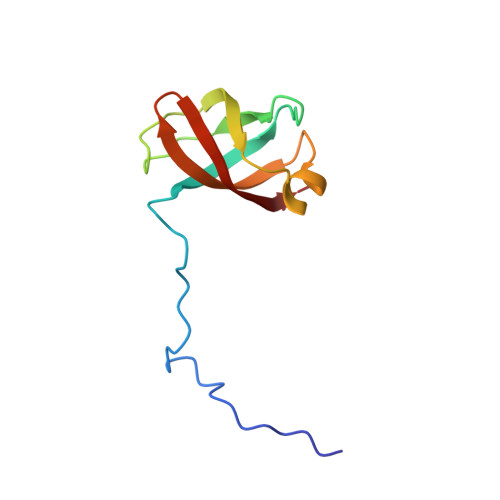
The resistance of gram-negative bacteria to silver ions is mediated by a silver efflux pump, which mainly relies on a tripartite efflux complex SilCBA, a metallochaperone SilF and an intrinsically disordered protein SilE. However, the precise mechanism by which silver ions are extruded from the cell and the different roles of SilB, SilF, and SilE remain poorly understood. To address these questions, we employed nuclear magnetic resonance and mass spectrometry to investigate the interplay between these proteins. We first solved the solution structures of SilF in its free and Ag + -bound forms, and we demonstrated that SilB exhibits two silver binding sites in its N and C termini. Conversely to the homologous Cus system, we determined that SilF and SilB interact without the presence of silver ions and that the rate of silver dissociation is eight times faster when SilF is bound to SilB, indicating the formation of a SilF-Ag-SilB intermediate complex. Finally, we have shown that SilE does not bind to either SilF or SilB, regardless of the presence or absence of silver ions, further corroborating that it merely acts as a regulator that prevents the cell from being overloaded with silver. Collectively, we have provided further insights into protein interactions within the sil system that contribute to bacterial resistance to silver ions.
- Université de Lyon, CNRS, UCB Lyon1, Institut des Sciences Analytiques, UMR5280, Villeurbanne, France.
Organizational Affiliation: