8ABD | pdb_00008abd

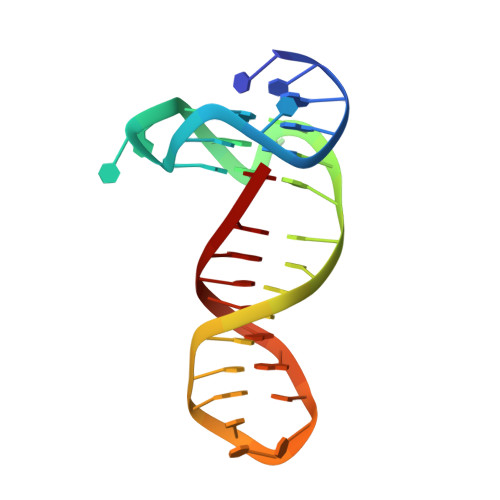
Solution structure of Phen-DC3 intercalating into a quadruplex-duplex hybrid

  • Classification: DNA
  • Organism(s): synthetic construct
  • Mutation(s): No 

  • Deposited: 2022-07-04 Released: 2022-11-02 
  • Deposition Author(s): Vianney, Y.M., Weisz, K.
  • Funding Organization(s): German Research Foundation (DFG)

Experimental Data Snapshot

  • Method: SOLUTION NMR
  • Conformers Calculated: 10 
  • Conformers Submitted: 10 
  • Selection Criteria: structures with the lowest energy 

wwPDB Validation 3D Report Full Report

Validation slider image for 8ABD

This is version 2.0 of the entry. See complete history

Literature

High-affinity binding at quadruplex-duplex junctions: rather the rule than the exception.

Vianney, Y.M.Weisz, K.

(2022) Nucleic Acids Res 50: 11948-11964

  • DOI: https://doi.org/10.1093/nar/gkac1088
  • Primary Citation Related Structures: 
    8ABD, 8ABN

  • PubMed Abstract: 

    Quadruplex-duplex (Q-D) junctions constitute unique structural motifs in genomic sequences. Through comprehensive calorimetric as well as high-resolution NMR structural studies, Q-D junctions with a hairpin-type snapback loop coaxially stacked onto an outer G-tetrad were identified to be most effective binding sites for various polycyclic quadruplex ligands. The Q-D interface is readily recognized by intercalation of the ligand aromatic core structure between G-tetrad and the neighboring base pair. Based on the thermodynamic and structural data, guidelines for the design of ligands with enhanced selectivity towards a Q-D interface emerge. Whereas intercalation at Q-D junctions mostly outcompete stacking at the quadruplex free outer tetrad or intercalation between duplex base pairs to varying degrees, ligand side chains considerably contribute to the selectivity for a Q-D target over other binding sites. In contrast to common perceptions, an appended side chain that additionally interacts within the duplex minor groove may confer only poor selectivity. Rather, the Q-D selectivity is suggested to benefit from an extension of the side chain towards the exposed part of the G-tetrad at the junction. The presented results will support the design of selective high-affinity binding ligands for targeting Q-D interfaces in medicinal but also technological applications.


  • Organizational Affiliation
    • Institute of Biochemistry, Universität Greifswald, Felix-Hausdorff-Str. 4, D-17489 Greifswald, Germany.

Macromolecule Content 

  • Total Structure Weight: 11.76 kDa 
  • Atom Count: 792 
  • Modeled Residue Count: 36 
  • Deposited Residue Count: 36 
  • Unique nucleic acid chains: 1

Macromolecules

Find similar nucleic acids by:  (by identity cutoff) 
Entity ID: 1
MoleculeChains LengthOrganismImage
DNA (36-MER)36synthetic construct
Sequence Annotations
Expand
Reference Sequence

Small Molecules

Ligands 1 Unique
IDChains Name / Formula / InChI Key2D Diagram3D Interactions
PQ3
(Subject of Investigation/LOI)

Query on PQ3


Download:Ideal Coordinates CCD File
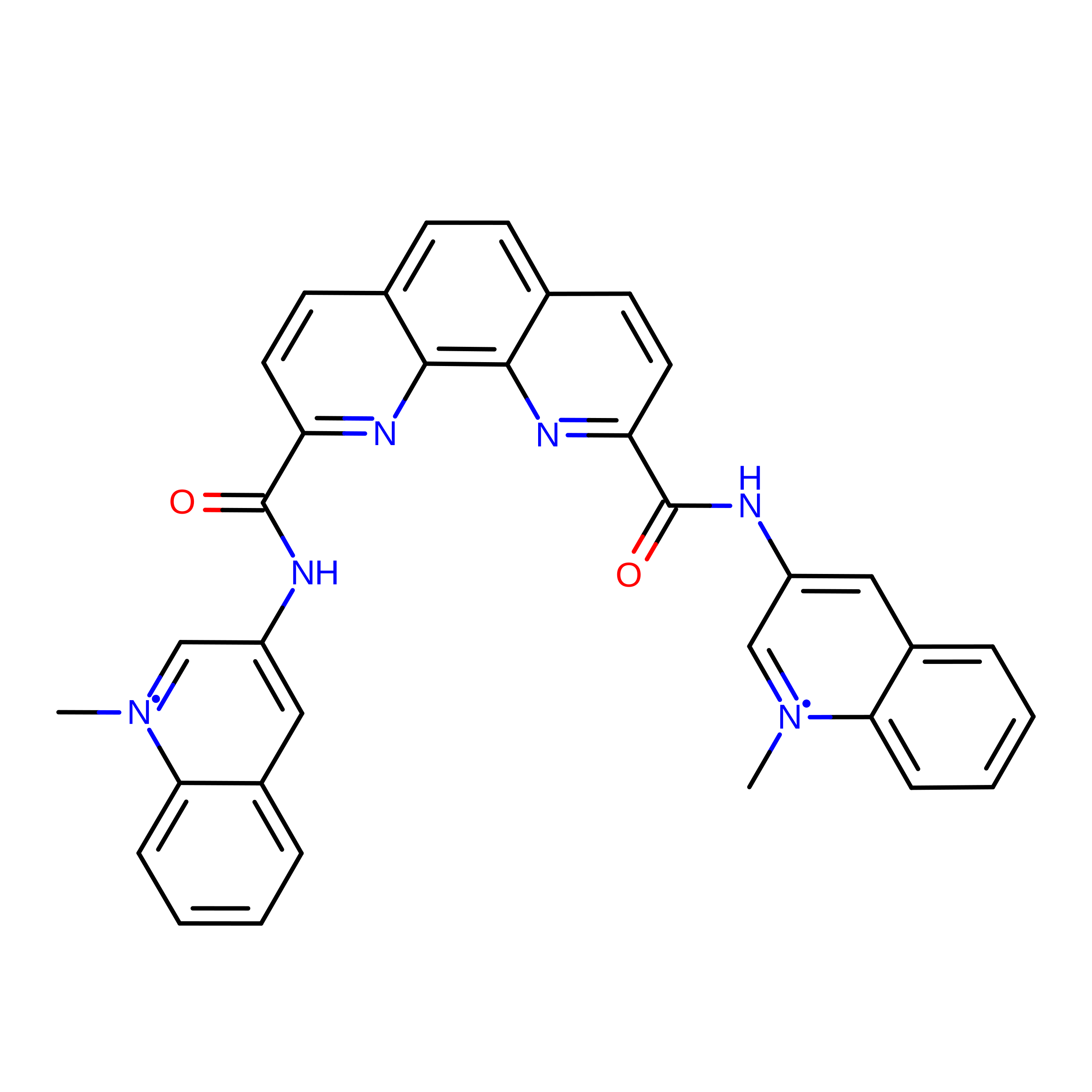
B [auth A]N2,N9-bis(1-methylquinolin-3-yl)-1,10-phenanthroline-2,9-dicarboxamide
C34 H26 N6 O2
CTOLNXAGCUTHBW-UHFFFAOYSA-P

Experimental Data & Validation

Experimental Data

  • Method: SOLUTION NMR
  • Conformers Calculated: 10 
  • Conformers Submitted: 10 
  • Selection Criteria: structures with the lowest energy 

Structure Validation

View Full Validation Report


Entry History 

& Funding Information

Deposition Data


Funding OrganizationLocationGrant Number
German Research Foundation (DFG)Germany410497337

Revision History  (Full details and data files)

  • Version 1.0: 2022-11-02
    Type: Initial release
  • Version 1.1: 2022-12-07
    Changes: Database references
  • Version 1.2: 2022-12-14
    Changes: Database references
  • Version 2.0: 2024-05-15
    Changes: Data collection, Database references, Non-polymer description