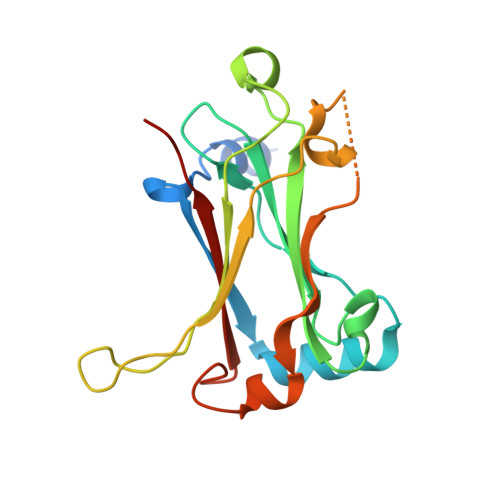
7YPC | pdb_00007ypc

Notothenia coriiceps TRAF4


Experimental Data Snapshot

  • Method: X-RAY DIFFRACTION
  • Resolution: 2.66 Å
  • R-Value Free: 
    0.228 (Depositor), 0.231 (DCC) 
  • R-Value Work: 
    0.207 (Depositor), 0.210 (DCC) 
  • R-Value Observed: 
    0.208 (Depositor) 

Starting Model: experimental
View more details

wwPDB Validation 3D Report Full Report

Validation slider image for 7YPC

This is version 1.1 of the entry. See complete history

Literature

Structure of fish TRAF4 and its implication in TRAF4-mediated immune cell and platelet signaling.

Kim, C.M.Jang, H.Hong, E.Lee, J.H.Park, H.H.

(2023) Fish Shellfish Immunol 132: 108462-108462

  • DOI: https://doi.org/10.1016/j.fsi.2022.108462
  • Primary Citation Related Structures: 
    7YPC

  • PubMed Abstract: 

    Due to an increasing interest in immunity and signal transduction in teleost fish, important key signaling molecules associated with the immune response, including TRAF molecules, have been recently cloned and characterized. To better understand the role of TRAF4 in fish immune signaling and compare it with the human system, our study cloned the TRAF4 gene from the Antarctic yellowbelly rockcod Notothenia coriiceps (ncTRAF4) and purified the protein. Here, we report the first crystal structure of teleost fish TRAF4. Based on biochemical characterization, our findings elucidated the mechanisms through which signaling molecules gain cold adaptivity. Additionally, we identified a platelet receptor GPIbβ homolog in N. coriiceps (ncGPIbβ) and found that the "RRFERLFKEARRTS" region of this homolog directly binds to ncTRAF4, indicating that ncTRAF4 also recognizes the "RLXA" motif for receptor interactions and further TARF4-mediated cellular signaling. Collectively, our findings provide novel insights into the mechanisms of TRAF4-mediated immune cell and platelet signaling in fish and the structural flexibility-mediated cold adaptiveness of signaling molecules.


  • Organizational Affiliation
    • College of Pharmacy, Chung-Ang University, Seoul, 06974, Republic of Korea.

Macromolecule Content 

  • Total Structure Weight: 66.44 kDa 
  • Atom Count: 4,054 
  • Modeled Residue Count: 492 
  • Deposited Residue Count: 570 
  • Unique protein chains: 1

Macromolecules

Find similar proteins by:|  3D Structure
Entity ID: 1
MoleculeChains  Sequence LengthOrganismDetailsImage
TNF receptor-associated factor
A, B, C
190Notothenia coriicepsMutation(s): 0 
Gene Names: traf4
UniProt
Find proteins for A0A6I9N9S6 (Notothenia coriiceps)
Explore A0A6I9N9S6 
Go to UniProtKB:  A0A6I9N9S6
Entity Groups
Sequence Clusters30% Identity50% Identity70% Identity90% Identity95% Identity100% Identity
UniProt GroupA0A6I9N9S6
Sequence Annotations
Expand
Reference Sequence

Experimental Data & Validation

Experimental Data

  • Method: X-RAY DIFFRACTION
  • Resolution: 2.66 Å
  • R-Value Free:  0.228 (Depositor), 0.231 (DCC) 
  • R-Value Work:  0.207 (Depositor), 0.210 (DCC) 
  • R-Value Observed: 0.208 (Depositor) 
Space Group: P 21 21 21
Unit Cell:
Length ( Å )Angle ( ˚ )
a = 111.859α = 90
b = 112.208β = 90
c = 112.036γ = 90
Software Package:
Software NamePurpose
PHENIXrefinement
PDB_EXTRACTdata extraction
HKL-2000data reduction
HKL-2000data scaling
PHASERphasing

Structure Validation

View Full Validation Report


Entry History 

& Funding Information

Deposition Data


Funding OrganizationLocationGrant Number
National Research Foundation (NRF, Korea)Korea, Republic Of--

Revision History  (Full details and data files)

  • Version 1.0: 2023-07-12
    Type: Initial release
  • Version 1.1: 2023-11-29
    Changes: Data collection, Refinement description