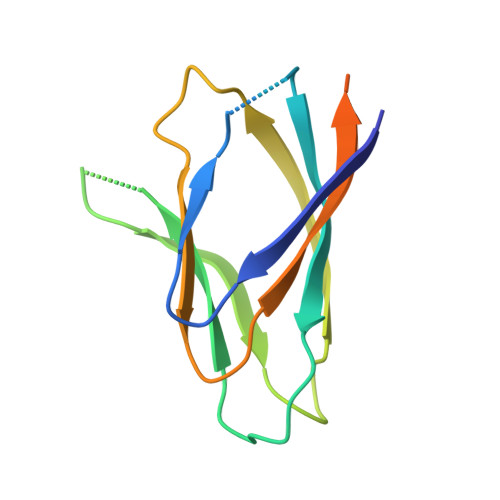
7WIM | pdb_00007wim

Crystal structure of Arabidopsis thaliana FKBP43 N-terminal domain


Experimental Data Snapshot

  • Method: X-RAY DIFFRACTION
  • Resolution: 2.29 Å
  • R-Value Free: 
    0.258 (Depositor), 0.265 (DCC) 
  • R-Value Work: 
    0.223 (Depositor), 0.236 (DCC) 
  • R-Value Observed: 
    0.224 (Depositor) 

Starting Model: experimental
View more details

wwPDB Validation 3D Report Full Report

Validation slider image for 7WIM

This is version 1.1 of the entry. See complete history

Literature

The plant nucleoplasmin AtFKBP43 needs its extended arms for histone interaction.

Singh, A.K.Saharan, K.Baral, S.Vasudevan, D.

(2022) Biochim Biophys Acta Gene Regul Mech 1865: 194872-194872

  • DOI: https://doi.org/10.1016/j.bbagrm.2022.194872
  • Primary Citation Related Structures: 
    7WIM

  • PubMed Abstract: 

    The nucleoplasmin family of histone chaperones is a key player in governing the dynamic architecture of chromatin, thereby regulating various DNA-templated processes. The crystal structure of the N-terminal domain of Arabidopsis thaliana FKBP43 (AtFKBP43), an FK506-binding immunophilin protein, revealed a characteristic nucleoplasmin fold, thus confirming it to be a member of the FKBP nucleoplasmin class. Small-Angle X-ray Scattering (SAXS) analyses confirmed its pentameric nature in solution, and additional studies confirmed the nucleoplasmin fold to be highly stable. Unlike its homolog AtFKBP53, the AtFKBP43 nucleoplasmin core domain could not interact with histones and required the acidic arms, C-terminal to the core, for histone association. However, SAXS generated low-resolution envelope structure, ITC, and AUC results revealed that an AtFKBP43 pentamer with C-terminal extensions interacts with H2A/H2B dimer and H3/H4 tetramer in an equimolar ratio, like AtFKBP53. Put together, AtFKBP43 belongs to a hitherto unreported subclass of FKBP nucleoplasmins that requires the C-terminal acidic stretches emanating from the core domain for histone interaction.


  • Organizational Affiliation
    • Institute of Life Sciences, Bhubaneswar 751023, India.

Macromolecule Content 

  • Total Structure Weight: 263.86 kDa 
  • Atom Count: 13,382 
  • Modeled Residue Count: 1,803 
  • Deposited Residue Count: 2,360 
  • Unique protein chains: 1

Macromolecules

Find similar proteins by:|  3D Structure
Entity ID: 1
MoleculeChains  Sequence LengthOrganismDetailsImage
Peptidyl-prolyl cis-trans isomerase FKBP43
A, B, C, D, E
A, B, C, D, E, F, G, H, I, J, K, L, M, N, O, P, Q, R, S, T
118Arabidopsis thalianaMutation(s): 0 
Gene Names: FKBP43At3g12340F28J15.1MQC3.15T2E22.33
EC: 5.2.1.8
UniProt
Find proteins for F4J9Q6 (Arabidopsis thaliana)
Explore F4J9Q6 
Go to UniProtKB:  F4J9Q6
Entity Groups
Sequence Clusters30% Identity50% Identity70% Identity90% Identity95% Identity100% Identity
UniProt GroupF4J9Q6
Sequence Annotations
Expand
Reference Sequence

Experimental Data & Validation

Experimental Data

  • Method: X-RAY DIFFRACTION
  • Resolution: 2.29 Å
  • R-Value Free:  0.258 (Depositor), 0.265 (DCC) 
  • R-Value Work:  0.223 (Depositor), 0.236 (DCC) 
  • R-Value Observed: 0.224 (Depositor) 
Space Group: P 1 21 1
Unit Cell:
Length ( Å )Angle ( ˚ )
a = 53.058α = 90
b = 203.914β = 96.14
c = 94.547γ = 90
Software Package:
Software NamePurpose
PHENIXrefinement
XDSdata reduction
Aimlessdata scaling
MOLREPphasing

Structure Validation

View Full Validation Report


Entry History 

& Funding Information

Deposition Data


Funding OrganizationLocationGrant Number
Science and Engineering Research Board (SERB)IndiaCRG/2018/000695/PS
Department of Biotechnology (DBT, India)IndiaBT/INF/22/SP22660/2017

Revision History  (Full details and data files)

  • Version 1.0: 2022-09-21
    Type: Initial release
  • Version 1.1: 2023-11-29
    Changes: Data collection, Refinement description