7VJL | pdb_00007vjl

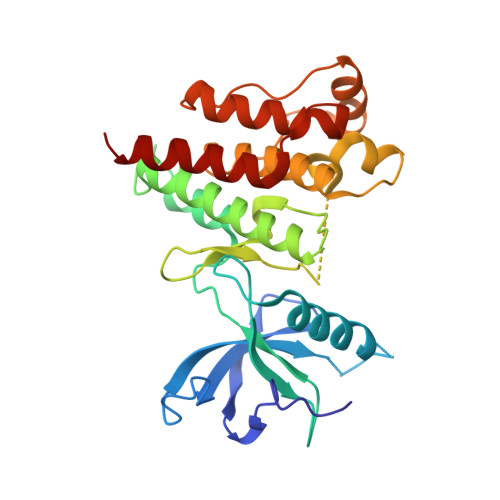
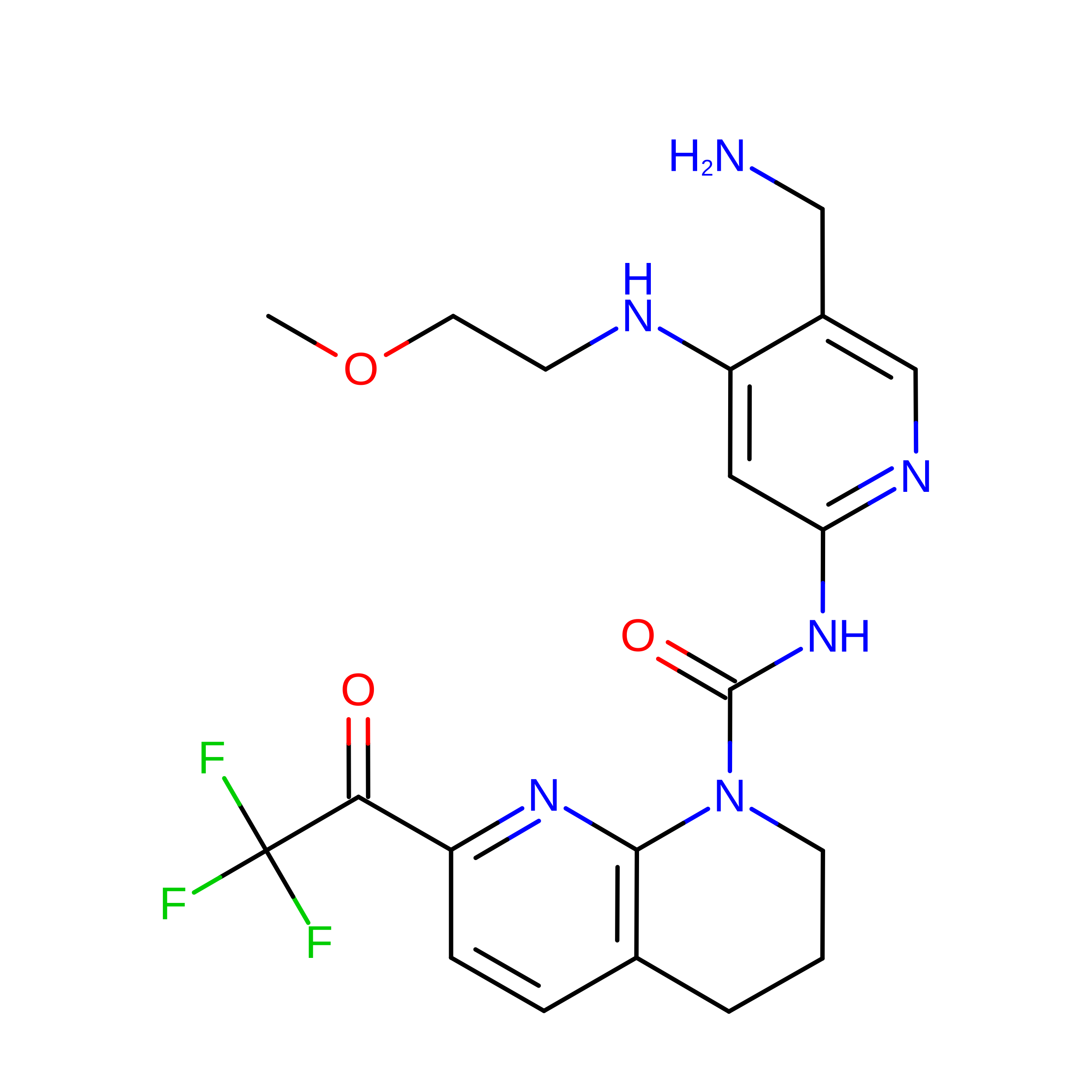
The crystal structure of FGFR4 kinase domain in complex with N-(5-cyano-4-((2-methoxyethyl)amino)pyridin-2-yl)-7-(2,2,2-trifluoroacetyl)-3,4-dihydro-1,8-naphthyridine-1(2H)-carboxamide


Experimental Data Snapshot

  • Method: X-RAY DIFFRACTION
  • Resolution: 2.90 Å
  • R-Value Free: 
    0.273 (Depositor) 
  • R-Value Work: 
    0.205 (Depositor) 
  • R-Value Observed: 
    0.212 (Depositor) 

Starting Model: experimental
View more details

wwPDB Validation 3D Report Full Report

Validation slider image for 7VJL

Ligand Structure Quality Assessment 


This is version 2.3 of the entry. See complete history

Literature

Characterization of an aromatic trifluoromethyl ketone as a new warhead for covalently reversible kinase inhibitor design.

Zhang, Z.Wang, Y.Chen, X.Song, X.Tu, Z.Chen, Y.Zhang, Z.Ding, K.

(2021) Bioorg Med Chem 50: 116457-116457

  • DOI: https://doi.org/10.1016/j.bmc.2021.116457
  • Primary Citation Related Structures: 
    7VJL

  • PubMed Abstract: 

    An aromatic trifluoromethyl ketone moiety was characterized as a new warhead for covalently reversible kinase inhibitor design to target the non-catalytic cysteine residue. Potent and selective covalently reversible inhibitors of FGFR4 kinase were successfully designed and synthesized by utilizing this new warhead. The binding mode of a representative inhibitor was fully characterized by using multiple technologies including MALDI-TOF mass spectrometry, dialysis assay and X-ray crystallographic studies etc. This functional group was also successfully applied to discovery of a new JAK3 inhibitor, suggesting its potential application in designing other kinase inhibitors.


  • Organizational Affiliation
    • International Cooperative Laboratory of Traditional Chinese Medicine Modernization and Innovative Drug Development, Ministry of Education (MOE) of PR China, College of Pharmacy, Jinan University, 601 Huangpu Avenue West, Guangzhou 510632, China.

Macromolecule Content 

  • Total Structure Weight: 68.51 kDa 
  • Atom Count: 4,186 
  • Modeled Residue Count: 529 
  • Deposited Residue Count: 602 
  • Unique protein chains: 1

Macromolecules

Find similar proteins by:|  3D Structure
Entity ID: 1
MoleculeChains  Sequence LengthOrganismDetailsImage
Fibroblast growth factor receptor 4
A, B
301Homo sapiensMutation(s): 0 
Gene Names: FGFR4JTK2TKF
EC: 2.7.10.1
UniProt & NIH Common Fund Data Resources
Find proteins for P22455 (Homo sapiens)
Explore P22455 
Go to UniProtKB:  P22455
PHAROS:  P22455
GTEx:  ENSG00000160867 
Entity Groups
Sequence Clusters30% Identity50% Identity70% Identity90% Identity95% Identity100% Identity
UniProt GroupP22455
Sequence Annotations
Expand
Reference Sequence

Small Molecules

Ligands 1 Unique
IDChains Name / Formula / InChI Key2D Diagram3D Interactions
7IF
(Subject of Investigation/LOI)

Query on 7IF


Download:Ideal Coordinates CCD File
C [auth A],
D [auth B]
N-[5-(aminomethyl)-4-(2-methoxyethylamino)pyridin-2-yl]-7-[2,2,2-tris(fluoranyl)ethanoyl]-3,4-dihydro-2H-1,8-naphthyridine-1-carboxamide
C20 H23 F3 N6 O3
OEKVHZLDKRFXOH-UHFFFAOYSA-N

Experimental Data & Validation

Experimental Data

  • Method: X-RAY DIFFRACTION
  • Resolution: 2.90 Å
  • R-Value Free:  0.273 (Depositor) 
  • R-Value Work:  0.205 (Depositor) 
  • R-Value Observed: 0.212 (Depositor) 
Space Group: P 21 21 21
Unit Cell:
Length ( Å )Angle ( ˚ )
a = 53.37α = 90
b = 66.785β = 90
c = 184.174γ = 90
Software Package:
Software NamePurpose
PHENIXrefinement
HKL-2000data scaling
Cootmodel building
PHASERphasing
HKL-2000data reduction

Structure Validation

View Full Validation Report


Ligand Structure Quality Assessment 


Entry History 

& Funding Information

Deposition Data


Funding OrganizationLocationGrant Number
Not funded--

Revision History  (Full details and data files)

  • Version 1.0: 2022-02-23
    Type: Initial release
  • Version 2.0: 2022-05-04
    Type: Coordinate replacement
    Reason: Ligand geometry
    Changes: Advisory, Atomic model, Data collection, Derived calculations, Refinement description, Source and taxonomy, Structure summary
  • Version 2.1: 2022-09-07
    Changes: Database references
  • Version 2.2: 2023-11-29
    Changes: Data collection, Refinement description
  • Version 2.3: 2024-11-13
    Changes: Structure summary