7UXD | pdb_00007uxd

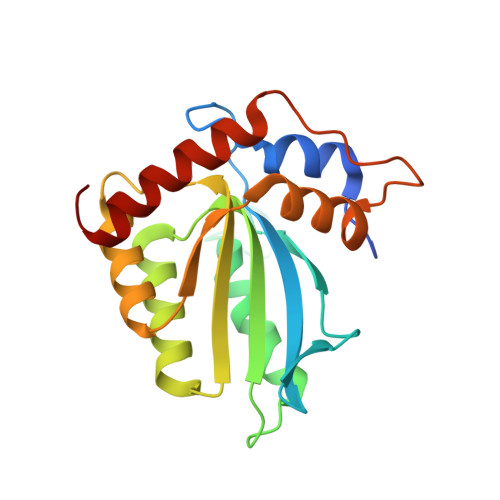
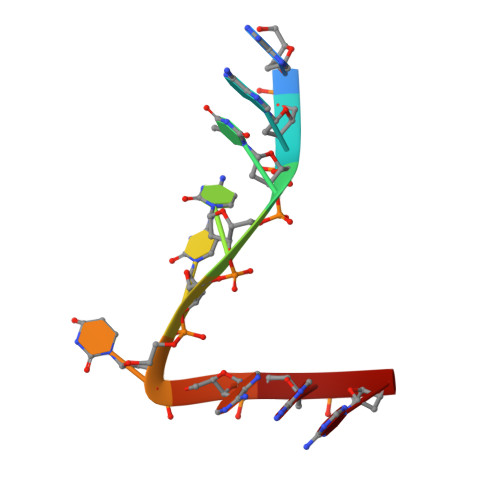
Crystal structure of APOBEC3G Catalytic domain complex with ssDNA containing 2'-deoxy Zebularine.


Experimental Data Snapshot

  • Method: X-RAY DIFFRACTION
  • Resolution: 1.50 Å
  • R-Value Free: 
    0.194 (Depositor), 0.199 (DCC) 
  • R-Value Work: 
    0.172 (Depositor), 0.176 (DCC) 
  • R-Value Observed: 
    0.174 (Depositor) 

Starting Model: experimental
View more details

wwPDB Validation 3D Report Full Report

Validation slider image for 7UXD

This is version 1.1 of the entry. See complete history

Literature

Structure of the catalytically active APOBEC3G bound to a DNA oligonucleotide inhibitor reveals tetrahedral geometry of the transition state.

Maiti, A.Hedger, A.K.Myint, W.Balachandran, V.Watts, J.K.Schiffer, C.A.Matsuo, H.

(2022) Nat Commun 13: 7117-7117

  • DOI: https://doi.org/10.1038/s41467-022-34752-1
  • Primary Citation Related Structures: 
    7UXD

  • PubMed Abstract: 

    APOBEC3 proteins (A3s) are enzymes that catalyze the deamination of cytidine to uridine in single-stranded DNA (ssDNA) substrates, thus playing a key role in innate antiviral immunity. However, the APOBEC3 family has also been linked to many mutational signatures in cancer cells, which has led to an intense interest to develop inhibitors of A3's catalytic activity as therapeutics as well as tools to study A3's biochemistry, structure, and cellular function. Recent studies have shown that ssDNA containing 2'-deoxy-zebularine (dZ-ssDNA) is an inhibitor of A3s such as A3A, A3B, and A3G, although the atomic determinants of this activity have remained unknown. To fill this knowledge gap, we determined a 1.5 Å resolution structure of a dZ-ssDNA inhibitor bound to active A3G. The crystal structure revealed that the activated dZ-H 2 O mimics the transition state by coordinating the active site Zn 2+ and engaging in additional stabilizing interactions, such as the one with the catalytic residue E259. Therefore, this structure allowed us to capture a snapshot of the A3's transition state and suggests that developing transition-state mimicking inhibitors may provide a new opportunity to design more targeted molecules for A3s in the future.


  • Organizational Affiliation
    • Cancer Innovation Laboratory, Frederick National Laboratory for Cancer Research, Frederick, MD, USA.

Macromolecule Content 

  • Total Structure Weight: 25.88 kDa 
  • Atom Count: 1,931 
  • Modeled Residue Count: 199 
  • Deposited Residue Count: 208 
  • Unique protein chains: 1
  • Unique nucleic acid chains: 1

Macromolecules


Find similar proteins by:|  3D Structure
Entity ID: 1
MoleculeChains  Sequence LengthOrganismDetailsImage
DNA dC->dU-editing enzyme APOBEC-3G199Homo sapiensMutation(s): 10 
Gene Names: APOBEC3GMDS019
EC: 3.5.4.38
UniProt & NIH Common Fund Data Resources
Find proteins for Q9HC16 (Homo sapiens)
Explore Q9HC16 
Go to UniProtKB:  Q9HC16
PHAROS:  Q9HC16
GTEx:  ENSG00000239713 
Entity Groups
Sequence Clusters30% Identity50% Identity70% Identity90% Identity95% Identity100% Identity
UniProt GroupQ9HC16
Sequence Annotations
Expand
Reference Sequence
Find similar nucleic acids by:  Sequence
Entity ID: 2
MoleculeChains LengthOrganismImage
DNA (5'-D(*AP*AP*TP*CP*CP*(DDN)P*AP*AP*A)-3')9synthetic construct
Sequence Annotations
Expand
Reference Sequence

Small Molecules

Experimental Data & Validation

Experimental Data

  • Method: X-RAY DIFFRACTION
  • Resolution: 1.50 Å
  • R-Value Free:  0.194 (Depositor), 0.199 (DCC) 
  • R-Value Work:  0.172 (Depositor), 0.176 (DCC) 
  • R-Value Observed: 0.174 (Depositor) 
Space Group: P 1 21 1
Unit Cell:
Length ( Å )Angle ( ˚ )
a = 47.489α = 90
b = 47.121β = 103.18
c = 52.042γ = 90
Software Package:
Software NamePurpose
HKL-2000data scaling
PHENIXrefinement
PDB_EXTRACTdata extraction
HKL-2000data reduction
PHASERphasing

Structure Validation

View Full Validation Report


Entry History 

& Funding Information

Deposition Data


Funding OrganizationLocationGrant Number
National Institutes of Health/National Cancer Institute (NIH/NCI)United States75N91019D00024
National Institutes of Health/National Institute Of Allergy and Infectious Diseases (NIH/NIAID)United StatesR01AI150478

Revision History  (Full details and data files)

  • Version 1.0: 2022-12-14
    Type: Initial release
  • Version 1.1: 2023-10-25
    Changes: Data collection, Refinement description