7TA2 | pdb_00007ta2

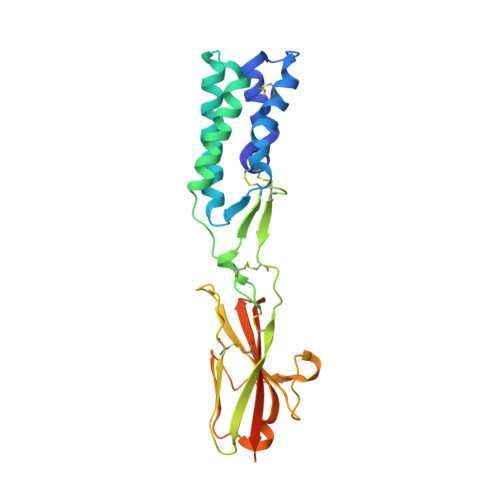
Crystal structure of the human sperm-expressed surface protein SPACA6


Experimental Data Snapshot

  • Method: X-RAY DIFFRACTION
  • Resolution: 2.25 Å
  • R-Value Free: 
    0.255 (Depositor), 0.255 (DCC) 
  • R-Value Work: 
    0.201 (Depositor), 0.206 (DCC) 
  • R-Value Observed: 
    0.204 (Depositor) 

Starting Model: experimental
View more details

wwPDB Validation 3D Report Full Report

Validation slider image for 7TA2

This is version 1.3 of the entry. See complete history

Literature

SPACA6 ectodomain structure reveals a conserved superfamily of gamete fusion-associated proteins.

Vance, T.D.R.Yip, P.Jimenez, E.Li, S.Gawol, D.Byrnes, J.Uson, I.Ziyyat, A.Lee, J.E.

(2022) Commun Biol 5: 984-984

  • DOI: https://doi.org/10.1038/s42003-022-03883-y
  • Primary Citation Related Structures: 
    7TA2

  • PubMed Abstract: 

    SPACA6 is a sperm-expressed surface protein that is critical for gamete fusion during mammalian sexual reproduction. Despite this fundamental role, little is known about how SPACA6 specifically functions. We elucidated the crystal structure of the SPACA6 ectodomain at 2.2-Å resolution, revealing a two-domain protein containing a four-helix bundle and Ig-like β-sandwich connected via a quasi-flexible linker. This structure is reminiscent of IZUMO1, another gamete fusion-associated protein, making SPACA6 and IZUMO1 founding members of a superfamily of fertilization-associated proteins, herein dubbed the IST superfamily. The IST superfamily is defined structurally by its distorted four-helix bundle and a pair of disulfide-bonded CXXC motifs. A structure-based search of the AlphaFold human proteome identified more protein members to this superfamily; remarkably, many of these proteins are linked to gamete fusion. The SPACA6 structure and its connection to other IST-superfamily members provide a missing link in our knowledge of mammalian gamete fusion.


  • Organizational Affiliation
    • Department of Laboratory Medicine and Pathobiology, Temerty Faculty of Medicine, University of Toronto, Toronto, ON, Canada.

Macromolecule Content 

  • Total Structure Weight: 27.84 kDa 
  • Atom Count: 1,811 
  • Modeled Residue Count: 220 
  • Deposited Residue Count: 236 
  • Unique protein chains: 1

Macromolecules

Find similar proteins by:|  3D Structure
Entity ID: 1
MoleculeChains  Sequence LengthOrganismDetailsImage
Sperm acrosome membrane-associated protein 6236Homo sapiensMutation(s): 0 
Gene Names: SPACA6SPACA6PUNQ2487/PRO5774
UniProt & NIH Common Fund Data Resources
Find proteins for W5XKT8 (Homo sapiens)
Explore W5XKT8 
Go to UniProtKB:  W5XKT8
PHAROS:  W5XKT8
GTEx:  ENSG00000182310 
Entity Groups
Sequence Clusters30% Identity50% Identity70% Identity90% Identity95% Identity100% Identity
UniProt GroupW5XKT8
Sequence Annotations
Expand
Reference Sequence

Small Molecules

Ligands 1 Unique
IDChains Name / Formula / InChI Key2D Diagram3D Interactions
BR

Query on BR


Download:Ideal Coordinates CCD File
B [auth A]
C [auth A]
D [auth A]
E [auth A]
F [auth A]
B [auth A],
C [auth A],
D [auth A],
E [auth A],
F [auth A],
G [auth A],
H [auth A],
I [auth A],
J [auth A],
K [auth A]
BROMIDE ION
Br
CPELXLSAUQHCOX-UHFFFAOYSA-M

Experimental Data & Validation

Experimental Data

  • Method: X-RAY DIFFRACTION
  • Resolution: 2.25 Å
  • R-Value Free:  0.255 (Depositor), 0.255 (DCC) 
  • R-Value Work:  0.201 (Depositor), 0.206 (DCC) 
  • R-Value Observed: 0.204 (Depositor) 
Space Group: P 21 21 21
Unit Cell:
Length ( Å )Angle ( ˚ )
a = 28.984α = 90
b = 46.522β = 90
c = 167.67γ = 90
Software Package:
Software NamePurpose
Aimlessdata scaling
PHENIXrefinement
PDB_EXTRACTdata extraction
DIALSdata reduction
AutoSolphasing

Structure Validation

View Full Validation Report


Entry History 

& Funding Information

Deposition Data


Funding OrganizationLocationGrant Number
Canadian Institutes of Health Research (CIHR)CanadaPJT-153281

Revision History  (Full details and data files)

  • Version 1.0: 2022-08-31
    Type: Initial release
  • Version 1.1: 2022-10-12
    Changes: Database references
  • Version 1.2: 2023-10-18
    Changes: Data collection, Refinement description
  • Version 1.3: 2024-10-23
    Changes: Structure summary