7T37 | pdb_00007t37

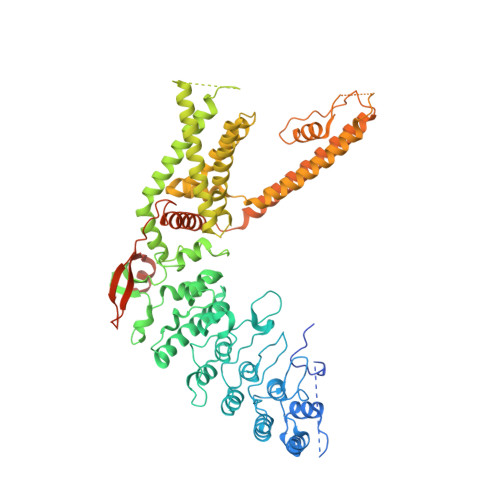
Activated state of 2-APB and CBD-bound wildtype rat TRPV2 in nanodiscs


Experimental Data Snapshot

  • Method: ELECTRON MICROSCOPY
  • Resolution: 3.70 Å
  • Aggregation State: PARTICLE 
  • Reconstruction Method: SINGLE PARTICLE 

wwPDB Validation 3D Report Full Report

Validation slider image for 7T37

This is version 1.2 of the entry. See complete history

Literature

Structural insights into TRPV2 activation by small molecules.

Pumroy, R.A.Protopopova, A.D.Fricke, T.C.Lange, I.U.Haug, F.M.Nguyen, P.T.Gallo, P.N.Sousa, B.B.Bernardes, G.J.L.Yarov-Yarovoy, V.Leffler, A.Moiseenkova-Bell, V.Y.

(2022) Nat Commun 13: 2334-2334

  • DOI: https://doi.org/10.1038/s41467-022-30083-3
  • Primary Citation Related Structures: 
    7N0M, 7N0N, 7T37, 7T38

  • PubMed Abstract: 

    Transient receptor potential vanilloid 2 (TRPV2) is involved in many critical physiological and pathophysiological processes, making it a promising drug target. Here we present cryo-electron microscopy (cryo-EM) structures of rat TRPV2 in lipid nanodiscs activated by 2-aminoethoxydiphenyl borate (2-APB) and propose a TRPV2-specific 2-ABP binding site at the interface of S5 of one monomer and the S4-S5 linker of the adjacent monomer. In silico docking and electrophysiological studies confirm the key role of His521 and Arg539 in 2-APB activation of TRPV2. Additionally, electrophysiological experiments show that the combination of 2-APB and cannabidiol has a synergetic effect on TRPV2 activation, and cryo-EM structures demonstrate that both drugs were able to bind simultaneously. Together, our cryo-EM structures represent multiple functional states of the channel, providing a native picture of TRPV2 activation by small molecules and a structural framework for the development of TRPV2-specific activators.


  • Organizational Affiliation
    • Department of Systems Pharmacology and Translational Therapeutics, Perelman School of Medicine, University of Pennsylvania, Philadelphia, PA, 19104, United States.

Macromolecule Content 

  • Total Structure Weight: 349.35 kDa 
  • Atom Count: 20,176 
  • Modeled Residue Count: 2,476 
  • Deposited Residue Count: 3,044 
  • Unique protein chains: 1

Macromolecules

Find similar proteins by:|  3D Structure
Entity ID: 1
MoleculeChains  Sequence LengthOrganismDetailsImage
Transient receptor potential cation channel subfamily V member 2
A, B, C, D
761Rattus norvegicusMutation(s): 0 
Gene Names: Trpv2Sac2bVrl1
Membrane Entity: Yes 
UniProt
Find proteins for Q9WUD2 (Rattus norvegicus)
Explore Q9WUD2 
Go to UniProtKB:  Q9WUD2
Entity Groups
Sequence Clusters30% Identity50% Identity70% Identity90% Identity95% Identity100% Identity
UniProt GroupQ9WUD2
Sequence Annotations
Expand
Reference Sequence

Small Molecules

Ligands 2 Unique
IDChains Name / Formula / InChI Key2D Diagram3D Interactions
P0T
(Subject of Investigation/LOI)

Query on P0T


Download:Ideal Coordinates CCD File
E [auth A],
G [auth B],
I [auth C],
L [auth D]
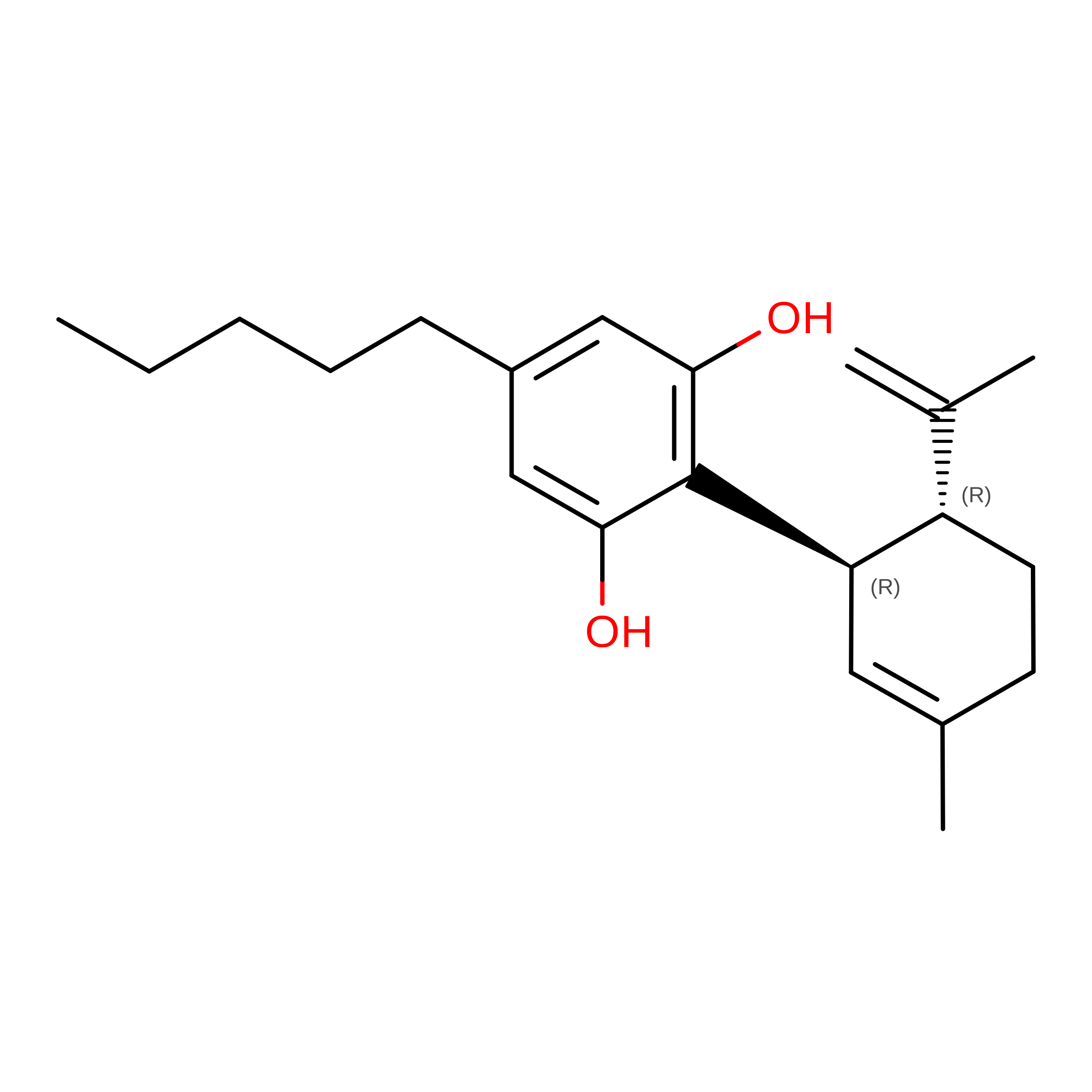
cannabidiol
C21 H30 O2
QHMBSVQNZZTUGM-ZWKOTPCHSA-N
FZ4
(Subject of Investigation/LOI)

Query on FZ4


Download:Ideal Coordinates CCD File
F [auth A],
H [auth B],
J [auth C],
K [auth D]
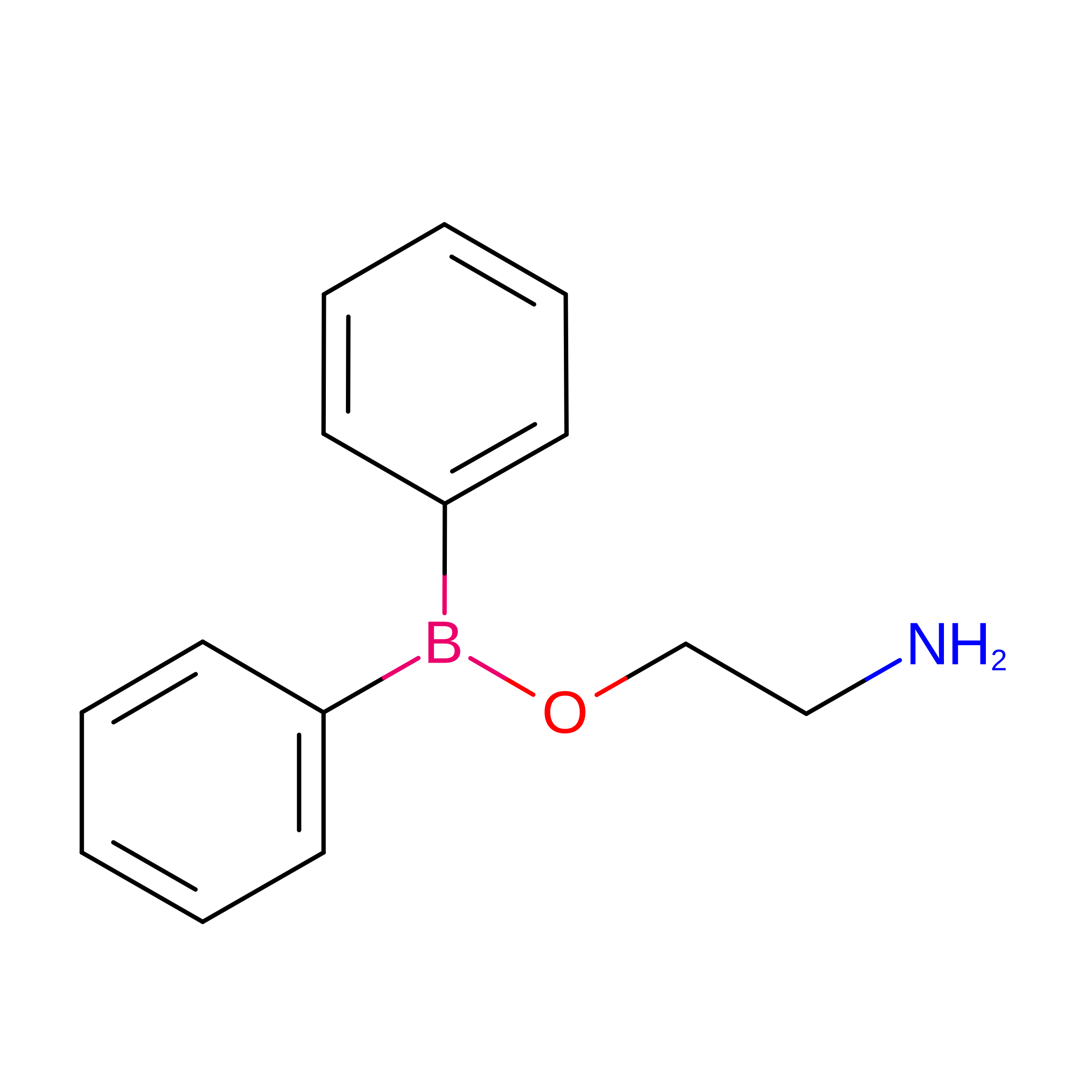
2-aminoethyl diphenylborinate
C14 H16 B N O
BLZVCIGGICSWIG-UHFFFAOYSA-N
Binding Affinity Annotations 
IDSourceBinding Affinity
P0T BindingDB:  7T37 IC50: 1100 (nM) from 1 assay(s)
EC50: 1200 (nM) from 1 assay(s)

Experimental Data & Validation

Experimental Data

  • Method: ELECTRON MICROSCOPY
  • Resolution: 3.70 Å
  • Aggregation State: PARTICLE 
  • Reconstruction Method: SINGLE PARTICLE 

Structure Validation

View Full Validation Report


Entry History 

& Funding Information

Deposition Data


Funding OrganizationLocationGrant Number
National Institutes of Health/National Institute of General Medical Sciences (NIH/NIGMS)United StatesR01GM103899
National Institutes of Health/National Institute of General Medical Sciences (NIH/NIGMS)United StatesR01GM129357

Revision History  (Full details and data files)

  • Version 1.0: 2022-05-04
    Type: Initial release
  • Version 1.1: 2022-05-11
    Changes: Database references
  • Version 1.2: 2024-02-28
    Changes: Data collection