7SSM | pdb_00007ssm

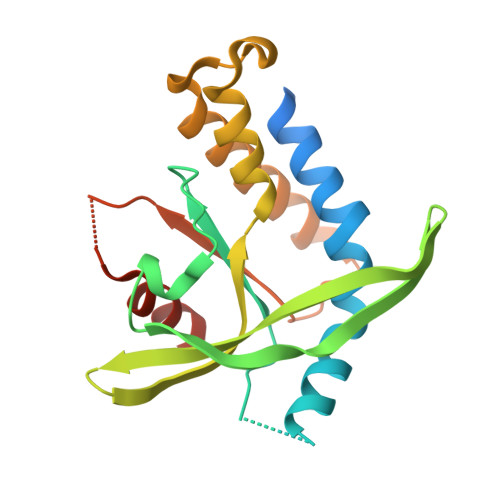
Crystal structure of human STING R232 in complex with compound 11


Experimental Data Snapshot

  • Method: X-RAY DIFFRACTION
  • Resolution: 1.96 Å
  • R-Value Free: 
    0.250 (Depositor), 0.254 (DCC) 
  • R-Value Work: 
    0.207 (Depositor), 0.209 (DCC) 
  • R-Value Observed: 
    0.209 (Depositor) 

Starting Model: experimental
View more details

wwPDB Validation 3D Report Full Report

Validation slider image for 7SSM

Ligand Structure Quality Assessment 


This is version 1.4 of the entry. See complete history

Literature

Discovery of Non-Nucleotide Small-Molecule STING Agonists via Chemotype Hybridization.

Cherney, E.C.Zhang, L.Lo, J.Huynh, T.Wei, D.Ahuja, V.Quesnelle, C.Schieven, G.L.Futran, A.Locke, G.A.Lin, Z.Monereau, L.Chaudhry, C.Blum, J.Li, S.Fereshteh, M.Li-Wang, B.Gangwar, S.Pan, C.Chong, C.Zhu, X.Posy, S.L.Sack, J.S.Zhang, P.Ruzanov, M.Harner, M.Akhtar, F.Schroeder, G.M.Vite, G.Fink, B.

(2022) J Med Chem 65: 3518-3538

  • DOI: https://doi.org/10.1021/acs.jmedchem.1c01986
  • Primary Citation Related Structures: 
    7SSM

  • PubMed Abstract: 

    The identification of agonists of the stimulator of interferon genes (STING) pathway has been an area of intense research due to their potential to enhance innate immune response and tumor immunogenicity in the context of immuno-oncology therapy. Initial efforts to identify STING agonists focused on the modification of 2',3'-cGAMP ( 1 ) (an endogenous STING activator ligand) and other closely related cyclic dinucleotides (CDNs). While these efforts have successfully identified novel CDNs that have progressed into the clinic, their utility is currently limited to patients with solid tumors that STING agonists can be delivered to intratumorally. Herein, we report the discovery of a unique class of non-nucleotide small-molecule STING agonists that demonstrate antitumor activity when dosed intratumorally in a syngeneic mouse model.


  • Organizational Affiliation
    • Bristol Myers Squibb Research and Development, P.O. Box 4000, Princeton, New Jersey 08543, United States.

Macromolecule Content 

  • Total Structure Weight: 24.39 kDa 
  • Atom Count: 1,359 
  • Modeled Residue Count: 169 
  • Deposited Residue Count: 210 
  • Unique protein chains: 1

Macromolecules

Find similar proteins by:|  3D Structure
Entity ID: 1
MoleculeChains  Sequence LengthOrganismDetailsImage
Stimulator of interferon genes protein210Homo sapiensMutation(s): 0 
Gene Names: STINGLOC340061hCG_1782396
UniProt & NIH Common Fund Data Resources
Find proteins for Q86WV6 (Homo sapiens)
Explore Q86WV6 
Go to UniProtKB:  Q86WV6
PHAROS:  Q86WV6
GTEx:  ENSG00000184584 
Entity Groups
Sequence Clusters30% Identity50% Identity70% Identity90% Identity95% Identity100% Identity
UniProt GroupQ86WV6
Sequence Annotations
Expand
Reference Sequence

Small Molecules

Ligands 1 Unique
IDChains Name / Formula / InChI Key2D Diagram3D Interactions
B7L
(Subject of Investigation/LOI)

Query on B7L


Download:Ideal Coordinates CCD File
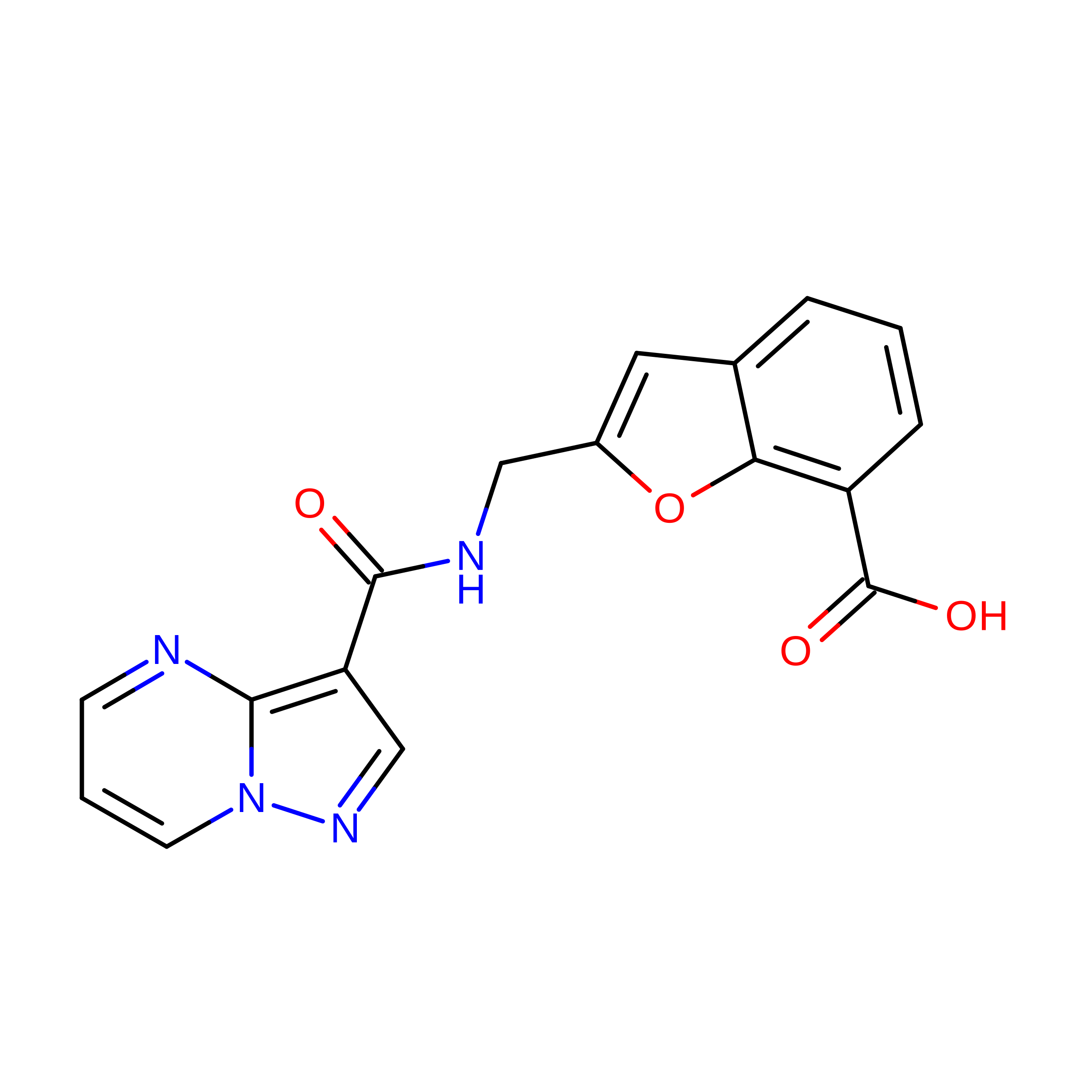
B [auth A]2-({[(8R)-pyrazolo[1,5-a]pyrimidine-3-carbonyl]amino}methyl)-1-benzofuran-7-carboxylic acid
C17 H12 N4 O4
BICDHWPHEXMVAT-UHFFFAOYSA-N
Binding Affinity Annotations 
IDSourceBinding Affinity
B7L BindingDB:  7SSM IC50: min: 1.40e+4, max: 4.00e+4 (nM) from 2 assay(s)
EC50: min: 5.00e+4, max: 1.00e+5 (nM) from 3 assay(s)

Experimental Data & Validation

Experimental Data

  • Method: X-RAY DIFFRACTION
  • Resolution: 1.96 Å
  • R-Value Free:  0.250 (Depositor), 0.254 (DCC) 
  • R-Value Work:  0.207 (Depositor), 0.209 (DCC) 
  • R-Value Observed: 0.209 (Depositor) 
Space Group: P 41 21 2
Unit Cell:
Length ( Å )Angle ( ˚ )
a = 110.08α = 90
b = 110.08β = 90
c = 36.2γ = 90
Software Package:
Software NamePurpose
Aimlessdata scaling
BUSTERrefinement
PDB_EXTRACTdata extraction
PHASERphasing

Structure Validation

View Full Validation Report


Ligand Structure Quality Assessment 


Entry History 

& Funding Information

Deposition Data


Funding OrganizationLocationGrant Number
Not funded--

Revision History  (Full details and data files)

  • Version 1.0: 2022-02-09
    Type: Initial release
  • Version 1.1: 2022-02-16
    Changes: Database references
  • Version 1.2: 2022-02-23
    Changes: Database references
  • Version 1.3: 2022-03-09
    Changes: Database references
  • Version 1.4: 2023-10-18
    Changes: Data collection, Refinement description