7SHJ | pdb_00007shj

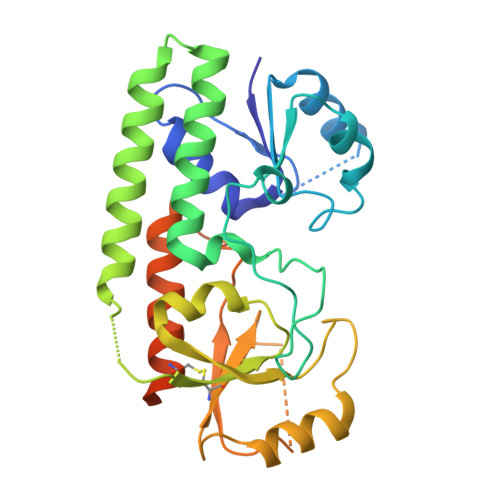
Crystal structure of Acinetobacter baumannii ZnuA in the metal-free state


Experimental Data Snapshot

  • Method: X-RAY DIFFRACTION
  • Resolution: 2.13 Å
  • R-Value Free: 
    0.253 (Depositor), 0.250 (DCC) 
  • R-Value Work: 
    0.230 (Depositor), 0.230 (DCC) 
  • R-Value Observed: 
    0.231 (Depositor) 

Starting Model: in silico
View more details

wwPDB Validation   3D Report Full Report


This is version 1.3 of the entry. See complete history


Literature

Structural and biochemical characterization of Acinetobacter baumannii ZnuA.

Alquethamy, S.Ganio, K.Luo, Z.Hossain, S.I.Hayes, A.J.Ve, T.Davies, M.R.Deplazes, E.Kobe, B.McDevitt, C.A.

(2022) J Inorg Biochem 231: 111787-111787

  • DOI: https://doi.org/10.1016/j.jinorgbio.2022.111787
  • Primary Citation of Related Structures:  
    7SHJ

  • PubMed Abstract: 

    Acinetobacter baumannii is a Gram-negative nosocomial pathogen associated with significant disease. Crucial to the survival and pathogenesis of A. baumannii is the ability to acquire essential micronutrients such as Zn(II). Recruitment of Zn(II) by A. baumannii is mediated, at least in part, by the periplasmic solute-binding protein ZnuA and the ATP-binding cassette transporter ZnuBC. Here, we combined genomic, biochemical, and structural approaches to characterize A. baumannii AB5075_UW ZnuA. Bioinformatic analyses using a diverse collection of A. baumannii genomes determined that ZnuA is highly conserved, with the binding site comprised by three strictly conserved histidine residues. The structure of metal-free ZnuA was determined at 2.1 Å resolution, with molecular dynamics analyses revealing loop α2β2, which harbors the putative Zn(II)-coordinating residue His41, to be highly mobile in the metal-free state. The contribution of the putative binding site histidine residues to Zn(II) interaction was further probed by mutagenesis. Analysis of ZnuA mutant variants was performed by quantitative metal binding assays, differential scanning fluorimetry, and affinity measurements, which showed that all three histidine residues contributed to Zn(II)-recruitment, albeit to different extents. Collectively, these analyses provide insight into the mechanism of Zn(II)-binding by A. baumannii ZnuA and expand our understanding of the functional diversity of Zn(II)-recruiting proteins.


  • Organizational Affiliation
    • Department of Microbiology and Immunology, The Peter Doherty Institute for Infection and Immunity, The University of Melbourne, Melbourne, Victoria, Australia.

Macromolecules
Find similar proteins by:  (by identity cutoff)  |  3D Structure
Entity ID: 1
MoleculeChains Sequence LengthOrganismDetailsImage
Zinc ABC transporter solute-binding protein
A, B
286Acinetobacter baumanniiMutation(s): 0 
Gene Names: G3N04_06260G3N12_05260G3N53_14455GY141_09205
UniProt
Find proteins for A0A6B2IEQ3 (Acinetobacter baumannii)
Explore A0A6B2IEQ3 
Go to UniProtKB:  A0A6B2IEQ3
Entity Groups  
Sequence Clusters30% Identity50% Identity70% Identity90% Identity95% Identity100% Identity
UniProt GroupA0A6B2IEQ3
Sequence Annotations
Expand
  • Reference Sequence
Small Molecules
Ligands 1 Unique
IDChains Name / Formula / InChI Key2D Diagram3D Interactions
NA
Query on NA

Download Ideal Coordinates CCD File 
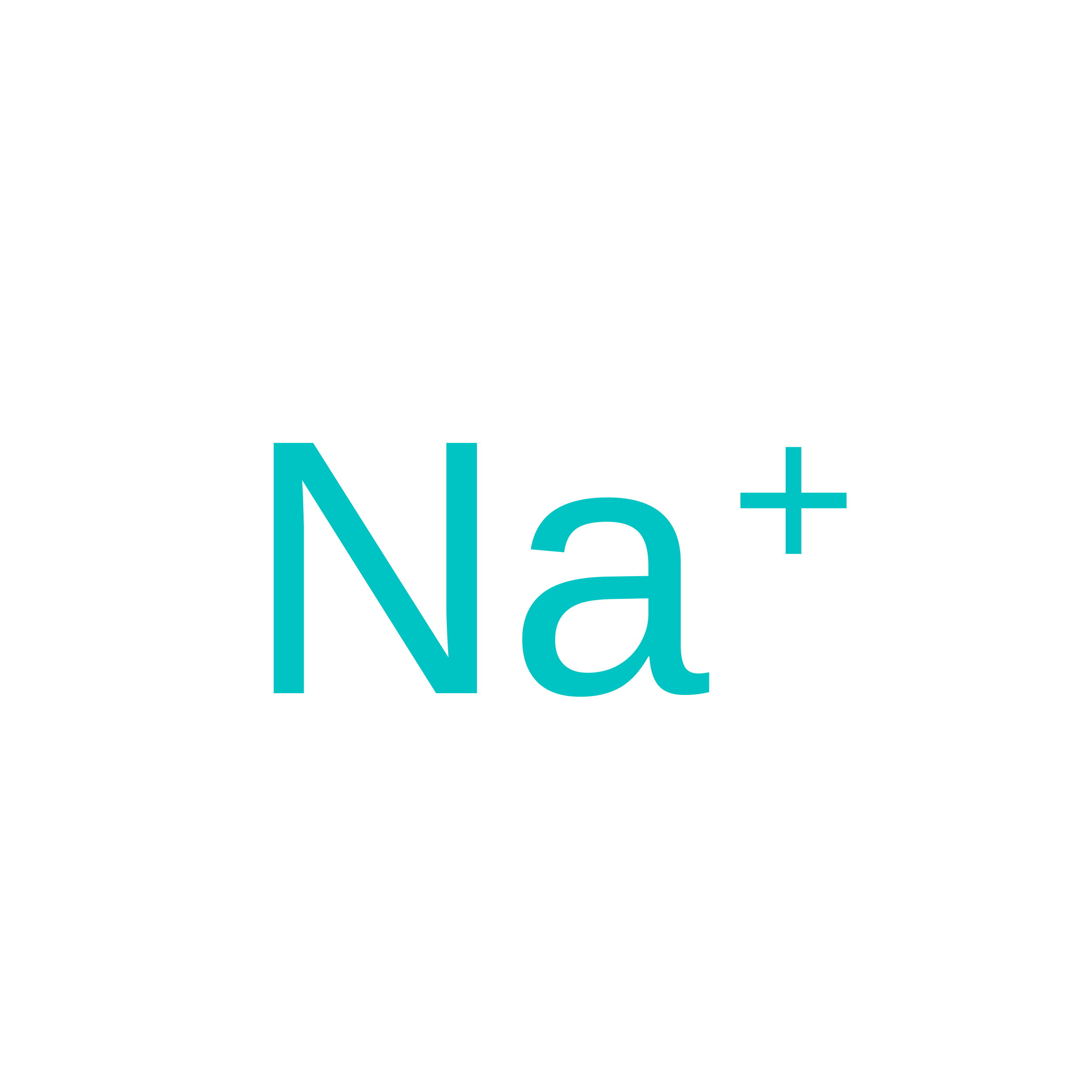
C [auth A]SODIUM ION
Na
FKNQFGJONOIPTF-UHFFFAOYSA-N
Experimental Data & Validation

Experimental Data

  • Method: X-RAY DIFFRACTION
  • Resolution: 2.13 Å
  • R-Value Free:  0.253 (Depositor), 0.250 (DCC) 
  • R-Value Work:  0.230 (Depositor), 0.230 (DCC) 
  • R-Value Observed: 0.231 (Depositor) 
Space Group: P 1 21 1
Unit Cell:
Length ( Å )Angle ( ˚ )
a = 55.519α = 90
b = 45.606β = 97.07
c = 97.659γ = 90
Software Package:
Software NamePurpose
PHENIXrefinement
XDSdata reduction
Aimlessdata scaling
PHASERphasing

Structure Validation

View Full Validation Report


Entry History & Funding Information

Deposition Data


Funding OrganizationLocationGrant Number
Australian Research Council (ARC)AustraliaFL180100109
National Health and Medical Research Council (NHMRC, Australia)Australia1180826

Revision History  (Full details and data files)

  • Version 1.0: 2022-10-12
    Type: Initial release
  • Version 1.1: 2023-05-10
    Changes: Database references
  • Version 1.2: 2024-04-03
    Changes: Data collection, Refinement description
  • Version 1.3: 2024-10-30
    Changes: Structure summary