Download Mendeley
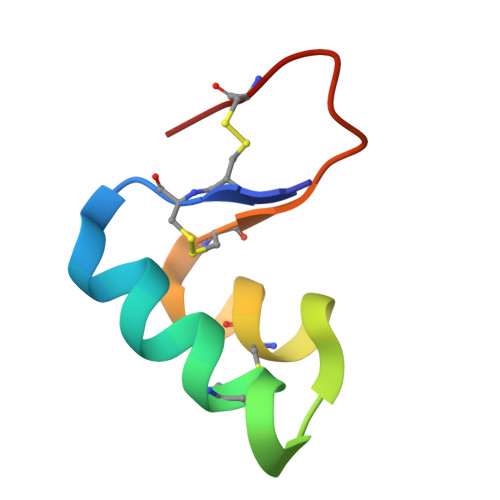
Neurotoxic and cytotoxic peptides underlie the painful stings of the tree nettle Urtica ferox.
Xie, J., Robinson, S.D., Gilding, E.K., Jami, S., Deuis, J.R., Rehm, F.B.H., Yap, K., Ragnarsson, L., Chan, L.Y., Hamilton, B.R., Harvey, P.J., Craik, D.J., Vetter, I., Durek, T.(2022) J Biol Chem 298: 102218-102218
- PubMed: 35780839 Search on PubMedSearch on PubMed Central
- DOI: https://doi.org/10.1016/j.jbc.2022.102218
- Primary Citation Related Structures:
7S7P - PubMed Abstract:
The stinging hairs of plants from the family Urticaceae inject compounds that inflict pain to deter herbivores. The sting of the New Zealand tree nettle (Urtica ferox) is among the most painful of these and can cause systemic symptoms that can even be life-threatening; however, the molecular species effecting this response have not been elucidated. Here we reveal that two classes of peptide toxin are responsible for the symptoms of U. ferox stings: Δ-Uf1a is a cytotoxic thionin that causes pain via disruption of cell membranes, while β/δ-Uf2a defines a new class of neurotoxin that causes pain and systemic symptoms via modulation of voltage-gated sodium (Na V ) channels. We demonstrate using whole-cell patch-clamp electrophysiology experiments that β/δ-Uf2a is a potent modulator of human Na V 1.5 (EC 50 : 55 nM), Na V 1.6 (EC 50 : 0.86 nM), and Na V 1.7 (EC 50 : 208 nM), where it shifts the activation threshold to more negative potentials and slows fast inactivation. We further found that both toxin classes are widespread among members of the Urticeae tribe within Urticaceae, suggesting that they are likely to be pain-causing agents underlying the stings of other Urtica species. Comparative analysis of nettles of Urtica, and the recently described pain-causing peptides from nettles of another genus, Dendrocnide, indicates that members of tribe Urticeae have developed a diverse arsenal of pain-causing peptides.
- Institute for Molecular Bioscience, The University of Queensland, Brisbane, Queensland, Australia.
Organizational Affiliation: