7Q5D | pdb_00007q5d

Structure of EPCR in a non-canonical conformation


Experimental Data Snapshot

  • Method: X-RAY DIFFRACTION
  • Resolution: 1.80 Å
  • R-Value Free: 
    0.195 (Depositor), 0.200 (DCC) 
  • R-Value Work: 
    0.183 (Depositor), 0.186 (DCC) 
  • R-Value Observed: 
    0.184 (Depositor) 

Starting Model: experimental
View more details

wwPDB Validation 3D Report Full Report

Validation slider image for 7Q5D

Ligand Structure Quality Assessment 


This is version 1.3 of the entry. See complete history

Literature

Structural vulnerability in EPCR suggests functional modulation.

Erausquin, E.Rodriguez-Fernandez, A.Rodriguez-Lumbreras, L.A.Fernandez-Recio, J.Dichiara-Rodriguez, M.G.Lopez-Sagaseta, J.

(2024) Sci Rep 14: 2591-2591

  • DOI: https://doi.org/10.1038/s41598-024-53160-7
  • Primary Citation Related Structures: 
    7Q5D

  • PubMed Abstract: 

    The endothelial protein C receptor (EPCR) is a fundamental component of the vascular system in mammals due to its contribution in maintaining blood in a non-prothrombotic state, which is crucial for overall life development. It accomplishes this by enhancing the conversion of protein C (PC) into the anticoagulant activated protein C (APC), with this property being dependent on a known EPCR conformation that enables direct interaction with PC/APC. In this study, we report a previously unidentified conformation of EPCR whereby Tyr154, critical for PC/APC binding, shows a striking non-canonical configuration. This unconventional form is incompatible with PC/APC binding, and reveals, for the first time, a region of structural vulnerability and potential modulation in EPCR. The identification of this malleability enhances our understanding of this receptor, prompting inquiries into the interplay between its plasticity and function, as well as its significance within the broader framework of EPCR's biology, which extends to immune conditions.


  • Organizational Affiliation
    • Unit of Protein Crystallography and Structural Immunology, Navarrabiomed, 31008, Navarra, Spain.

Macromolecule Content 

  • Total Structure Weight: 24 kDa 
  • Atom Count: 1,575 
  • Modeled Residue Count: 173 
  • Deposited Residue Count: 195 
  • Unique protein chains: 1

Macromolecules

Find similar proteins by:|  3D Structure
Entity ID: 1
MoleculeChains  Sequence LengthOrganismDetailsImage
Endothelial protein C receptor195Homo sapiensMutation(s): 0 
Gene Names: PROCREPCR
UniProt & NIH Common Fund Data Resources
Find proteins for Q9UNN8 (Homo sapiens)
Explore Q9UNN8 
Go to UniProtKB:  Q9UNN8
PHAROS:  Q9UNN8
GTEx:  ENSG00000101000 
Entity Groups
Sequence Clusters30% Identity50% Identity70% Identity90% Identity95% Identity100% Identity
UniProt GroupQ9UNN8
Glycosylation
Glycosylation Sites: 2Go to GlyGen: Q9UNN8-1
Sequence Annotations
Expand
Reference Sequence

Oligosaccharides

Help  
Entity ID: 2
MoleculeChains Length2D Diagram GlycosylationD Interactions
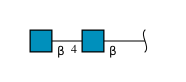
2-acetamido-2-deoxy-beta-D-glucopyranose-(1-4)-2-acetamido-2-deoxy-beta-D-glucopyranose
B, C
2N-Glycosylation
Glycosylation Resources
GlyTouCan: G42666HT
GlyCosmos: G42666HT
GlyGen: G42666HT

Experimental Data & Validation

Experimental Data

  • Method: X-RAY DIFFRACTION
  • Resolution: 1.80 Å
  • R-Value Free:  0.195 (Depositor), 0.200 (DCC) 
  • R-Value Work:  0.183 (Depositor), 0.186 (DCC) 
  • R-Value Observed: 0.184 (Depositor) 
Space Group: P 31 2 1
Unit Cell:
Length ( Å )Angle ( ˚ )
a = 70.47α = 90
b = 70.47β = 90
c = 96.635γ = 120
Software Package:
Software NamePurpose
PHENIXrefinement
XDSdata reduction
Aimlessdata scaling
PHASERphasing

Structure Validation

View Full Validation Report


Ligand Structure Quality Assessment 


Entry History 

& Funding Information

Deposition Data


Funding OrganizationLocationGrant Number
Spanish Ministry of Science, Innovation, and UniversitiesSpainPGC2018-094894-B-I00
Spanish Ministry of Science, Innovation, and UniversitiesSpainRYC-2017-21683

Revision History  (Full details and data files)

  • Version 1.0: 2022-09-14
    Type: Initial release
  • Version 1.1: 2024-01-31
    Changes: Data collection, Database references, Refinement description
  • Version 1.2: 2024-11-13
    Changes: Structure summary
  • Version 1.3: 2026-08-12
    Changes: Database references