7PUD | pdb_00007pud

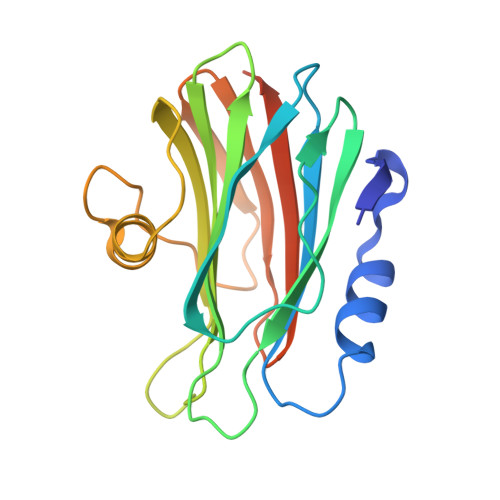
Bryoporin - actinoporin from moss Physcomitrium patens


Experimental Data Snapshot

  • Method: X-RAY DIFFRACTION
  • Resolution: 1.25 Å
  • R-Value Free: 
    0.228 (Depositor), 0.236 (DCC) 
  • R-Value Work: 
    0.209 (Depositor), 0.213 (DCC) 
  • R-Value Observed: 
    0.210 (Depositor) 

Starting Model: experimental
View more details

wwPDB Validation 3D Report Full Report

Validation slider image for 7PUD

This is version 1.3 of the entry. See complete history

Literature

Pore-forming moss protein bryoporin is structurally and mechanistically related to actinoporins from evolutionarily distant cnidarians.

Solinc, G.Svigelj, T.Omersa, N.Snoj, T.Pirc, K.Znidarsic, N.Yamaji-Hasegawa, A.Kobayashi, T.Anderluh, G.Podobnik, M.

(2022) J Biological Chem 298: 102455-102455

  • DOI: https://doi.org/10.1016/j.jbc.2022.102455
  • Primary Citation Related Structures: 
    7PUD

  • PubMed Abstract: 

    Pore-forming proteins perforate lipid membranes and consequently affect their integrity and cell fitness. Therefore, it is not surprising that many of these proteins from bacteria, fungi, or certain animals act as toxins. While pore-forming proteins have also been found in plants, there is little information about their molecular structure and mode of action. Bryoporin is a protein from the moss Physcomitrium patens, and its corresponding gene was found to be upregulated by various abiotic stresses, especially dehydration, as well as upon fungal infection. Based on the amino acid sequence, it was suggested that bryoporin was related to the actinoporin family of pore-forming proteins, originally discovered in sea anemones. Here, we provide the first detailed structural and functional analysis of this plant cytolysin. The crystal structure of monomeric bryoporin is highly similar to those of actinoporins. Our cryo-EM analysis of its pores showed an actinoporin-like octameric structure, thereby revealing a close kinship of proteins from evolutionarily distant organisms. This was further confirmed by our observation of bryoporin's preferential binding to and formation of pores in membranes containing animal sphingolipids, such as sphingomyelin and ceramide phosphoethanolamine; however, its binding affinity was weaker than that of actinoporin equinatoxin II. We determined bryoporin did not bind to major sphingolipids found in fungi or plants, and its membrane-binding and pore-forming activity was enhanced by various sterols. Our results suggest that bryoporin could represent a part of the moss defense arsenal, acting as a pore-forming toxin against membranes of potential animal pathogens, parasites, or predators.


  • Organizational Affiliation
    • Department of Molecular Biology and Nanobiotechnology, National Institute of Chemistry, Ljubljana, Slovenia.

Macromolecule Content 

  • Total Structure Weight: 22.43 kDa 
  • Atom Count: 1,692 
  • Modeled Residue Count: 175 
  • Deposited Residue Count: 191 
  • Unique protein chains: 1

Macromolecules

Find similar proteins by:|  3D Structure
Entity ID: 1
MoleculeChains  Sequence LengthOrganismDetailsImage
Bryoporin191Physcomitrium patensMutation(s): 0 
Gene Names: PHYPADRAFT_61094
UniProt
Find proteins for Q5UCA8 (Physcomitrium patens)
Explore Q5UCA8 
Go to UniProtKB:  Q5UCA8
Entity Groups
Sequence Clusters30% Identity50% Identity70% Identity90% Identity95% Identity100% Identity
UniProt GroupQ5UCA8
Sequence Annotations
Expand
Reference Sequence

Small Molecules

Ligands 2 Unique
IDChains Name / Formula / InChI Key2D Diagram3D Interactions
MPD

Query on MPD


Download:Ideal Coordinates CCD File
B [auth A],
C [auth A]
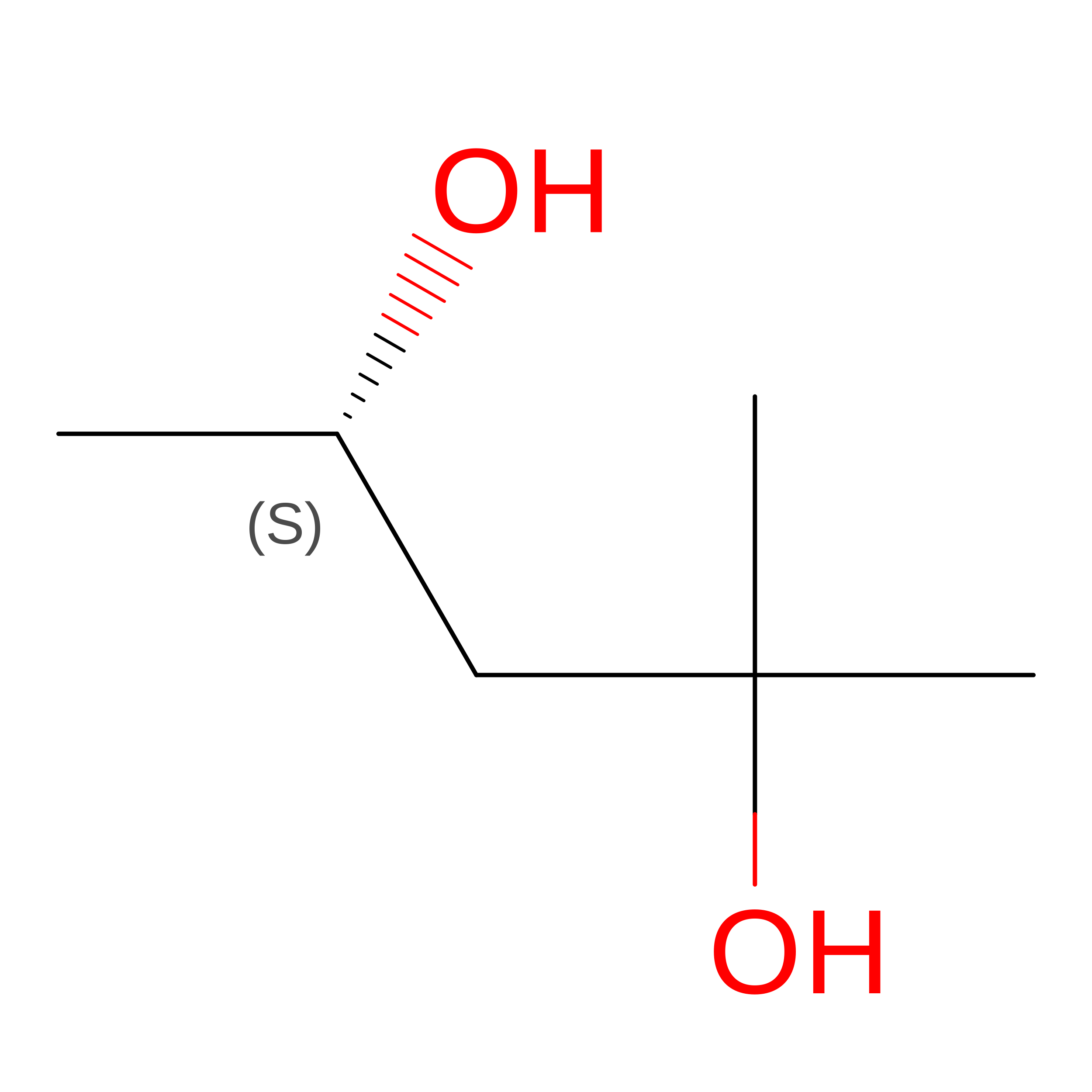
(4S)-2-METHYL-2,4-PENTANEDIOL
C6 H14 O2
SVTBMSDMJJWYQN-YFKPBYRVSA-N
SO4

Query on SO4


Download:Ideal Coordinates CCD File
D [auth A]
E [auth A]
F [auth A]
G [auth A]
H [auth A]
D [auth A],
E [auth A],
F [auth A],
G [auth A],
H [auth A],
I [auth A],
J [auth A],
K [auth A]
SULFATE ION
O4 S
QAOWNCQODCNURD-UHFFFAOYSA-L

Experimental Data & Validation

Experimental Data

  • Method: X-RAY DIFFRACTION
  • Resolution: 1.25 Å
  • R-Value Free:  0.228 (Depositor), 0.236 (DCC) 
  • R-Value Work:  0.209 (Depositor), 0.213 (DCC) 
  • R-Value Observed: 0.210 (Depositor) 
Space Group: P 2 21 21
Unit Cell:
Length ( Å )Angle ( ˚ )
a = 37.918α = 90
b = 54.497β = 90
c = 81.967γ = 90
Software Package:
Software NamePurpose
PHENIXrefinement
Cootmodel building
PHENIXmodel building
XSCALEdata scaling
PHASERphasing
XDSdata reduction

Structure Validation

View Full Validation Report


Entry History 

& Funding Information

Deposition Data


Funding OrganizationLocationGrant Number
Slovenian Research AgencySloveniaP1-0391

Revision History  (Full details and data files)

  • Version 1.0: 2022-09-28
    Type: Initial release
  • Version 1.1: 2022-10-05
    Changes: Database references
  • Version 1.2: 2022-10-12
    Changes: Database references
  • Version 1.3: 2024-01-31
    Changes: Data collection, Refinement description